David Rumelhart
{{Short description|American psychologist (1942–2011)}} {{Infobox scientist | image = DavidRumelhart-IJCNNseattle1991-07-08.jpg | image_size = | image_upright = | alt = | caption = Rumelhart in 1991 | birth_name = David Everett Rumelhart | birth_date = {{birth date|1942|6|12}} | birth_place = [[Wessington Springs, South Dakota]], US | death_date = {{death date and age|2011|03|13|1942|06|12}} | death_place = [[Chelsea, Michigan]], US | field = [[Psychology]] | work_institution = [[Stanford University]][[University of California, San Diego]] | alma_mater = | doctoral_advisor = [[William Kaye Estes]] | doctoral_students = [[Michael I. Jordan]][[Robert J. Glushko]] | thesis_title = The Effects of Interpresentation Intervals on Performance in a Continuous Paired-Associate Task | thesis_year = 1967 | thesis_url = https://www.proquest.com/docview/302266839/ | known_for = [[Connectionism]][[Artificial neural network|Artificial neural network modeling]][[Deep Learning]]Applications of [[backpropagation]] | author_abbreviation_bot = | author_abbreviation_zoo = | prizes = [[MacArthur Fellowship]] (July 1987)[[United States National Academy of Sciences|National Academy of Sciences]]Warren Medal of the [[Society of Experimental Psychologists]][[American Psychiatric Association|APA]] Distinguished Scientific Contribution Award[[University of Louisville]] [[Grawemeyer Award]] (2002) | religion = | footnotes = }} '''David Everett Rumelhart''' (June 12, 1942 – March 13, 2011){{cite news|last=Carey|first=Benedict|title=David Rumelhart Dies at 68; Created Computer Simulations of Perception|url=https://www.nytimes.com/2011/03/19/health/19rumelhart.html|newspaper=The New York Times|date=March 18, 2011}} was an American psychologist who made many contributions to the formal analysis of [[cognition|human cognition]], working primarily within the frameworks of [[mathematical psychology]], [[symbolic artificial intelligence]], and [[parallel distributed processing]]. He also admired formal [[Linguistics|linguistic]] approaches to cognition, and explored the possibility of formulating a [[formal grammar]] to capture the structure of stories.
==Early life and education== Rumelhart was born in [[Mitchell, South Dakota]] on June 12, 1942. His parents were Everett Leroy and Thelma Theora (Ballard) Rumelhart.{{cite news | title = Profile details: David Everett Rumelhart | publisher = Marquis Who's Who }} He began his college education at the [[University of South Dakota]], receiving a B.A. in [[psychology]] and [[mathematics]] in 1963. He studied mathematical psychology at [[Stanford University]], receiving his Ph.D. in 1967.
==Career== From 1967 to 1987, he served on the faculty of the Department of Psychology at the [[University of California, San Diego]]. In 1987, he moved to [[Stanford University]], serving as Professor there until 1998.
Rumelhart was elected to the [[United States National Academy of Sciences|National Academy of Sciences]] in 1991 and received many prizes, including a [[MacArthur Fellowship]] in July 1987, the Warren Medal of the [[Society of Experimental Psychologists]], and the [[American Psychiatric Association|APA]] Distinguished Scientific Contribution Award. Together with [[James McClelland (psychologist)|James McClelland]], he won the 2002 [[University of Louisville]] [[Grawemeyer Award]] in Psychology.{{cite web|title=David E. Rumelhart: A Scientific Biography|url=http://rumelhartprize.org/?page_id=10|access-date=2016-02-03|archive-url=https://web.archive.org/web/20131030220027/http://rumelhartprize.org/?page_id=10|archive-date=2013-10-30}}
==Personal life== Rumelhart became disabled by [[Pick's disease]], a progressive [[neurodegenerative disease]], and at the end of his life lived with his brother in [[Ann Arbor, Michigan]]. He died in [[Chelsea, Michigan]]. He is survived by two sons.
==Work== Rumelhart was the first author of a highly cited paper from 1985{{Cite journal |last1=Rumelhart |first1=David E. |last2=Hinton |first2=Geoffrey E. |last3=Williams |first3=Ronald J. |date=1986-10-09 |title=Learning representations by back-propagating errors |journal=Nature |language=en |volume=323 |issue=6088 |pages=533–536 |doi=10.1038/323533a0 |bibcode=1986Natur.323..533R |s2cid=205001834 |issn=1476-4687}} (co-authored by [[Geoffrey Hinton]] and [[Ronald J. Williams]]) that applied the [[Backpropagation|back-propagation algorithm]] to multi-layer neural networks. This work showed through experiments that such networks can learn useful [[Knowledge representation|internal representations]] of data. The approach has been widely used for basic cognition researches (e.g., memory, visual recognition) and practical applications. The 1985 paper does not cite earlier publications of backpropagation, such as the 1974 dissertation of [[Paul Werbos]],{{cite thesis |last=Werbos |first=Paul |title=Beyond regression: New tools for prediction and analysis in the behavioral sciences |date=November 1974 |type=PhD |publisher=Harvard University}} as they did not know the earlier publications.
Rumelhart developed backpropagation in spring of 1982 independently.{{cite book |last1=Rumelhart |first1=D. E. |url=https://cpb-us-e2.wpmucdn.com/labs.utdallas.edu/dist/e/71/files/2020/12/BackpropagationTheBasicTheory.pdf |title=Backpropagation: Theory, Architectures, and Applications |last2=Durbin |first2=R. |last3=Golden |first3=R. |last4=Chauvin |first4=Y. |date=1995 |publisher=Lawrence Erlbaum |editor-last1=Chauvin |editor-first1=Y. |location=Hillsdale, NJ |pages=1–34 |chapter=Chapter 1. Backpropagation: The basic theory |editor-last2=Rumelhart |editor-first2=D. E.}}Chapter 12. Rosenfeld, Edward, and James A. Anderson, eds. 2000. ''Talking Nets: An Oral History of Neural Networks''. Reprint edition. The MIT Press. In 1983, he showed it to [[Terry Sejnowski]], who tried it and found it to train much faster than [[Boltzmann machine|Boltzmann machines]] (developed in 1983).Chapter 14. Rosenfeld, Edward, and James A. Anderson, eds. 2000. ''Talking Nets: An Oral History of Neural Networks''. Reprint edition. The MIT Press. Geoffrey Hinton however did not accept backpropagation, preferring Boltzmann machines, only accepting backpropagation a year later.Chapter 16. Rosenfeld, Edward, and James A. Anderson, eds. 2000. ''Talking Nets: An Oral History of Neural Networks''. Reprint edition. The MIT Press.
In the same year, Rumelhart also published ''Parallel Distributed Processing: Explorations in the Microstructure of Cognition''{{cite book|author=David E. Rumelhart |author2=James L. McClelland |author3=PDP Research Group |title=Parallel Distributed Processing: Explorations in the Microstructure of Cognition |year=1987|isbn=9780262680530 |url=https://archive.org/details/paralleldistribu00rume|access-date=2016-02-03|url-access=registration}} with [[James McClelland (psychologist)|James McClelland]], which described their creation of computer simulations of [[perceptron]]s, giving to computer scientists their first testable models of neural processing, and which is now regarded as a central text in the field of [[cognitive science]].
His 1986 work with McClelland ignited the "past tense debate" during the 1980s revival of neural networks.{{cite book |last1=Rumelhart |first1=D. E. |title=Parallel distributed processing: explorations in the microstructure of cognition, vol. 2: psychological and biological models |last2=McClelland |first2=J. L. |date=1986 |publisher=MIT Press |isbn=978-0-262-13218-3 |place=Cambridge, MA, USA |pages=216–271 |chapter=On learning the past tenses of English verbs |access-date=2023-11-03 |chapter-url=https://web.stanford.edu/~jlmcc/papers/PDP/Chapter18.pdf}} The connectionism side debated the symbolic side, represented by [[Jerry Fodor]], [[Gary Marcus]], [[Zenon Pylyshyn]], [[Steven Pinker]], etc. The debate concerned whether neural networks or symbolic programs were adequate models for how English speakers can turn a verb into its past tense.{{Cite journal |last1=Seidenberg |first1=Mark S. |last2=Plaut |first2=David C. |date=August 2014 |title=Quasiregularity and Its Discontents: The Legacy of the Past Tense Debate |journal=Cognitive Science |language=en |volume=38 |issue=6 |pages=1190–1228 |doi=10.1111/cogs.12147 |issn=0364-0213 |pmid=25104139 |s2cid=11791286}}Pinker, Steven. "Four decades of rules and associations, or whatever happened to the past tense debate." ''Language, the brain, and cognitive development: Papers in honor of Jacques Mehler'' (2001): 157–179.
Rumelhart's models of semantic cognition and specific knowledge in a diversity of learned domains using initially non-hierarchical neuron-like processing units continue to interest scientists in the fields of [[artificial intelligence]], [[anthropology]], [[information science]], and [[decision science]].
In his honor, in 2000 the ''Robert J. Glushko and Pamela Samuelson Foundation'' created the [[Rumelhart Prize|David E. Rumelhart Prize]] for Contributions to the Theoretical Foundations of Human Cognition.{{cite web|publisher=linguistlist.org|title=Message 1: THE RUMELHART PRIZE Announcement and Call for Nominations|date=9 September 2000 |url=https://linguistlist.org/issues/11/11-1898/}} A ''[[Review of General Psychology]]'' survey, published in 2002, ranked Rumelhart as the 88th most cited psychologist of the 20th century, tied with [[John Garcia (psychologist)|John Garcia]], [[James J. Gibson]], [[Louis Leon Thurstone]], [[Margaret Floy Washburn]], and [[Robert S. Woodworth]].{{cite journal |last1=Haggbloom |first1=Steven J. |display-authors=et al |title=The 100 most eminent psychologists of the 20th century |journal=Review of General Psychology |volume=6 |issue=2 |year=2002 |pages=139–152 |doi=10.1037/1089-2680.6.2.139 |url=http://www.apa.org/monitor/julaug02/eminent.aspx |last2=Warnick |first2=Jason E. |last3=Jones |first3=Vinessa K. |last4=Yarbrough |first4=Gary L. |last5=Russell |first5=Tenea M. |last6=Borecky |first6=Chris M. |last7=McGahhey |first7=Reagan |last8=Powell |first8=John L. III|s2cid=145668721 }} {{Further|Wickelphone}}
==References== {{reflist}}
==External links==
- [http://www.rumelhartprize.org/ David E. Rumelhart Prize] {{Webarchive|url=https://web.archive.org/web/20160308065029/http://rumelhartprize.org/ |date=2016-03-08 }}
- [https://www.nytimes.com/2011/03/19/health/19rumelhart.html?scp=1&sq=rumelhart&st=cse/ NY Times Obituary]
{{Authority control}}
{{DEFAULTSORT:Rumelhart, David}} [[Category:1942 births]] [[Category:2011 deaths]] [[Category:Computational psychologists]] [[Category:American cognitive neuroscientists]] [[Category:MacArthur Fellows]] [[Category:Members of the United States National Academy of Sciences]] [[Category:Fellows of the American Academy of Arts and Sciences]] [[Category:University of South Dakota alumni]] [[Category:Stanford University alumni]] [[Category:Stanford University Department of Psychology faculty]] [[Category:People from Jerauld County, South Dakota]] [[Category:Deaths from dementia in Michigan]] [[Category:Deaths from Pick's disease]] [[Category:Fellows of the Cognitive Science Society]] [[Category:People from Mitchell, South Dakota]] [[Category:Fellows of the Association for the Advancement of Artificial Intelligence]] [[Category:APA Distinguished Scientific Award for an Early Career Contribution to Psychology recipients]]
From MOAI Insights

공장의 뇌는 어떻게 생겼는가 — 제조운영 AI 아키텍처 해부
지식관리, 업무자동화, 의사결정지원 — 따로 보면 다 있던 것들입니다. 제조 AI의 진짜 차이는 이 셋이 순환하면서 '우리 공장만의 지능'을 만든다는 데 있습니다.
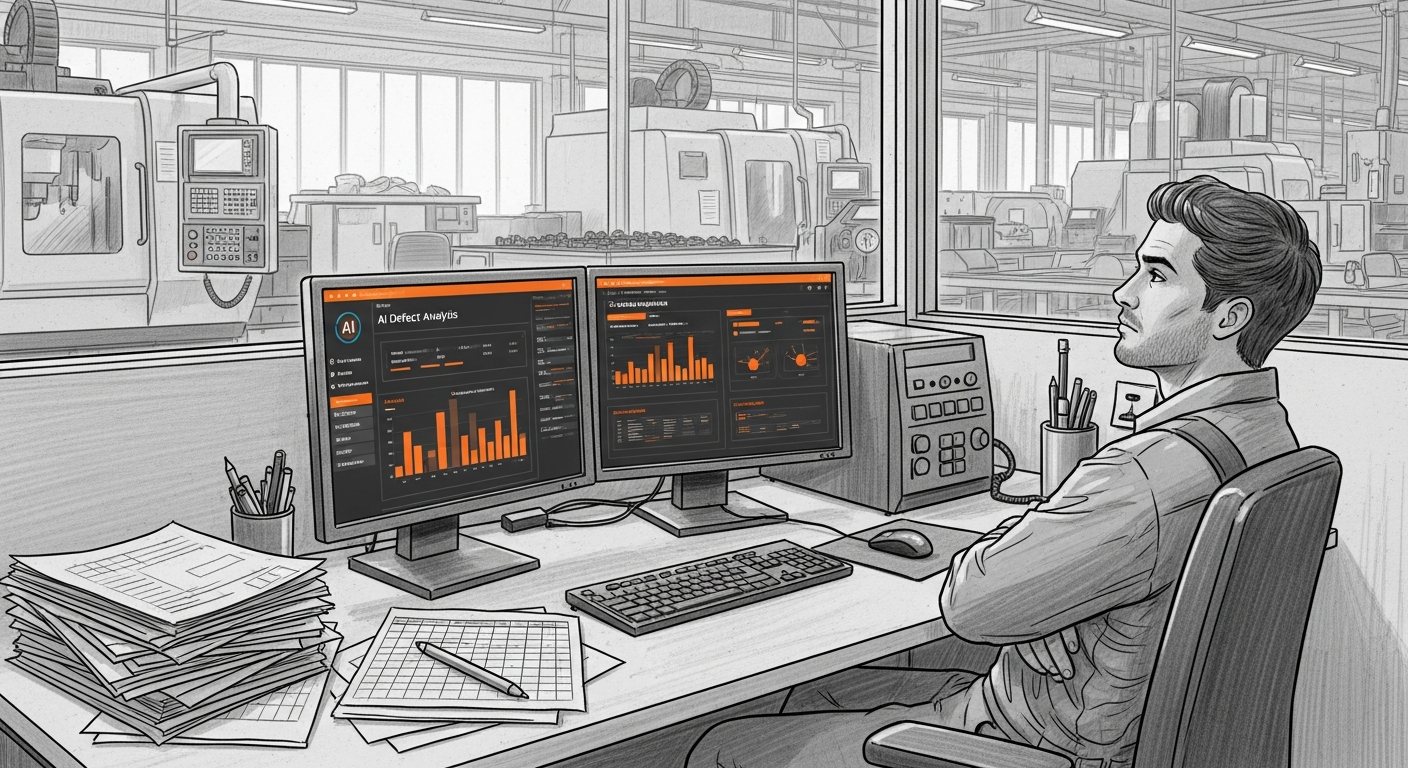
그 30분을 18년 동안 매일 반복했습니다 — 품질팀장이 본 AI Agent
18년차 품질팀장이 매일 아침 30분씩 반복하던 데이터 분석을 AI Agent가 3분 만에 해냈습니다. 챗봇과는 완전히 다른 물건 — 직접 시스템에 접근해서 데이터를 꺼내고 분석하는 AI의 현장 도입기.

ERP 20년, 나는 왜 AI를 얹기로 했나
ERP 20년차 제조IT본부장의 고백: 3,200만 행의 데이터가 잠들어 있었다. ERP를 바꾸지 않고 AI를 얹자, 일주일 걸리던 불량 분석이 수 초로 줄었다.
Want to apply this in your factory?
MOAI helps manufacturing companies adopt AI tailored to their operations.
Talk to us →