Erik Brynjolfsson
{{short description|American academic|bot=PearBOT 5}} {{Use mdy dates|date=December 2019}} {{Infobox scientist | name = Erik Brynjolfsson | image = Erik Brynjolfsson at MIT Sloan CIO Symposium 2013 (cropped).jpg | image_size = | caption = Brynjolfsson in 2013 | birth_date = | birth_place = [[Roskilde]], Denmark | death_date = | death_place = | citizenship = United States | fields = [[Information Systems]][[Economics]]Technological Change | workplaces = [[MIT]][[Stanford University]] | alma_mater = [[Harvard University]][[Massachusetts Institute of Technology]] | doctoral_advisor = [[Thomas W. Malone]] | academic_advisors = | doctoral_students = | notable_students = [[Shuman Ghosemajumder]][[Lorin Hitt]][[Yu (Jeffrey) Hu]][[Michael D. Smith (economist)|Michael D. Smith]][[Marshall Van Alstyne]][[Xiaoquan (Michael) Zhang]] | known_for = [[Productivity paradox]][[The Long Tail]][[Product bundling|Bundling]] of Information Goods [[Cyberbalkanization]] | influences = | influenced = | thesis_title = Information technology and the re-organization of work: theory and evidence | thesis_year = 1991 | thesis_url = https://ideas.repec.org/p/mit/sloanp/2471.html | students = | signature = | footnotes = }}
'''Erik Brynjolfsson''' is an American academic, author and inventor. He is the Jerry Yang and Akiko Yamazaki Professor and a Senior Fellow{{Cite web|title =Report of the Stanford University President | url = https://news.stanford.edu/today/2020/12/09/report-president-academic-council-professoriate-appointments/ |website = Stanford| date = December 9, 2020 |access-date = 2021-07-04}} at [[Stanford University]] where he directs the Digital Economy Lab at the Stanford Institute for Human-Centered AI, with appointments at SIEPR,{{cite web | url=https://siepr.stanford.edu/news/erik-brynjolfsson-join-stanford-faculty | title=Erik Brynjolfsson to join Stanford faculty | Stanford Institute for Economic Policy Research (SIEPR) | date=February 25, 2020 }} the Stanford Department of Economics and the [[Stanford Graduate School of Business]]. He is also a research associate at the [[National Bureau of Economic Research]]{{cite web | url=https://www.nber.org/people/erik_brynjolfsson| title=Erik Brynjolfsson, Research Associate as National Bureau of Economic Research | date=May 20, 2023 }} and an author of several books.{{cite web | url=https://wwnorton.com/books/the-second-machine-age/| title=The Second Machine Age | date=May 20, 2023 }} From 1990 to 2020, he was a professor at MIT.
Brynjolfsson contributes IT [[Productivity paradox|productivity]] research and work on the economics of information, the economics of AI, and the digital economy more generally. According to [[Martin Wolf]], "No economist has done more to promote the revolutionary implications of information technology than MIT’s Erik Brynjolfsson."{{Cite web |title=The long wait for a productivity resurgence |url=https://www.ft.com/content/8bea636a-6d78-11e8-852d-d8b934ff5ffa |access-date=2024-03-08 |website=www.ft.com|date=June 12, 2018 |last1=Wolf |first1=Martin }}
== Biography == Erik Brynjolfsson was born in [[Roskilde]], Denmark, to Marguerite Reman Brynjolfsson and [[Ari Brynjolfsson]], a [[nuclear physicist]]. He attended [[Wayland High School]], in Wayland, Massachusetts, where he was the [[valedictorian]].{{Cite book |last=Wayland (Mass.) |url=http://archive.org/details/waylandtownrepor1979wayl |title=Wayland Annual Reports 1979-1981 |date=1979 |publisher=Printed at the Middlesex Freeman Office |others=Wayland Free Public Library}}{{Cite web |url=https://ing.dk/artikel/mit-professor-kunstig-intelligens-kan-blive-det-bedste-der-er-sket-menneskeheden |title=MIT-professor: 'Kunstig intelligens kan blive det bedste, der er sket for menneskeheden' |trans-title=MIT professor: 'Artificial intelligence could be the best thing that has happened to humanity' |date=March 25, 2017 |last=Lund |first=Morten Vittrup |work=[[Ingeniøren]] |language=da}}
In 1984, he earned his [[Bachelor of Arts|A.B.]], ''[[magna cum laude]]'', and his [[Master of Science|S.M.]] in [[applied mathematics]] and decision sciences at [[Harvard University]]. He received a [[Ph.D.]] in Managerial Economics in 1991 from the [[MIT Sloan School of Management]].[http://mitsloan.mit.edu/faculty/pdf/cv/Brynjolfsson%20vita%202010-02-05.pdf Curriculum Vitae Erik Brynjolfsson] {{Webarchive|url=https://web.archive.org/web/20130327182933/http://mitsloan.mit.edu/faculty/pdf/cv/Brynjolfsson%20vita%202010-02-05.pdf |date=March 27, 2013 }} February, 2010.
After graduating from college, he taught courses on Building Expert Systems and on Applications of Artificial Intelligence at Harvard Extension School with Tod Loofbourrow. In 1987, he co-founded the Expert Systems subgroup of the [[Boston Computer Society]]{{Cite journal |last=Rotenberg |first=Jonathan |date=1987 |title=323 People Who Made the BCS |url=https://www.dtvgroup.com/BCS/Computer_Update_1987.pdf |journal=Computer Update |issue=March/April |pages=43}} and shortly thereafter, co-authored a series of articles on the topic.{{Cite journal |last=Brynjolfsson, Erik & Loofbourrow, Tod |date=1988 |title=PC tools: An overview of expert system building tools for PCs |url=https://journals.sagepub.com/doi/10.1177/089443939000800304?icid=int.sj-abstract.similar-articles.2 |journal=PC AI |issue=September/October |pages=31–32|doi=10.1177/089443939000800304 |url-access=subscription }}
Brynjolfsson served on the faculty of MIT from 1990 to 2020, where he was a professor at the [[MIT Sloan School of Management]] and Director of the [[MIT Initiative on the Digital Economy]], and Director of the [[MIT Center for Digital Business]]. He also taught at Harvard from 1985 to 1995 and [[Stanford University|Stanford]] from 1996 to 1998.
In 2001 he was appointed the Schussel Family Professor of Management at the [[MIT Sloan School of Management]]. In February 2020, Stanford announced that Brynjolfsson would join its faculty in July, 2020. He also lectures, consults, and serves on corporate boards.
Brynjolfsson is of Icelandic descent.{{Cite web |title=SÍMTALIÐ ... ER VIÐ ERIK BRYNJÓLFSSON Tölvuvæðing og framleiðni |url=http://www.mbl.is/greinasafn/grein/124323/ |access-date=2016-01-02 |website=www.mbl.is}}
=== Teaching === At Stanford, Brynjolfsson teaches a graduate course on "The AI Awakening: Implications for the Economy and Society"{{Cite web |title=Stanford University Explore Courses |url=https://explorecourses.stanford.edu/search?q=ECON295 |access-date=2024-01-05 |website=explorecourses.stanford.edu}} which has included guest lectures by [[Mira Murati]], [[Jeff Dean]], [[Eric Schmidt]], [[Alexandr Wang]], [[Mustafa Suleyman]] and others.{{Cite web |title=Teaching |url=https://www.brynjolfsson.com/teaching |access-date=2024-01-05 |website=Erik Brynjolfsson |language=en-US}}
At MIT, he taught the course 15.567, The Economics of Information: Strategy, Structure, and Pricing, at MIT.{{cite web|url=http://ocw.mit.edu/courses/sloan-school-of-management/15-567-the-economics-of-information-strategy-structure-and-pricing-fall-2010/|title=The Economics of Information: Strategy, Structure and Pricing | Sloan School of Management | MIT OpenCourseWare|website=ocw.mit.edu|access-date=2017-12-12}} He hosts a related blog, ''Economics of Information''.
=== Public Service === Along with [[Tom M. Mitchell|Tom Mitchell]], Brynjolfsson co-chaired two committees for the [[National Academy of Sciences|National Academies of Sciences]], one on "Automation and the US Workforce"{{Cite web |url=https://www.nationalacademies.org/our-work/information-technology-automation-and-the-us-workforce |access-date=2024-01-06 |website=www.nationalacademies.org|title=Information Technology Automation and the US Workforce | National Academies}} in 2017 and one on "Artificial Intelligence and the Future of Work” released in 2024.{{Cite web |url=https://www.nationalacademies.org/our-work/automation-and-the-us-workforce-an-update |access-date=2024-01-06 |website=www.nationalacademies.org|title=Automation and the US Workforce an Update | National Academies}}
Brynjolfsson also directed the analysis of AI for the National Network for Critical Technology Assessment.{{Cite web |title=Erik Brynjolfsson |url=https://nncta.org/directory/bios/brynjolfsson-erik.html |access-date=2024-01-06 |website=nncta.org |language=en}} He has testified{{Cite web |last=Brynjolfsson |first=Erik |date=September 24, 2019 |title=Artificial Intelligence and the Future of Work |url=https://www.congress.gov/116/meeting/house/109981/witnesses/HHRG-116-SY15-Wstate-BrynjolfssonE-20190924.pdf |access-date=January 6, 2024 |website=Congress.gov}} about AI for the United States Congress and participated in AI Summits at the White House.{{Cite web |title=CSAIL director invited to White House AI summit {{!}} MIT CSAIL |url=https://www.csail.mit.edu/news/csail-director-invited-white-house-ai-summit |access-date=2024-01-06 |website=www.csail.mit.edu}}
In 2016, he co-founded the AI Index and serves on its Steering Committee{{Cite web |title=AI Index 2023 {{!}} Stanford HAI |url=https://hai.stanford.edu/research/ai-index-2023 |access-date=2024-01-06 |website=hai.stanford.edu |language=en}} and was a co-author of the original (2016) report{{Cite web |title=2016 Report {{!}} One Hundred Year Study on Artificial Intelligence (AI100) |url=https://ai100.stanford.edu/2016-report |access-date=2024-01-06 |website=ai100.stanford.edu |language=en}} for the [[One Hundred Year Study on Artificial Intelligence|One Hundred Year Study of Artificial Intelligence]].
=== Awards === His research has been recognized with nine "best paper" awards by fellow academics, including the John DC Little Award for the best paper in Marketing Science.{{Cite web |url=https://www.informs.org/Recognizing-Excellence/Award-Recipients/Erik-Brynjolfsson |title=Erik Brynjolfsson |publisher=[[Institute for Operations Research and the Management Sciences|INFORMS]] |access-date=2019-12-03}} Along with Andrew McAfee, he was awarded the top prize in the Digital Thinkers category at the Thinkers 50 Gala on November 9, 2015.{{cite web|title=Thinkers 50|url=http://thinkers50.com/t50-awards/awards-2015/|website=Thinkers 50|date=November 9, 2015 |access-date=2015-11-10}}
In 2011, he was elected Distinguished Fellow of the Information Systems Society.{{Cite web |last=INFORMS |title=ISS Distinguished Fellow Award |url=https://www.informs.org/Recognizing-Excellence/Community-Prizes/Information-Systems-Society/ISS-Distinguished-Fellow-Award |access-date=2024-07-13 |website=INFORMS |language=en-US}}
In 2015, he received the Herb Simon Award for his work on digital economics,{{Cite web |last=Bence |first=Stubnya |date=2016-04-07 |title=Tömegek munkáját veszik majd el a robotok |url=http://index.hu/gazdasag/2016/04/07/erik_brynjolfsson_interju_robot_automatizacio_munkaeropiac_munka/ |access-date=2024-01-06 |website=index.hu |language=hu}} and in 2020 he was recognized with an Honorary Doctorate from the [[University of Turku]] for his research on the effects of information technology and AI on innovation, productivity and future work.{{Cite web |title=University of Turku Confers 15 Honorary Doctors in May {{!}} University of Turku |url=https://www.utu.fi/en/news/news/university-of-turku-confers-15-honorary-doctors-in-may |access-date=2023-12-03 |website=www.utu.fi |language=en}} Brynjolfsson was one of the inaugural fellows of the Schmidt Sciences AI2050 initiative.{{Cite web |last=Medina |first=Gabe |date=2022-02-16 |title=Schmidt Futures Launches AI2050 to Protect Our Human Future in the Age of Artificial Intelligence |url=https://www.schmidtfutures.com/schmidt-futures-launches-ai2050-to-protect-our-human-future-in-the-age-of-artificial-intelligence/ |access-date=2024-01-06 |website=Schmidt Futures |language=en-US}}
== Research == Brynjolfsson is known for studying the economics of information systems{{cite web|title=Google Scholars in Economics of Information systems|url=https://scholar.google.com/citations?view_op=search_authors&hl=en&mauthors=label:economics_of_information_systems|website=Google Scholar|access-date=2021-07-04}} and the economics of AI.{{Cite web |title=Google Scholars of Economics of AI |url=https://scholar.google.com/citations?hl=en&view_op=search_authors&mauthors=label:economics_of_AI&btnG= |access-date=2024-01-20 |website=scholar.google.com}}
His early work measured the productivity contributions of IT and the complementary role of organizational capital and other intangibles. Along with [[Paul Milgrom]], he wrote the lead article ("Complementarities in Organizations"){{Citation |last1=Brynjolfsson |first1=Erik |title=1. Complementarity in Organizations |date=2012-12-09 |pages=11–55 |url=https://www.degruyter.com/document/doi/10.1515/9781400845354-003/html |access-date=2024-07-08 |publisher=Princeton University Press |language=en |doi=10.1515/9781400845354-003 |isbn=978-1-4008-4535-4 |last2=Milgrom |first2=Paul|url-access=subscription }} in the [[NBER]] ''Handbook of Organizational Economics''. Along with Daniel Rock and Chad Syverson, he wrote the lead article ("AI and the Modern Productivity Paradox"){{Citation |last1=Brynjolfsson |first1=Erik |title=1. Artificial Intelligence and the Modern Productivity Paradox: A Clash of Expectations and Statistics |date=2019-06-07 |pages=23–60 |url=https://www.degruyter.com/document/doi/10.7208/9780226613475-003/html |access-date=2024-07-08 |publisher=University of Chicago Press |language=en |doi=10.7208/9780226613475-003 |isbn=978-0-226-61347-5 |last2=Rock |first2=Daniel |last3=Syverson |first3=Chad|doi-broken-date=July 2, 2025 }} in the NBER volume on the ''Economics of Artificial Intelligence''.
Brynjolfsson has done research on digital commerce, the [[Long Tail]], [[Product bundling|bundling]] and pricing models, intangible assets and the effects of IT on business strategy, [[productivity]] and performance.{{cite web|title=SIEPR Profile of Erik Brynjolfsson|url=https://siepr.stanford.edu/people/erik-brynjolfsson|website=Stanford Institute for Economic Policy Research|access-date=2021-07-04}} In several of his books and articles, Brynjolfsson has argued that technology is racing ahead, and called for greater efforts to update our skills, organizations and institutions more rapidly.
=== Books === Brynjolfsson is the author of several books, including ''Wired for Innovation''{{Cite book |last1=Brynjolfsson |first1=Erik |url=https://www.jstor.org/stable/j.ctt5hhgrf |title=Wired for Innovation: How Information Technology Is Reshaping the Economy |last2=Saunders |first2=Adam |date=2010 |publisher=The MIT Press |jstor=j.ctt5hhgrf |isbn=978-0-262-51861-1}} with Adam Saunders, and ''[[Race Against the Machine]]'', ''[[The Second Machine Age]]: Work, Progress, and Prosperity in a Time of Brilliant Technologies'' and ''Machine, Platform, Crowd''{{Cite web |title=Machine, Platform, Crowd |url=https://wwnorton.com/books/Machine-Platform-Crowd/ |access-date=2025-03-10 |website=wwnorton.com |language=en}} with [[Andrew McAfee]].
The ''Second Machine Age'' was described as "pioneering a fundamentally new economics, one based not on the old reality of scarcity but on a new reality of abundance that we are only just beginning to comprehend."{{Cite news |last=Pearlstein |first=Steven |date=2023-05-17 |title=Book Review: 'The Second Machine Age,' by Erik Brynjolfsson and Andrew McAfee |url=https://www.washingtonpost.com/opinions/review-the-second-machine-age-by-erik-brynjolfsson-and-andrew-mcafee/2014/01/17/ace0611a-718c-11e3-8b3f-b1666705ca3b_story.html |access-date=2024-03-07 |newspaper=Washington Post |language=en-US |issn=0190-8286}}
=== Information technology and productivity === At the urging of [[Robert Solow]], who first called attention to the gap between the computerization and productivity,{{Cite web |title=Erik Brynjolfsson: 'This could be the best decade in history — or the worst' |url=https://www.ft.com/content/b71759fe-397b-4688-bc81-b082edb25f31 |access-date=2024-03-08 |website=www.ft.com|date=January 31, 2024 |last1=Parikh |first1=Tej }} Brynjolfsson wrote a review of the "IT [[Productivity paradox|Productivity Paradox]]".{{cite book|title=Productivity Paradox|oclc=310949457}}
In separate research, he documented a [[Correlation and dependence|correlation]] between IT investment and productivity. His work provides evidence that the use of Information Technology is most likely to increase productivity when it is combined with complementary business processes and human capital.{{cite journal|title=IT and Workplace Organization|url=https://academic.oup.com/qje/article-abstract/117/1/339/1851770?redirectedFrom=fulltext | journal=Quarterly Journal of Economics| date=February 2002 | volume=117 | issue=1 | pages=339–376 | doi=10.1162/003355302753399526 |access-date=2021-07-04| last1=Bresnahan | first1=Timothy F. | last2=Brynjolfsson | first2=Erik | last3=Hitt | first3=Lorin M. }}
A subsequent article, the ''[[Productivity J-Curve]]'', described how these intangible investments might initially lead to stagnant or even lower productivity followed by a take-off.{{Cite journal |last1=Brynjolfsson |first1=Erik |last2=Rock |first2=Daniel |last3=Syverson |first3=Chad |date=January 2021 |title=The Productivity J-Curve: How Intangibles Complement General Purpose Technologies |url=https://www.aeaweb.org/articles?id=10.1257/mac.20180386 |journal=American Economic Journal: Macroeconomics |language=en |volume=13 |issue=1 |pages=333–372 |doi=10.1257/mac.20180386 |issn=1945-7707}}
=== Measuring the Digital Economy === Working with [[Avinash Collis]], [[Felix Eggers]], and others, Brynjolfsson developed new methods for measuring the digital economy using "massive online choice experiments".{{Cite journal |last1=Brynjolfsson |first1=Erik |last2=Collis |first2=Avinash |last3=Eggers |first3=Felix |date=2019 |title=Using Massive Online Choice Experiments to Measure Changes in Well-Being |journal=Proceedings of the National Academy of Sciences |volume=116 |issue=15 |pages=7250–7255|doi=10.1073/pnas.1815663116 |pmid=30914458 |pmc=6462102 |bibcode=2019PNAS..116.7250B |doi-access=free }} This work shows that even when goods like Wikipedia or email have zero price, and therefore may have little or no direct contribution to [[GDP]] as it is conventionally measured, they may still contribute significantly to well-being and consumer surplus.{{Cite journal |last1=Brynjolfsson |first1=Erik |last2=Collis |first2=Avinash |date=2019 |title=How Should We Measure the Digital Economy? |url=http://digamoo.free.fr/hbr1119.pdf |journal=Harvard Business Review |volume=97 |issue=6 |pages=140–148}} They introduced a new measure, [[GDP-B]], which seeks to address these challenges{{Cite news |last1=Brynjolfsson |first1=Erik |last2=Parker |first2=Ceri |date=May 23, 2019 |title=Economists have got GDP calculations wrong for years - here's why |url=https://www.weforum.org/stories/2019/05/an-economist-explains-how-to-value-the-internet/ |access-date=March 10, 2025 |work=World Economic Forum}} by measuring the [[consumer surplus]] from these goods and assess how it changes over time.
=== Using AI to augment and extend human capabilities === Brynjolfsson has argued for using AI to augment and complement humans, rather than replace and substitute for them.
The key conclusion of his 2011 book [[Race Against the Machine]] was the humans should aim to work ''with'' machines as partners, rather than try to race ''against'' them. This built on his work stressing the importance of complementarities for achieving the full benefits of information technology.{{Cite journal |last1=Brynjolfsson |first1=Erik |last2=Hitt |first2=Lorin M. |date=2000 |title=Beyond Computation: Information Technology, Organizational Transformation and Business Performance |url=https://www.aeaweb.org/articles?id=10.1257/jep.14.4.23 |journal=Journal of Economic Perspectives |language=en |volume=14 |issue=4 |pages=23–48 |doi=10.1257/jep.14.4.23 |issn=0895-3309}}
In 2013, he gave a TED talk on the economic implications of AI in the opening session of [[TED (conference)|TED]] where he argued that the key to economic growth was to use AI to augment human capabilities rather than replace them.{{Citation |last=Brynjolfsson |first=Erik |title=The key to growth? Race with the machines |date=2013-04-23 |url=https://www.ted.com/talks/erik_brynjolfsson_the_key_to_growth_race_with_the_machines |access-date=2024-01-05}} Brynjolfsson was called a “techno optimist” after this debate,{{Cite news |last=Aeppel |first=Timothy |title=Techno-optimist Erik Brynjolfsson Takes on Robert Gordon in Growth Debate |url=https://www.wsj.com/articles/BL-REB-26071 |access-date=2024-03-07 |work=WSJ |language=en-US}} though he prefers the moniker “mindful optimist”{{Cite web |date=2019-10-04 |title=The AI "awakening" |url=https://hai.stanford.edu/news/ai-awakening |access-date=2024-03-07 |website=hai.stanford.edu |language=en}} noting that he concluded his TED talk with the words “Technology is not Destiny. We shape our Destiny.”
In 2018, he gave an Invited Talk at the [[International Conference on Learning Representations]] on “What Can Machine Learning Do? Workforce Implications” where he challenged AI researchers to create systems that augment and extend human capabilities, rather than merely imitate them.{{Citation |title=Erik Brynjolfsson: What Can Machine Learning Do? Workforce Implications (ICLR 2018) | date=May 3, 2018 |url=https://www.youtube.com/watch?v=txhAqVez0hI |access-date=2024-03-15 |language=en}}
In 2022, he wrote an article called "[[The Turing Test|The Turing Trap]]", arguing that too often technologists, business executives and policymakers focus on using AI to automate and replace humans, which can limit the benefits of the technology and increase inequality, and that they should look for opportunities to augment human capabilities.{{Cite web |title=The Turing Trap: The Promise & Peril of Human-Like Artificial Intelligence |url=https://digitaleconomy.stanford.edu/news/the-turing-trap-the-promise-peril-of-human-like-artificial-intelligence/ |access-date=2024-03-15 |website=Stanford Digital Economy Lab |language=en-US}}
== Entrepreneur and Inventor == Brynjolfsson has been the co-founder of three companies (Foundation Technologies, Inc. [[Flexplay|Flexplay Technologies, Inc]]. and Workhelix, Inc) and has been awarded several U.S. patents.{{Cite web |last=Brynjolfsson |first=Erik |date=June 2, 2020 |title=Curriculum Vitae |url=https://cap.stanford.edu/profiles/viewCV?facultyId=200725&name=Erik_Brynjolfsson |access-date=December 2, 2023 |website=Stanford University}} He also served on the Boards of Directors of two publicly traded companies, [[Computer Sciences Corporation|Computer Science Corporation]] (2010–2015) and [[SCSK|CSK Holdings, Inc]]. (2005–2008).
Brynjolfsson designed the game software [[Dragonfire II: The Dungeonmaster's Assistant|Dragonfire II]]. As an inventor, he's been awarded patents for forecasting of skills and tasks, as well as optical storage media.{{Cite web |title=Erik Brynjolfsson Inventions, Patents and Patent Applications - Justia Patents Search |url=https://patents.justia.com/inventor/erik-brynjolfsson |access-date=2024-03-10 |website=patents.justia.com}}
=== Workhelix ===
Brynjolfsson co-founded Workhelix, Inc, a firm that helps companies assess their opportunities for using generative AI and other technologies.{{Cite web|title =The Batch: What Matters Right Now | url = https://info.deeplearning.ai/text-to-music-generation-military-drone-swarm-machine-translation-blocks-asylum-seekers |website = Deeplearning.ai | date = September 20, 2023 |access-date = 2023-11-07}} It applies the “task-based approach”, a methodology building on work by Brynjolfsson, [[Tom M. Mitchell]] and Daniel Rock for analyzing various technologies’ ability to augment or automate individual tasks. {{Cite journal |last1=Brynjolfsson |first1=Erik |last2=Mitchell |first2=Tom |last3=Rock |first3=Daniel |date=2018 |title= What Can Machines Learn, and What Does It Mean for Occupations and the Economy? |journal= AEA Papers and Proceedings |volume=108 |issue=May |pages=43–47| doi=10.1257/pandp.20181019 |hdl=1721.1/120302 |hdl-access=free }}
=== Inclusive Innovation Challenge === Brynjolfsson was the co-founder of the MIT Inclusive Innovation Challenge (IIC), a global tournament designed to encourage entrepreneurs to use technology to create a more equitable future. IIC winners have collectively generated over $170 million in revenue, raised over $1 billion in capital, created more than 7,000 jobs, and served 350 million people.{{Cite web |date=2019-12-23 |title=MIT Inclusive Innovation Challenge drives a more equitable economy |url=https://news.mit.edu/2019/mit-inclusive-innovation-challenge-mit-solve-driving-more-equitable-economy-1223 |access-date=2023-12-03 |website=MIT News {{!}} Massachusetts Institute of Technology |language=en}}
== Books ==
- Brynjolfsson, E., & Saunders, A. (2010). [https://www.jstor.org/stable/j.ctt5hhgrf Wired for Innovation]. ''How Information technology in reshaping the economy. Massachusetts Institute of Technology. USA''.
- Brynjolfsson, E., & McAfee, A. (2011). ''[[Race Against the Machine|Race against the machine]]: How the digital revolution is accelerating innovation, driving productivity, and irreversibly transforming employment and the economy''. Brynjolfsson and McAfee.
- Brynjolfsson, Erik and McAfee, Andrew (January, 2014) [http://www.secondmachineage.com The Second Machine Age: Work, Progress and Prosperity in a Time of Brilliant Technologies] {{Webarchive|url=https://web.archive.org/web/20140222021744/http://www.secondmachineage.com/ |date=February 22, 2014 }}, W.W. Norton & Company, {{ISBN|978-0-393-23935-5}}
- McAfee, A., & Brynjolfsson, E. (2017). ''[https://wwnorton.com/books/Machine-Platform-Crowd/ Machine, Platform, Crowd]: Harnessing our digital future''. WW Norton & Company.
== Selected publications ==
- Brynjolfsson Erik and Mitchell, Tom (December, 2017) [https://science.sciencemag.org/content/358/6370/1530 What can machine learning do? Workforce implications] Science.
- Brynjolfsson Erik, Syverson, Chad and Rock Daniel (2019) [https://prod.nber.org/papers/w24001 Artificial Intelligence and the Modern Productivity Paradox: A Clash of Expectations and Statistics] National Bureau of Economic Research.
-
- Bresnahan, Timothy, Brynjolfsson, Erik and Hitt, Lorin (February, 2002) "Information Technology, Workplace Organization and the Demand for Skilled Labor: Firm Level Evidence" '''Quarterly Journal of Economics'''', Vol. 117, pp. 339–376.
-
- Bakos, Yannis and Brynjolfsson, Erik (December, 1999) "Bundling Information Goods: Pricing, Profits and Efficiency", Management Science,' Vol. 45, No. 12, pp.1613–1630.
== References == {{reflist}}
== External links ==
- [http://brynjolfsson.com Brynjolfsson's Web Site] with links to research papers.
- [http://digitaleconomics.stanford.edu The Stanford Digital Economy Lab].
- [http://www.economicsofinformation.com ''Economics of Information'' Blog]
- Profile in [https://web.archive.org/web/20110522203946/http://www.businessweek.com/magazine/content/03_39/b3851623.htm?chan=search Business Week], September 29, 2003. ("If e-business had an oracle, Erik Brynjolfsson would be the anointed.")
- Profile in [http://www.optimizemag.com/disciplines/business-leadership/showArticle.jhtml?articleID=171201828&pgno=2&queryText=null Optimize], October, 2005. (Brynjolfsson ranked second in research study of "most influential academics of business technology")
- Profile in [https://web.archive.org/web/20070929051319/http://www.scmr.com/article/CA6300591.html?text=brynjolfsson Supply Chain Management], January, 2006.
- [https://archive.today/20130120031225/http://www.cioinsight.com/article2/0,1540,1457918,00.asp CIO Insight] Interview, "Expert Voice: Erik Brynjolfsson on Organizational Capital" October, 2001.
- Profile in [http://www.informationweek.com/shared/printHTMLArticle.jhtml?article=/782/productiv4.htm Informationweek], April 17, 2000. ("When it comes to explaining the relationship between IT and worker productivity—bandwagon jumpers like Federal Reserve chairman Alan Greenspan notwithstanding—the generally acknowledged expert in the field is Erik Brynjolfsson ...")
- {{TED speaker}} ** [https://www.ted.com/talks/erik_brynjolfsson_the_key_to_growth_race_with_the_machines TED Talk on the impact of technical change] (TED2013)
{{Authority control}}
{{DEFAULTSORT:Brynjolfsson, Erik}} [[Category:1962 births]] [[Category:Living people]] [[Category:Harvard University alumni]] [[Category:MIT Sloan School of Management alumni]] [[Category:MIT Sloan School of Management faculty]] [[Category:American people of Icelandic descent]] [[Category:Harvard University faculty]] [[Category:Information systems researchers]] [[Category:Stanford University Graduate School of Business faculty]] [[Category:Wayland High School alumni]]
From MOAI Insights
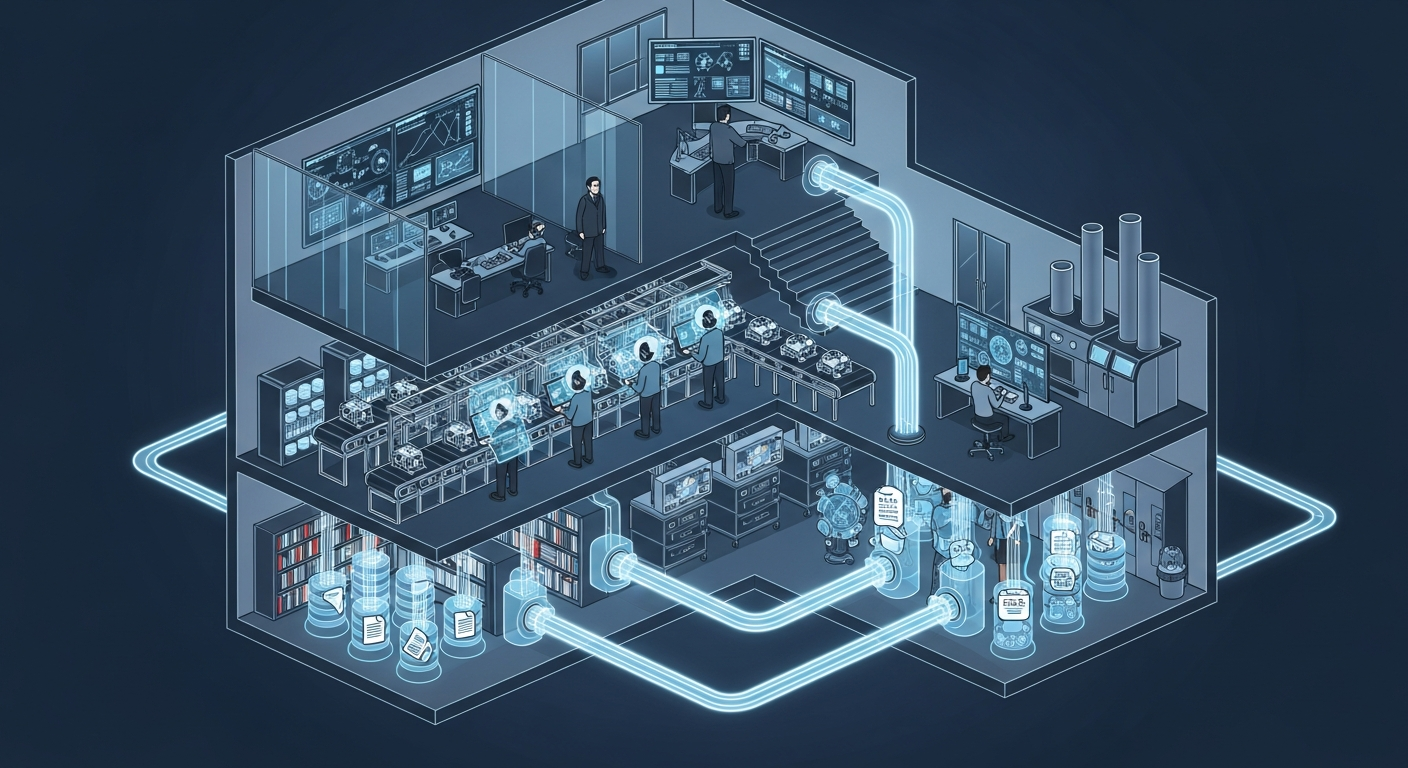
공장의 뇌는 어떻게 생겼는가 — 제조운영 AI 아키텍처 해부
지식관리, 업무자동화, 의사결정지원 — 따로 보면 다 있던 것들입니다. 제조 AI의 진짜 차이는 이 셋이 순환하면서 '우리 공장만의 지능'을 만든다는 데 있습니다.

그 30분을 18년 동안 매일 반복했습니다 — 품질팀장이 본 AI Agent
18년차 품질팀장이 매일 아침 30분씩 반복하던 데이터 분석을 AI Agent가 3분 만에 해냈습니다. 챗봇과는 완전히 다른 물건 — 직접 시스템에 접근해서 데이터를 꺼내고 분석하는 AI의 현장 도입기.
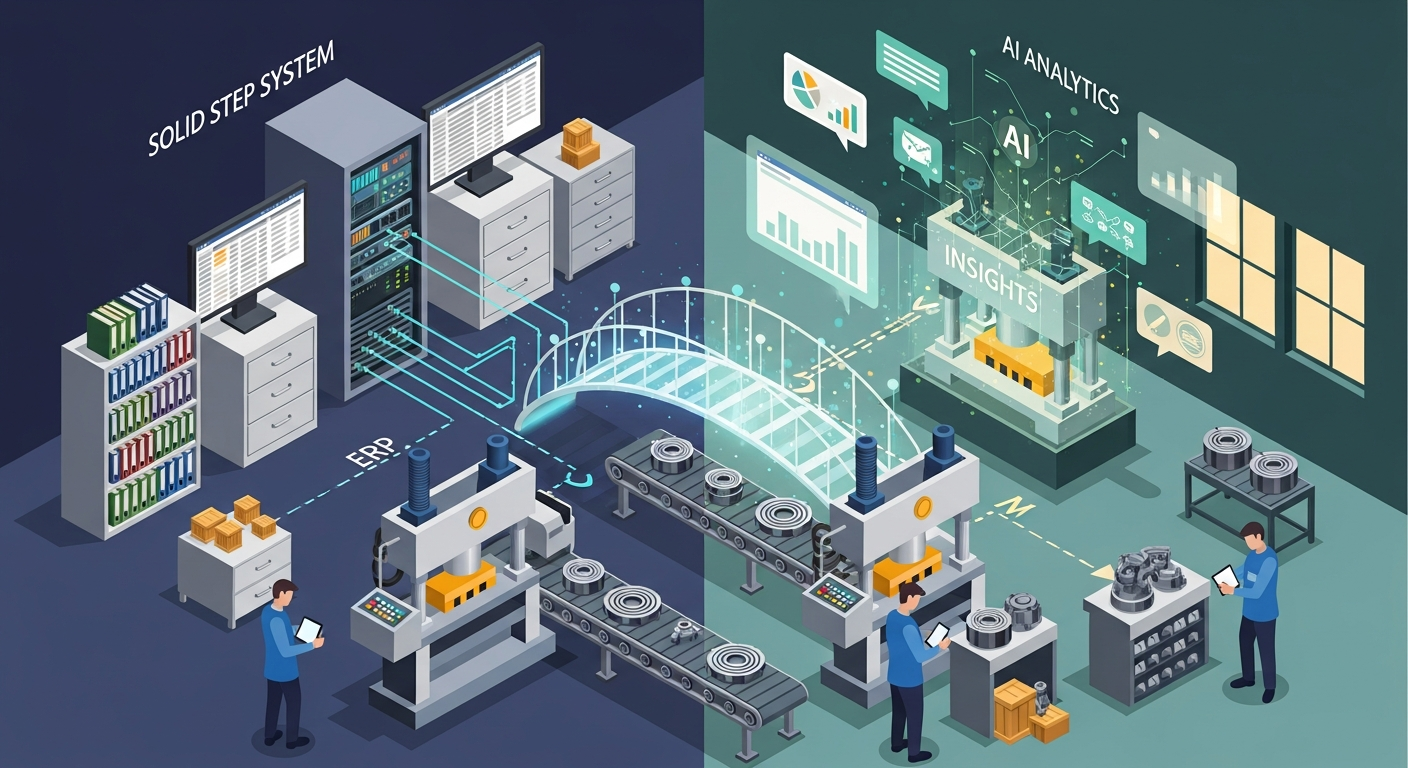
ERP 20년, 나는 왜 AI를 얹기로 했나
ERP 20년차 제조IT본부장의 고백: 3,200만 행의 데이터가 잠들어 있었다. ERP를 바꾸지 않고 AI를 얹자, 일주일 걸리던 불량 분석이 수 초로 줄었다.
Want to apply this in your factory?
MOAI helps manufacturing companies adopt AI tailored to their operations.
Talk to us →