Generalize
{{Short description|Form of abstraction}} {{Other uses}} {{Use dmy dates|date=December 2020}} {{Wiktionary|generalization}}
A '''generalization''' is a form of [[abstraction]] whereby common properties of specific instances are formulated as general concepts or claims.{{Cite web|url=https://www.dictionary.com/browse/generalization|title=Definition of generalization {{!}} Dictionary.com|website=www.dictionary.com|language=en|access-date=30 November 2019}} Generalizations posit the existence of a domain or [[set theory|set]] of elements, as well as one or more common characteristics shared by those elements (thus creating a [[conceptual model]]). As such, they are the essential basis of all valid [[deductive]] inferences (particularly in [[logic]], mathematics and science), where the process of [[falsifiability|verification]] is necessary to determine whether a generalization holds true for any given situation.
Generalization can also be used to refer to the process of identifying the parts of a whole, as belonging to the whole. The parts, which might be unrelated when left on their own, may be brought together as a group, hence belonging to the whole by establishing a common relation between them.
However, the parts cannot be generalized into a whole—until a common relation is established among ''all'' parts. This does not mean that the parts are unrelated, only that no common relation has been established yet for the generalization.
The concept of generalization has broad application in many connected disciplines, and might sometimes have a more specific meaning in a specialized context (e.g. generalization in psychology, [[Generalization (learning)|generalization in learning]]).
In general, given two related concepts ''A'' and ''B,'' ''A'' is a "generalization" of ''B'' (equiv., ''B'' is a [[special case]] of ''A'') if and only if both of the following hold:
- Every instance of concept ''B'' is also an instance of concept ''A.''
- There are instances of concept ''A'' which are not instances of concept ''B''.
For example, the concept ''animal'' is a generalization of the concept ''bird'', since every bird is an animal, but not all animals are birds (dogs, for instance). For more, see [[Specialisation (biology)]].
==Hypernym and hyponym== {{See also|Semantic change}} The connection of ''generalization'' to ''specialization'' (or ''[[particularization]]'') is reflected in the contrasting words [[hypernym]] and [[hyponym]]. A hypernym as a [[generic antecedents|generic]] stands for a class or group of equally ranked items, such as the term ''tree'' which stands for equally ranked items such as ''peach'' and ''oak'', and the term ''ship'' which stands for equally ranked items such as ''cruiser'' and ''steamer''. In contrast, a hyponym is one of the items included in the generic, such as ''peach'' and ''oak'' which are included in ''tree'', and ''cruiser'' and ''steamer'' which are included in ''ship''. A hypernym is superordinate to a hyponym, and a hyponym is subordinate to a hypernym.{{Cite web|url=https://www.thoughtco.com/hypernym-words-term-1690943|title=Definition and Examples of Hypernyms in English|last=Nordquist|first=Richard|website=ThoughtCo|language=en|access-date=30 November 2019}}
==Examples==
===Biological generalization=== [[File:Generalization process using trees.svg|thumb|right|alt=Diagram|When the mind makes a generalization, it extracts the essence of a concept based on its analysis of similarities from many discrete objects. The resulting simplification enables higher-level thinking.]] An animal is a generalization of a [[mammal]], a bird, a fish, an [[amphibian]] and a reptile.
===Cartographic generalization of geo-spatial data=== {{Main|Cartographic generalization}} Generalization has a long history in [[cartography]] as an art of creating maps for different scale and purpose. [[Cartographic generalization]] is the process of selecting and representing information of a map in a way that adapts to the scale of the display medium of the map. In this way, every map has, to some extent, been generalized to match the criteria of display. This includes small cartographic scale maps, which cannot convey every detail of the real world. As a result, cartographers must decide and then adjust the content within their maps, to create a suitable and useful map that conveys the [[geospatial]] information within their representation of the world.{{Cite web|url=https://www.axismaps.com/guide/general/scale-and-generalization/|title=Scale and Generalization|date=14 October 2019|website=Axis Maps|access-date=30 November 2019}}
Generalization is meant to be context-specific. That is to say, correctly generalized maps are those that emphasize the most important map elements, while still representing the world in the most faithful and recognizable way. The level of detail and importance in what is remaining on the map must outweigh the insignificance of items that were generalized—so as to preserve the distinguishing characteristics of what makes the map useful and important.
===Mathematical generalizations=== In [[mathematics]], one commonly says that a concept or a result {{mvar|B}} is a ''generalization'' of {{mvar|A}} if {{mvar|A}} is defined or proved before {{mvar|B}} (historically or conceptually) and {{mvar|A}} is a special case of {{mvar|B}}.
- The [[complex numbers]] are a generalization of the [[real numbers]], which are a generalization of the [[rational numbers]], which are a generalization of the [[integers]], which are a generalization of the [[natural numbers]].
- A [[polygon]] is a generalization of a 3-sided [[triangle]], a 4-sided [[quadrilateral]], and so on to [[Variable (mathematics)|''n'']] sides.
- A [[hypercube]] is a generalization of a 2-dimensional square, a 3-dimensional [[cube]], and so on to ''n'' [[dimension]]s.
- A [[quadric]], such as a [[hypersphere]], [[ellipsoid]], [[paraboloid]], or [[hyperboloid]], is a generalization of a [[conic section]] to higher dimensions.
- A [[Taylor series]] is a generalization of a [[MacLaurin series]].
- The [[binomial formula]] is a generalization of the formula for (1+x)^n.
- A [[ring (mathematics)|ring]] is a generalization of a [[field (mathematics)|field]].
==See also== {{wikiquote}}
- [[Anti-unification]]
- [[Categorical imperative]] (ethical generalization)
- ''[[Ceteris paribus]]''
- {{section link|Class diagram|Generalization/Inheritance}}
- [[External validity]] (scientific studies)
- [[Faulty generalization]]
- [[Generic (disambiguation)]]
- [[Critical thinking]]
- [[Generic antecedent]]
- [[Hasty generalization]]
- [[Inheritance (object-oriented programming)]]
- ''[[Mutatis mutandis]]''
- [[-onym]]
- [[Ramer–Douglas–Peucker algorithm]]
- [[Semantic compression]]
- [[Inventor's paradox]]
== References == [[Category:Generalizations]] [[Category:Critical thinking skills]] [[Category:Inductive_reasoning]]
Related Articles
From MOAI Insights

디지털 트윈, 당신 공장엔 이미 있다 — 엑셀과 MES 사이 어딘가에
디지털 트윈은 10억짜리 3D 시뮬레이션이 아니다. 지금 쓰고 있는 엑셀에 좋은 질문 하나를 더하는 것 — 두 전문가가 중소 제조기업이 이미 가진 데이터로 예측하는 공장을 만드는 현실적 로드맵을 제시한다.
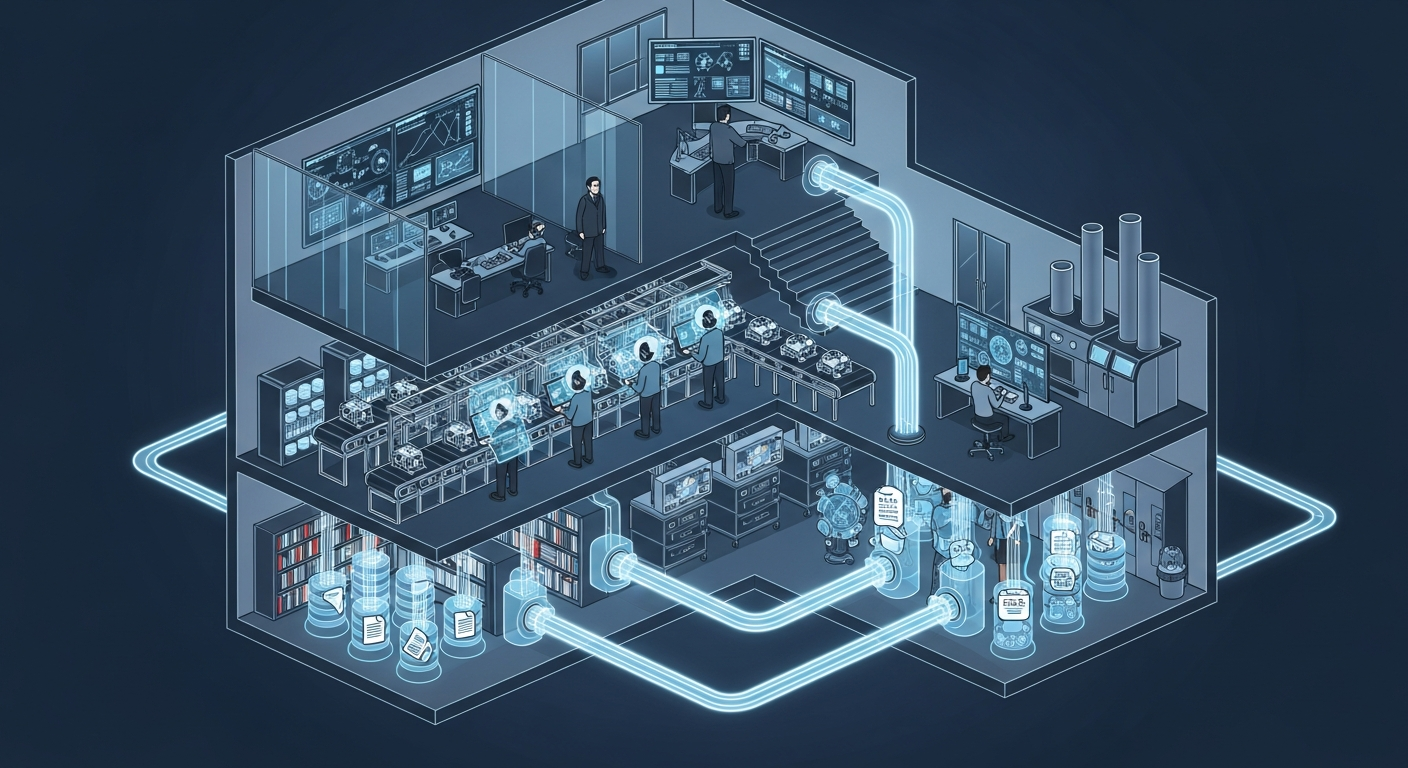
공장의 뇌는 어떻게 생겼는가 — 제조운영 AI 아키텍처 해부
지식관리, 업무자동화, 의사결정지원 — 따로 보면 다 있던 것들입니다. 제조 AI의 진짜 차이는 이 셋이 순환하면서 '우리 공장만의 지능'을 만든다는 데 있습니다.

그 30분을 18년 동안 매일 반복했습니다 — 품질팀장이 본 AI Agent
18년차 품질팀장이 매일 아침 30분씩 반복하던 데이터 분석을 AI Agent가 3분 만에 해냈습니다. 챗봇과는 완전히 다른 물건 — 직접 시스템에 접근해서 데이터를 꺼내고 분석하는 AI의 현장 도입기.
Want to apply this in your factory?
MOAI helps manufacturing companies adopt AI tailored to their operations.
Talk to us →