John Hopfield
{{short description|American scientist (born 1933)}} {{for|his father|John J. Hopfield (spectroscopist)}} {{Use mdy dates|date=October 2024}} {{Infobox scientist | name = John Hopfield | image = John J. Hopfield delivering his lecture at the 2024 Nobel Prize Lectures in Stockholm.jpg | caption = John J. Hopfield delivering his lecture at the 2024 Nobel Prize Lectures | birth_name = John Joseph Hopfield | birth_date = {{birth date and age|1933|7|15}} | birth_place = [[Chicago]], [[Illinois]], U.S. | death_date = | death_place = | education = [[Swarthmore College]] ([[Bachelor of Arts|BA]])[[Cornell University]] ([[Doctor of Philosophy|PhD]]) | known_for = [[Hopfield network]][[Modern Hopfield network]][[Hopfield dielectric]][[Polariton]][[Kinetic proofreading]] | parents = [[John J. Hopfield (spectroscopist)|John J. Hopfield]][[Helen Hopfield]] | awards = {{ubl |[[Oliver Buckley Prize]] (1969) |[[Dirac Medal (ICTP)|Dirac Medal]] of the [[ICTP]] (2001) |[[Harold Pender Award]] (2002) |[[Albert Einstein World Award of Science]] (2005) |[[Franklin Institute Awards|Benjamin Franklin Medal]] (2019) |[[Boltzmann Medal]] (2022) |[[Nobel Prize in Physics]] (2024) |[[Queen Elizabeth Prize for Engineering]] (2025)}} | field = [[Physics]][[Molecular biology]][[Complex systems]][[Neuroscience]][[Machine Learning]][[Artificial Intelligence]] | workplaces = [[Bell Labs]][[Princeton University]][[University of California, Berkeley]][[California Institute of Technology]] | thesis_title = A Quantum-Mechanical Theory of the Contribution of Excitons to the Complex Dielectric Constant of Crystals | thesis_url = https://www.proquest.com/docview/301894791/ | thesis_year = 1958 | doctoral_advisor = [[Albert Overhauser]] | doctoral_students = [[Steven Girvin]] [[Gerald Mahan]][[Bertrand Halperin]][[David J. C. MacKay]][[José Onuchic]][[Terry Sejnowski]][[Erik Winfree]][[Li Zhaoping]] }} '''John Joseph Hopfield''' (born July 15, 1933){{Cite web |title=Hopfield, John J. |url=https://history.aip.org/phn/11501013.html |access-date=October 8, 2024 |website=Physics History Network American Institute of Physics}} is an American physicist and [[emeritus]] professor of [[Princeton University]], most widely known for his study of [[associative neural networks]] in 1982. He is known for the development of the [[Hopfield network]]. Before its invention, research in artificial intelligence (AI) was in a decay period or [[AI winter]], Hopfield's work revitalized large-scale interest in this field.{{Crevier 1993}}
In 2024 Hopfield, along with [[Geoffrey Hinton]], was awarded the [[Nobel Prize in Physics]] for "foundational discoveries and inventions that enable [[machine learning]] with [[artificial neural network]]s."{{Cite web |title=Press release: The Nobel Prize in Physics 2024 |url=https://www.nobelprize.org/prizes/physics/2024/press-release/ |access-date=October 8, 2024 |website=NobelPrize.org |language=en-US |archive-date=October 8, 2024 |archive-url=https://web.archive.org/web/20241008150403/https://www.nobelprize.org/prizes/physics/2024/press-release/ |url-status=live }}{{citation |last1=Taylor |first1=D.B. |display-authors=et al. |title=Nobel Physics Prize Awarded for Pioneering A.I. Research by 2 Scientists |url=https://www.nytimes.com/2024/10/08/science/nobel-prize-physics.html |journal=The New York Times |date=October 8, 2024 |access-date=October 8, 2024 |archive-date=October 8, 2024 |archive-url=https://web.archive.org/web/20241008123756/https://www.nytimes.com/2024/10/08/science/nobel-prize-physics.html |url-status=live }} He has been awarded various major physics awards for his work in multidisciplinary fields including [[condensed matter physics]], [[statistical mechanics|statistical physics]] and [[biophysics]].
==Biography==
=== Early life and education === John Joseph Hopfield was born in 1933 in [[Chicago]] to physicists [[John J. Hopfield (spectroscopist)|John Joseph Hopfield]] (born in Poland as Jan Józef Chmielewski) and [[Helen Hopfield]] (née Staff).{{Cite book |last=Lindsay |first=Grace |url=https://books.google.com/books?id=ieYdEAAAQBAJ&dq=john+hopfield+biography&pg=PA90 |title=Models of the Mind: How Physics, Engineering and Mathematics Have Shaped Our Understanding of the Brain |date=March 4, 2021 |publisher=Bloomsbury Publishing |isbn=978-1-4729-6645-2 |language=en |access-date=October 8, 2024 |archive-date=October 8, 2024 |archive-url=https://web.archive.org/web/20241008150358/https://books.google.com/books?id=ieYdEAAAQBAJ&dq=john+hopfield+biography&pg=PA90 |url-status=live }}{{cite web | url=https://books.google.com/books?id=_f4IAQAAMAAJ&q=Helen+Staff+Hopfield | title=American Men of Science: A Biographical Directory |volume=3 |publisher=Science Press | date=1966 }}
Hopfield received a [[Bachelor of Arts]] with a major in physics from [[Swarthmore College]] in Pennsylvania in 1954 and a [[Doctor of Philosophy]] in physics from [[Cornell University]] in 1958. His doctoral dissertation was titled "A quantum-mechanical theory of the contribution of [[exciton]]s to the complex [[Relative permittivity|dielectric constant]] of crystals".{{cite Q|Q130468423}} His [[doctoral advisor]] was [[Albert Overhauser]].
=== Career === He spent two years in the theory group at [[Bell Laboratories]] working on optical properties of semiconductors working with [[David Gilbert Thomas]]{{Cite book |last=Orton |first=John W. |url=https://books.google.com/books?id=0hdREAAAQBAJ&dq=john+hopfield+semiconductors+bell+labs&pg=PA297 |title=The Story of Semiconductors |date=December 11, 2008 |publisher=OUP Oxford |isbn=978-0-19-156544-1 |language=en}} and later on a quantitative model to describe the cooperative behavior of [[hemoglobin]] in collaboration with [[Robert G. Shulman]].{{Cite journal |date=March 1, 1985 |title=American Physical Society Meets in Baltimore |url=https://pubs.aip.org/physicstoday/article/38/3/87/403879/American-Physical-Society-Meets-in-Baltimore |journal=Physics Today |language=en |volume=38 |issue=3 |pages=87–93 |doi=10.1063/1.2814495 |bibcode=1985PhT....38c..87. |issn=0031-9228|url-access=subscription }} Subsequently he became a faculty member at [[University of California, Berkeley]] (physics, 1961–1964), [[Princeton University]] (physics, 1964–1980), [[California Institute of Technology]] (Caltech, chemistry and biology, 1980–1997) and again at Princeton (1997–), where he is the Howard A. Prior Professor of Molecular Biology, emeritus.{{Cite web |last=Office of Communications |date=October 8, 2024 |title=Princeton's John Hopfield receives Nobel Prize in physics |url=https://www.princeton.edu/news/2024/10/08/princetons-john-hopfield-receives-nobel-prize-physics |access-date=October 8, 2024 |website=Princeton University |language=en |archive-date=October 8, 2024 |archive-url=https://web.archive.org/web/20241008150359/https://www.princeton.edu/news/2024/10/08/princetons-john-hopfield-receives-nobel-prize-physics |url-status=live }}
In 1976, he participated in a science short film on the structure of the hemoglobin, featuring [[Linus Pauling]].{{Cite web |date=1976 |title=The Life and the Structure of Hemoglobin, American Institute of Physics |url=https://scarc.library.oregonstate.edu/coll/pauling/blood/video/1976v.7.html |access-date=October 9, 2024 |website=Orego State Documentary History of Linus Pauling}}
From 1981 to 1983 [[Richard Feynman]], [[Carver Mead]] and Hopfield gave a one-year course at Caltech called "The Physics of Computation".{{Cite book |last=Hey |first=Anthony |url=https://books.google.com/books?id=ZkIPEAAAQBAJ |title=Feynman And Computation |date=March 8, 2018 |publisher=CRC Press |isbn=978-0-429-96900-3 |language=en}}{{Cite journal |last=Hillis |first=W. Daniel |date=February 1, 1989 |title=Richard Feynman and the Connection Machine |url=https://pubs.aip.org/physicstoday/article/42/2/78/405542/Richard-Feynman-and-the-Connection-MachineIn-his |journal=Physics Today |volume=42 |issue=2 |pages=78–83 |doi=10.1063/1.881196 |bibcode=1989PhT....42b..78H |issn=0031-9228|url-access=subscription }} This collaboration inspired the [[Computation and Neural Systems]] PhD program at Caltech in 1986, co-founded by Hopfield.{{Cite web |title=Caltech Celebrates 30 Years of its Computation and Neural Systems Option {{!}} Caltech Alumni |url=https://alumni.caltech.edu/caltech-celebrates-30-years-of-its-computation-and-neural-systems-option/ |access-date=October 8, 2024 |language=en-US |archive-date=October 8, 2024 |archive-url=https://web.archive.org/web/20241008150405/https://alumni.caltech.edu/caltech-celebrates-30-years-of-its-computation-and-neural-systems-option/ |url-status=live }}
His former PhD students include [[Gerald Mahan]] (PhD in 1964),{{Cite web |title=Gerald Mahan Obituary (1937 - 2021) - New York, NY - The Oregonian |url=https://obits.oregonlive.com/us/obituaries/oregon/name/gerald-mahan-obituary?id=31921970 |access-date=2024-10-13 |website=Legacy.com}} [[Bertrand Halperin]] (1965),{{MathGenealogy|id=15862|name=John Joseph Hopfield}} [[Steven Girvin]] (1977), [[Terry Sejnowski]] (1978), [[Erik Winfree]] (1998), [[José Onuchic]] (1987), [[Li Zhaoping]] (1990){{Cite thesis |last=Li |first=Zhaoping |title=A model of the olfactory bulb and beyond |date=1990 |degree=phd |publisher=California Institute of Technology |url=https://thesis.library.caltech.edu/8083/ |language=en}} and [[David J. C. MacKay]] (1992).
== Work == In his doctoral work of 1958, he wrote on the interaction of [[exciton]]s in crystals, coining the term [[polariton]] for a [[quasiparticle]] that appears in [[solid-state physics]].{{Cite journal |last=Hopfield |first=J. J. |date=December 1, 1958 |title=Theory of the Contribution of Excitons to the Complex Dielectric Constant of Crystals |url=https://link.aps.org/doi/10.1103/PhysRev.112.1555 |journal=Physical Review |language=en |volume=112 |issue=5 |pages=1555–1567 |doi=10.1103/PhysRev.112.1555 |bibcode=1958PhRv..112.1555H |issn=0031-899X|url-access=subscription }}{{Cite book |last=Agranovich |first=Vladimir M. |url=https://books.google.com/books?id=dYePg7KvyIIC&dq=history+of+polariton+hopfield&pg=PA106 |title=Excitations in Organic Solids |date=February 12, 2009 |publisher=OUP Oxford |isbn=978-0-19-155291-5 |language=en |access-date=October 8, 2024 |archive-date=October 8, 2024 |archive-url=https://web.archive.org/web/20241008150402/https://books.google.com/books?id=dYePg7KvyIIC&dq=history+of+polariton+hopfield&pg=PA106 |url-status=live }} He wrote: "The polarization field 'particles' analogous to [[photon]]s will be called 'polaritons'." His polariton model is sometimes known as the [[Hopfield dielectric]].{{Cite journal |last1=Huttner |first1=B. |last2=Barnett |first2=S. M. |date=1992 |title=Dispersion and Loss in a Hopfield Dielectric |url=https://iopscience.iop.org/article/10.1209/0295-5075/18/6/003 |journal=Europhysics Letters |language=en |volume=18 |issue=6 |pages=487 |doi=10.1209/0295-5075/18/6/003 |bibcode=1992EL.....18..487H |issn=0295-5075 |access-date=October 8, 2024 |archive-date=October 8, 2024 |archive-url=https://web.archive.org/web/20241008143515/https://iopscience.iop.org/article/10.1209/0295-5075/18/6/003 |url-status=live |url-access=subscription }}
From 1959 to 1963, Hopfield and David G. Thomas investigated the exciton structure of [[cadmium sulfide]] from its reflection spectra. Their experiments and theoretical models allowed to understand the optical spectroscopy of [[II-VI semiconductor compound]]s.{{Cite journal |last1=Reynolds |first1=D. C. |last2=Litton |first2=C. W. |last3=Collins |first3=T. C. |date=1965 |title=Some Optical Properties of Group II-VI Semiconductors (I) |url=https://onlinelibrary.wiley.com/doi/10.1002/pssb.19650090302 |journal=Physica Status Solidi B |language=en |volume=9 |issue=3 |pages=645–684 |doi=10.1002/pssb.19650090302 |bibcode=1965PSSBR...9..645R |issn=0370-1972|url-access=subscription }}
Condensed matter physicist [[Philip W. Anderson]] reported that John Hopfield was his "hidden collaborator" for his 1961–1970 works on the [[Anderson impurity model]] which explained the [[Kondo effect]]. Hopfield was not included as a co-author in the papers but Anderson admitted the importance of Hopfield's contribution in various of his writings.{{Cite book |last=Zangwill |first=Andrew |url=https://books.google.com/books?id=DK8SEAAAQBAJ |title=A Mind Over Matter: Philip Anderson and the Physics of the Very Many |date=January 8, 2021 |publisher=Oxford University Press |isbn=978-0-19-264055-0 |language=en}}
William C. Topp and Hopfield introduced the concept of norm-conserving [[pseudopotential]]s in 1973.{{Cite journal |last1=Topp |first1=William C. |last2=Hopfield |first2=John J. |date=1973-02-15 |title=Chemically Motivated Pseudopotential for Sodium |url=https://link.aps.org/doi/10.1103/PhysRevB.7.1295 |journal=Physical Review B |language=en |volume=7 |issue=4 |pages=1295–1303 |doi=10.1103/PhysRevB.7.1295 |bibcode=1973PhRvB...7.1295T |issn=0556-2805|url-access=subscription }}{{Cite book |last=Martin |first=Richard M. |url=https://books.google.com/books?id=wvXvDwAAQBAJ |title=Electronic Structure: Basic Theory and Practical Methods |date=2020-08-27 |publisher=Cambridge University Press |isbn=978-1-108-42990-0 |language=en}}{{Cite book |last1=Marx |first1=Dominik |url=https://books.google.com/books?id=VRZUw8Wk4CIC&dq=hoppfield+topp+pseudopotentials&pg=PT130 |title=Ab Initio Molecular Dynamics: Basic Theory and Advanced Methods |last2=Hutter |first2=Jürg |date=2009-04-30 |publisher=Cambridge University Press |isbn=978-1-139-47719-2 |language=en}}
In 1974 he introduced a mechanism for error correction in [[Enzyme catalysis|biochemical reactions]] known as [[kinetic proofreading]] to explain the accuracy of [[DNA replication]].{{Cite journal |last=Hopfield |first=J. J. |date=1974 |title=Kinetic Proofreading: A New Mechanism for Reducing Errors in Biosynthetic Processes Requiring High Specificity |journal=Proceedings of the National Academy of Sciences |language=en |volume=71 |issue=10 |pages=4135–4139 |doi=10.1073/pnas.71.10.4135 |doi-access=free |issn=0027-8424 |pmc=434344 |pmid=4530290|bibcode=1974PNAS...71.4135H }}{{Cite book |last1=Flyvbjerg |first1=Henrik |url=https://books.google.com/books?id=QSVKAAAAQBAJ&dq=biography+hopfield+kinetic+proofreading&pg=PA449 |title=Physics of Bio-Molecules and Cells: Les Houches Session LXXV, 2–27 July 2001 |last2=Jülicher |first2=Frank |last3=Ormos |first3=Pal |last4=David |first4=Francois |date=July 1, 2003 |publisher=Springer Science & Business Media |isbn=978-3-540-45701-5 |language=en |access-date=October 8, 2024 |archive-date=October 8, 2024 |archive-url=https://web.archive.org/web/20241008150403/https://books.google.com/books?id=QSVKAAAAQBAJ&dq=biography+hopfield+kinetic+proofreading&pg=PA449 |url-status=live }}
Hopfield published his first paper in neuroscience in 1982, titled "Neural networks and physical systems with emergent collective computational abilities" where he introduced what is now known as [[Hopfield network]], a type of artificial network that can serve as a [[content-addressable memory]], made of binary neurons that can be 'on' or 'off'.{{Cite journal |last=Hopfield |first=J J |date=April 1982 |title=Neural networks and physical systems with emergent collective computational abilities. |journal=Proceedings of the National Academy of Sciences of the United States of America |volume=79 |issue=8 |pages=2554–2558 |doi=10.1073/pnas.79.8.2554 |doi-access=free |issn=0027-8424 |pmid=6953413|pmc=346238 |bibcode=1982PNAS...79.2554H }} He extended his formalism to continuous [[activation function]]s in 1984.{{Cite journal |last=Hopfield |first=J J |date=1984 |title=Neurons with graded response have collective computational properties like those of two-state neurons. |journal=Proceedings of the National Academy of Sciences of the United States of America |volume=81 |issue=10 |pages=3088–3092 |issn=0027-8424 |pmid=6587342 |doi=10.1073/pnas.81.10.3088 |doi-access=free|pmc=345226 |bibcode=1984PNAS...81.3088H }} The 1982 and 1984 papers represent his two most cited works. Hopfield has said that the inspiration came from his knowledge of [[spin glass]]es from his collaborations with P. W. Anderson.{{Cite journal |last=Hopfield |first=John J. |date=March 1, 2014 |title=Whatever Happened to Solid State Physics? |journal=Annual Review of Condensed Matter Physics |language=en |volume=5 |issue=1 |pages=1–13 |doi=10.1146/annurev-conmatphys-031113-133924 |bibcode=2014ARCMP...5....1H |issn=1947-5454|doi-access=free }}
Together with [[David W. Tank]], Hopfield developed a method in 1985–1986{{Cite journal |last1=Hopfield |first1=J. J. |last2=Tank |first2=D. W. |date=July 1, 1985 |title="Neural" computation of decisions in optimization problems |url=https://link.springer.com/article/10.1007/BF00339943 |journal=Biological Cybernetics |language=en |volume=52 |issue=3 |pages=141–152 |doi=10.1007/BF00339943 |pmid=4027280 |issn=1432-0770 |access-date=October 8, 2024 |archive-date=October 8, 2024 |archive-url=https://web.archive.org/web/20241008150833/https://link.springer.com/article/10.1007/BF00339943 |url-status=live |url-access=subscription }}{{Cite journal |last1=Hopfield |first1=John J. |last2=Tank |first2=David W. |date=August 8, 1986 |title=Computing with Neural Circuits: A Model |url=https://www.science.org/doi/10.1126/science.3755256 |journal=Science |language=en |volume=233 |issue=4764 |pages=625–633 |doi=10.1126/science.3755256 |pmid=3755256 |bibcode=1986Sci...233..625H |issn=0036-8075 |access-date=October 8, 2024 |archive-date=April 14, 2024 |archive-url=https://web.archive.org/web/20240414215541/https://www.science.org/doi/10.1126/science.3755256 |url-status=live |url-access=subscription }} for solving discrete optimization problems based on the continuous-time dynamics using a Hopfield network with continuous activation function. The optimization problem was encoded in the interaction parameters (weights) of the network. The effective temperature of the analog system was gradually decreased, as in global optimization with [[simulated annealing]].{{Cite journal |last=The Nobel Committee for Physics |date=October 8, 2024 |title=Scientific Background to the Nobel Prize in Physics 2024 |url=https://www.nobelprize.org/uploads/2024/09/advanced-physicsprize2024.pdf |journal=The Royal Swedish Academy of Sciences |access-date=October 8, 2024 |archive-date=October 8, 2024 |archive-url=https://web.archive.org/web/20241008115608/https://www.nobelprize.org/uploads/2024/09/advanced-physicsprize2024.pdf |url-status=live }}
Hopfield is one of the pioneers of the [[critical brain hypothesis]], he was the first to link neural networks with [[self-organized criticality]] in reference to the [[Olami–Feder–Christensen model]] for earthquakes in 1994.{{Cite book |last=Pruessner |first=Gunnar |url=https://books.google.com/books?id=TXKcpGqMSDYC&dq=herz+hopfield+brain+self+organized+criticality&pg=PA70 |title=Self-Organised Criticality: Theory, Models and Characterisation |date=2012-08-30 |publisher=Cambridge University Press |isbn=978-0-521-85335-4 |language=en}}{{Cite journal |last=Hopfield |first=John J. |date=1994-02-01 |title=Neurons, Dynamics and Computation |url=https://pubs.aip.org/physicstoday/article/47/2/40/408001/Neurons-Dynamics-and-ComputationBrains-have-long |journal=Physics Today |volume=47 |issue=2 |pages=40–46 |doi=10.1063/1.881412 |bibcode=1994PhT....47b..40H |issn=0031-9228|url-access=subscription }} In 1995, Hopfield and Andreas V. Herz showed that avalanches in neural activity follow power law distribution associated to earthquakes.{{Cite journal |last1=Hopfield |first1=J J |last2=Herz |first2=A V |date=1995-07-18 |title=Rapid local synchronization of action potentials: toward computation with coupled integrate-and-fire neurons. |journal=Proceedings of the National Academy of Sciences |language=en |volume=92 |issue=15 |pages=6655–6662 |doi=10.1073/pnas.92.15.6655 |issn=0027-8424 |pmc=41391 |pmid=7624307 |doi-access=free|bibcode=1995PNAS...92.6655H }}{{Cite journal |last=Beggs |first=John |date=2007 |title=Neuronal avalanche |journal=Scholarpedia |language=en |volume=2 |issue=1 |pages=1344 |doi=10.4249/scholarpedia.1344 |doi-access=free |bibcode=2007SchpJ...2.1344B |issn=1941-6016}}
The original Hopfield networks had a limited memory, this problem was addressed by Hopfield and Dimitry Krotov in 2016.{{Cite journal |last1=Krotov |first1=Dmitry |last2=Hopfield |first2=John J. |date=2016 |title=Dense Associative Memory for Pattern Recognition |url=https://papers.nips.cc/paper_files/paper/2016/hash/eaae339c4d89fc102edd9dbdb6a28915-Abstract.html |url-status=live |journal=Advances in Neural Information Processing Systems |publisher=Curran Associates, Inc. |volume=29 |arxiv=1606.01164 |archive-url=https://web.archive.org/web/20240619113658/https://papers.nips.cc/paper_files/paper/2016/hash/eaae339c4d89fc102edd9dbdb6a28915-Abstract.html |archive-date=June 19, 2024 |access-date=October 8, 2024}} Large memory storage Hopfield networks are now known as [[modern Hopfield network]]s.{{Cite book |last1=Kahana |first1=Michael J. |url=https://books.google.com/books?id=mLYMEQAAQBAJ&dq=%22modern+Hopfield+networks%22&pg=PA229 |title=The Oxford Handbook of Human Memory, Two Volume Pack: Foundations and Applications |last2=Wagner |first2=Anthony D. |date=2024 |publisher=Oxford University Press |isbn=978-0-19-774614-1 |language=en}}
== Views on artificial intelligence == In March 2023, Hopfield signed an open letter titled "[[Pause Giant AI Experiments: An Open Letter|Pause Giant AI Experiments]]", calling for a pause on the training of [[artificial intelligence]] (AI) systems more powerful than [[GPT-4]]. The letter, signed by over 30,000 individuals including AI researchers [[Yoshua Bengio]] and [[Stuart J. Russell|Stuart Russell]], cited risks such as human obsolescence and [[Control problem|society-wide loss of control]].{{Cite web |last=Feathers |first=Todd |date=2024-10-08 |title=Nobel Prize Goes to 'Godfathers of AI' Who Now Fear Their Work Is Growing Too Powerful |url=https://gizmodo.com/nobel-prize-goes-to-godfathers-of-ai-who-now-fear-their-work-is-growing-too-powerful-2000509098 |access-date=2024-10-09 |website=Gizmodo |language=en-US}}{{Cite web |title=Pause Giant AI Experiments: An Open Letter |url=https://futureoflife.org/open-letter/pause-giant-ai-experiments/ |access-date=2024-10-09 |website=Future of Life Institute |language=en-US}}
Upon being jointly awarded the 2024 Nobel Prize in Physics, Hopfield revealed he was very unnerved by recent advances in AI capabilities, and said "as a physicist, I'm very unnerved by something which has no control".{{Cite web |date=2024-10-09 |title=Nobel winner John Hopfield warns of 'catastrophe' if AI advances are not 'controlled' |url=https://www.hindustantimes.com/world-news/nobel-winner-john-hopfield-warns-of-catastrophe-if-ai-advances-are-not-controlled-101728432757395.html |website=Hindustan Times}} In a followup press conference in Princeton University, Hopfield compared AI with [[discovery of nuclear fission]], which led to [[nuclear weapon]]s and [[nuclear power]].
== Awards and honors == [[File:1969 Oliver E. Buckley Prize.jpg|thumb|upright=1.2|The 1969 ceremony of the [[Oliver E. Buckley Prize]] of condensed matter physics. [[Luis Walter Alvarez]] (left) congratulates [[David Gilbert Thomas]] (middle) and John Hopfield (right).]] Hopfield received a [[Sloan Research Fellowship]]{{Cite web |title=Fellows Database {{!}} Alfred P. Sloan Foundation |url=https://sloan.org/fellows-database |access-date=2024-10-10 |website=sloan.org |language=en}} in 1962 and as his father, he received a [[Guggenheim Fellowship]] (1968).{{Cite web |title=John J. Hopfield – John Simon Guggenheim Memorial Foundation… |url=https://www.gf.org/fellows/john-j-hopfield-2/ |access-date=2024-10-10 |language=en-US}} Hopfield was elected as a member of the [[American Physical Society]] (APS) in 1969,{{Cite web |title=APS Fellowship recipients |url=https://www.aps.org/funding-recognition/aps-fellowship?award_recipients%5Bquery%5D=hopfield |website=American Physical Society}}{{Cite web |last=APS Press Office |date=8 October 2024 |title=American Physical Society congratulates winners of the 2024 Nobel Prize in Physics |url=https://www.aps.org/about/news/2024/10/nobel-physics-2024-winners}} a member of the [[National Academy of Sciences]] in 1973, a member of the [[American Academy of Arts and Sciences]] in 1975, and a member of the [[American Philosophical Society]] in 1988.{{Cite web |title=John J. Hopfield |url=http://www.nasonline.org/member-directory/members/54422.html |url-status=live |archive-url=https://web.archive.org/web/20190324140236/http://www.nasonline.org/member-directory/members/54422.html |archive-date=March 24, 2019 |access-date=May 24, 2020 |website=www.nasonline.org}}{{Cite web |date=October 12, 2023 |title=John Joseph Hopfield |url=https://www.amacad.org/person/john-joseph-hopfield |url-status=live |archive-url=https://web.archive.org/web/20241008161356/https://www.amacad.org/person/john-joseph-hopfield |archive-date=October 8, 2024 |access-date=May 24, 2020 |website=American Academy of Arts & Sciences}}{{Cite web |title=APS Member History |url=https://search.amphilsoc.org/memhist/search?creator=John+Hopfield+&title=&subject=&subdiv=&mem=&year=&year-max=&dead=&keyword=&smode=advanced |url-status=live |archive-url=https://web.archive.org/web/20231018060406/https://search.amphilsoc.org/memhist/search?creator=John+Hopfield+&title=&subject=&subdiv=&mem=&year=&year-max=&dead=&keyword=&smode=advanced |archive-date=October 18, 2023 |access-date=May 24, 2020 |website=search.amphilsoc.org}} He was the President of the APS in 2006.{{Cite web |url=http://www.aip.org/history/acap/biographies/bio.jsp?hopfieldj |title=John Hopfield, Array of Contemporary Physicists |access-date=October 19, 2013 |archive-url=https://web.archive.org/web/20131019172143/http://www.aip.org/history/acap/biographies/bio.jsp?hopfieldj |archive-date=October 19, 2013 |url-status=dead }}
In 1969 Hopfield and [[David Gilbert Thomas]] were awarded the [[Oliver E. Buckley Prize]] of condensed matter physics by the APS "for their joint work combining theory and experiment which has advanced the understanding of the interaction of light with solids".{{Cite web |title=Honors and Award Winners |url=https://www.aps.org/funding-recognition/winners?award_recipients%5Bpage%5D=1265 |access-date=October 8, 2024 |website=American Physical Society}}
In 1983 he was awarded the MacArthur Foundational Prize by the [[MacArthur Fellows Program]].{{Cite journal |date=October 5, 1983 |title=Biologist awarded $224,000 - tax free, no strings attached |url=https://campuspubs.library.caltech.edu/2425/1/1983_10_17_05.pdf |journal=CalTech News |volume=17 |issue=5 |pages=6}} In 1985, Hopfield received the Golden Plate Award of the [[Academy of Achievement|American Academy of Achievement]]{{cite web |title=Golden Plate Awardees of the American Academy of Achievement |url=https://achievement.org/our-history/golden-plate-awards/#science-exploration |url-status=live |archive-url=https://web.archive.org/web/20161215023909/https://achievement.org/our-history/golden-plate-awards/#science-exploration |archive-date=December 15, 2016 |access-date=June 26, 2020 |website=American Academy of Achievement |publisher=}} and the [[Max Delbruck Prize]] in Biophysics by the APS. In 1988, he received the [[Michelson–Morley Award]] by [[Case Western Reserve University]].{{Cite journal |date=Spring 1988 |title=Random Walk - Honors and Awards |url=https://calteches.library.caltech.edu/53/ |journal=Engineering and Science |series=Record Number: CaltechES:51.3.0 |publisher=CalTech |volume=51 |issue=3 |pages=43}} Hopfield received the Neural Networks Pioneer Award in 1997 by the [[Institute of Electrical and Electronics Engineers]] (IEEE).{{Cite web |title=Past Recipients - IEEE Computational Intelligence Society |url=https://cis.ieee.org/awards/past-recipients |access-date=2024-10-10 |website=cis.ieee.org |language=en-gb}} [[File:John J. Hopfield and Geoffrey E. Hinton, 2024 Nobel Prize Laureate in Physics.jpg|thumb|Geoffrey E. Hinton (left) and Hopfield at 2024 Nobel Week]] He was awarded the [[Dirac Medal (ICTP)|Dirac Medal]] of the [[International Centre for Theoretical Physics]] in 2001 "for important contributions in an impressively broad spectrum of scientific subjects"{{Cite web |title=Dirac Medallist 2001 {{!}} ICTP |url=https://www.ictp.it/home/dirac-medallist-2001 |access-date=October 20, 2023 |website=www.ictp.it |archive-date=October 8, 2024 |archive-url=https://web.archive.org/web/20241008150847/https://www.ictp.it/home/dirac-medallist-2001 |url-status=live }}{{Cite journal |date=October 1, 2001 |title=Princeton Physicist Garners Dirac Medal |journal=Physics Today |language=en |volume=54 |issue=10 |pages=85 |doi=10.1063/1.1420565 |issn=0031-9228 |doi-access=free |bibcode=2001PhT....54S..85. }} including "an entirely different [collective] organizing principle in [[Sense of smell|olfaction]]" and "a new principle in which neural function can take advantage of the temporal structure of the 'spiking' interneural communication".
Hopfield received the [[Harold Pender Award]] in 2002 for his accomplishments in [[computational neuroscience]] and [[neural engineering]] from the [[Moore School of Electrical Engineering]], [[University of Pennsylvania]].{{Cite web |title=Pender Lecture |url=https://events.seas.upenn.edu/distinguished-lectures/pender-lecture/ |access-date=2024-10-13 |language=en-US}} He received the [[Albert Einstein World Award of Science]] in 2005 in the field of life sciences.{{cite web|title=Albert Einstein World Award of Science 2005|url=http://www.consejoculturalmundial.org/winners-science-johnj.php|access-date=August 13, 2013|url-status=dead|archive-url=https://web.archive.org/web/20131023001446/http://www.consejoculturalmundial.org/winners-science-johnj.php|archive-date=October 23, 2013}} In 2007, he gave the [[List of Fritz London Memorial Lectures|Fritz London Memorial Lecture]] at [[Duke University]], titled "How Do We Think So Fast? From Neurons to Brain Computation".{{Cite web |title=Fritz London Memorial Lecture {{!}} Department of Physics |url=https://physics.duke.edu/fritz-london-memorial-lecture |access-date=2024-10-13 |website=physics.duke.edu |language=en}} Hopfield received the [[IEEE Frank Rosenblatt Award]] in 2009 for his contributions in understanding information processing in biological systems.{{Cite web |last=MacPherson |first=Kitta |date=8 May 2009 |title=Hopfield wins IEEE's Rosenblatt Award |url=https://www.princeton.edu/news/2009/05/08/hopfield-wins-ieees-rosenblatt-award |access-date=2024-10-10 |website=Princeton University |language=en}} In 2012 he was awarded the [[Swartz Prize]] by the [[Society for Neuroscience]].{{Cite web |title=Swartz Prize awarded to John Hopfield for contributions to computational neuroscience |url=https://research.princeton.edu/news/swartz-prize-awarded-john-hopfield-contributions-computational-neuroscience |access-date=2024-10-10 |website=Office of the Dean for Research |language=en}} In 2019 he was awarded the [[Benjamin Franklin Medal (Franklin Institute)|Benjamin Franklin Medal in Physics]] by the [[Franklin Institute]],{{Cite web |date=December 10, 2018 |title=John J. Hopfield Named Winner of 2019 Benjamin Franklin Medal in Physics - IAS News {{!}} Institute for Advanced Study |url=https://www.ias.edu/news/2018/hopfield-benjamin-franklin-medal |access-date=October 9, 2024 |website=www.ias.edu |language=en}} and in 2022 he shared the [[Boltzmann Medal]] award in statistical physics with [[Deepak Dhar]].{{Cite web |title=STATPHYS28 |url=https://statphys28.org/boltzmannmedal.html |access-date=October 8, 2024 |website=statphys28.org |archive-date=April 14, 2024 |archive-url=https://web.archive.org/web/20240414210119/https://statphys28.org/boltzmannmedal.html |url-status=live }}
He was jointly awarded the 2024 [[Nobel Prize in Physics]] with [[Geoffrey E. Hinton]] for "foundational discoveries and inventions that enable machine learning with artificial neural networks".{{cite web |title=The Nobel Prize in Physics 2024 |url=https://www.nobelprize.org/prizes/physics/2024/summary/ |accessdate=October 8, 2024 |publisher=Nobel Media AB |archive-date=October 8, 2024 |archive-url=https://web.archive.org/web/20241008150842/https://www.nobelprize.org/prizes/physics/2024/summary/ |url-status=live }}{{Cite AV media |url=https://www.youtube.com/watch?v=SBGG4WNweEc |title=Announcement of the 2024 Nobel Prize in Physics |date=October 8, 2024 |last=Nobel Prize |access-date=October 8, 2024 |via=YouTube |archive-date=October 8, 2024 |archive-url=https://web.archive.org/web/20241008125632/https://www.youtube.com/watch?v=SBGG4WNweEc |url-status=live }}{{Cite journal |last=McClelland |first=James L. |date=2025-04-17 |title=Profile of John Hopfield and Geoffrey Hinton: 2024 Nobel laureates in physics |url=https://www.wikidata.org/wiki/Q134052937 |journal=Proceedings of the National Academy of Sciences of the United States of America |volume=122 |issue=16 |doi=10.1073/PNAS.2423094122|doi-access=free |pmc=12037045 }}
In 2025 he was awarded the [[Queen Elizabeth Prize for Engineering]] jointly with [[Yoshua Bengio]], [[Bill Dally]], [[Geoffrey E. Hinton]], [[Yann LeCun]], [[Jen-Hsun Huang]] and [[Fei-Fei Li]] for the development of modern machine learning.[https://qeprize.org/winners/modern-machine-learning Queen Elizabeth Prize for Engineering 2025]
==References== {{reflist}}
==External links== {{Scholia}}
- [http://genomics.princeton.edu/hopfield/Index.html Homepage at Princeton] {{Webarchive|url=https://web.archive.org/web/20180102042829/http://genomics.princeton.edu/hopfield/Index.html |date=January 2, 2018 }}
- [http://www.scholarpedia.org/article/User:Hopfield User:John J. Hopfield – Scholarpedia]
- {{cite journal |doi=10.1146/annurev-conmatphys-031113-133924 |title=Whatever Happened to Solid State Physics? |date=2014 |last1=Hopfield |first1=John J. |journal=Annual Review of Condensed Matter Physics |volume=5 |pages=1–13 |bibcode=2014ARCMP...5....1H |doi-access=free }}. This review traces the trajectory of solid state physics through Hopfield's own experiences.
- {{Cite web |last=Hopfield |first=John |date=October 2018 |title=Now What? |url=https://pni.princeton.edu/people/john-j-hopfield/now-what |access-date=15 October 2024 |website=Princeton Neuroscience Institute}} (Auto-biographical essay)
- P. Charbonneau, ''[https://api.nakala.fr/data/11280%2F5fd45598/9965ea09d6b94c0fdf8123f70e9e019719c192b3 History of RSB Interview: John J. Hopfield]'', transcript of an oral history conducted 2020 by Patrick Charbonneau and Francesco Zamponi, History of RSB Project, CAPHÉS, École normale supérieure, Paris, 2020, 21 p. https://doi.org/11280/5fd45598
{{Albert Einstein World Award of Science Laureates|state=collapsed}} {{Presidents of the American Physical Society}} {{Nobel Prize in Physics}} {{2024 Nobel Prize winners}} {{Authority control}}
{{DEFAULTSORT:Hopfield, John}} [[Category:American biophysicists]] [[Category:1933 births]] [[Category:Living people]] [[Category:Albert Einstein World Award of Science Laureates]] [[Category:American artificial intelligence researchers]] [[Category:MacArthur Fellows]] [[Category:Fellows of the American Physical Society]] [[Category:Members of the United States National Academy of Sciences]] [[Category:California Institute of Technology faculty]] [[Category:Princeton University faculty]] [[Category:University of California, Berkeley College of Letters and Science faculty]] [[Category:Cornell University alumni]] [[Category:Swarthmore College alumni]] [[Category:21st-century American physicists]] [[Category:20th-century American physicists]] [[Category:21st-century American biologists]] [[Category:American people of Polish descent]] [[Category:Place of birth missing (living people)]] [[Category:Members of the American Philosophical Society]] [[Category:Fellows of the American Academy of Arts and Sciences]] [[Category:Oliver E. Buckley Condensed Matter Prize winners]] [[Category:Presidents of the American Physical Society]] [[Category:Benjamin Franklin Medal (Franklin Institute) laureates]] [[Category:20th-century American biologists]] [[Category:American Nobel laureates]] [[Category:Nobel laureates in Physics]] [[Category:Recipients of the Boltzmann Medal]]
From MOAI Insights
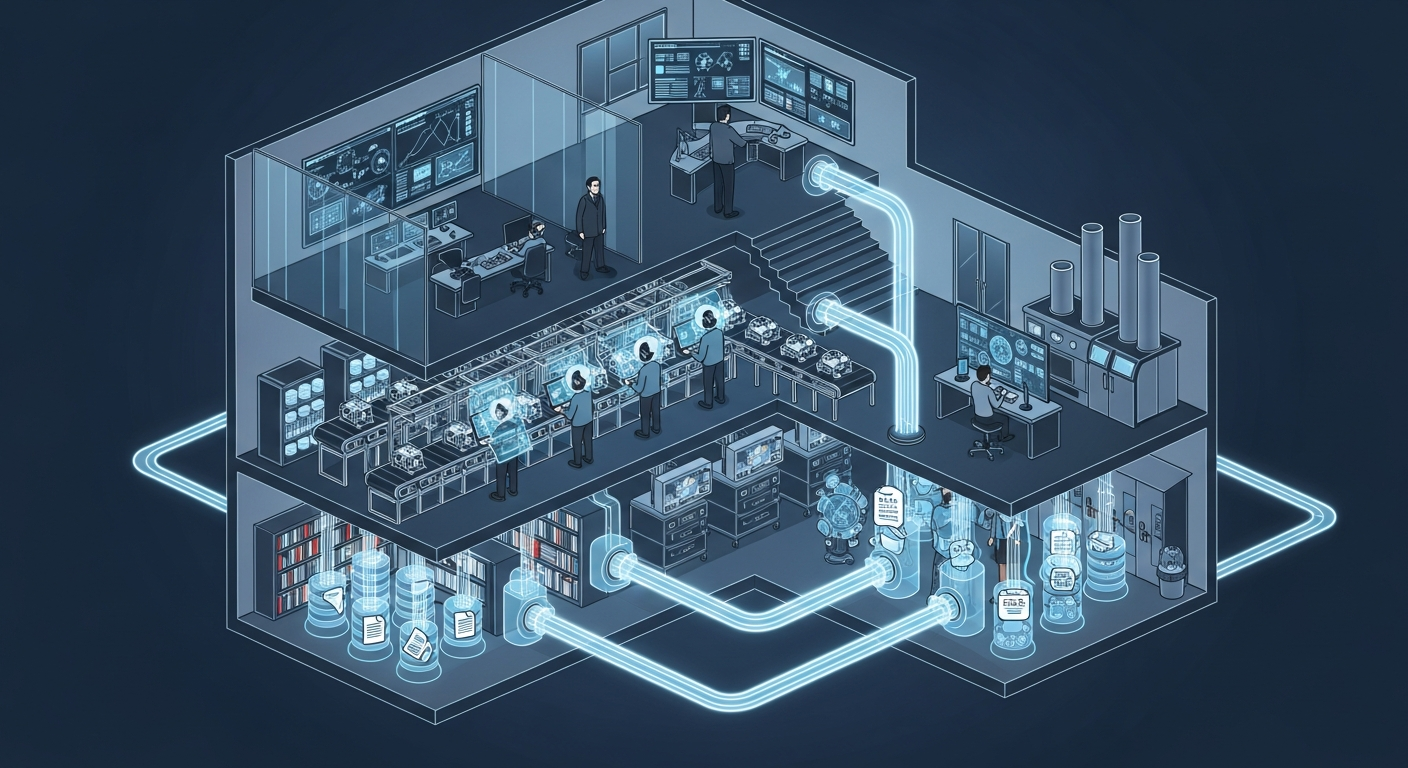
공장의 뇌는 어떻게 생겼는가 — 제조운영 AI 아키텍처 해부
지식관리, 업무자동화, 의사결정지원 — 따로 보면 다 있던 것들입니다. 제조 AI의 진짜 차이는 이 셋이 순환하면서 '우리 공장만의 지능'을 만든다는 데 있습니다.
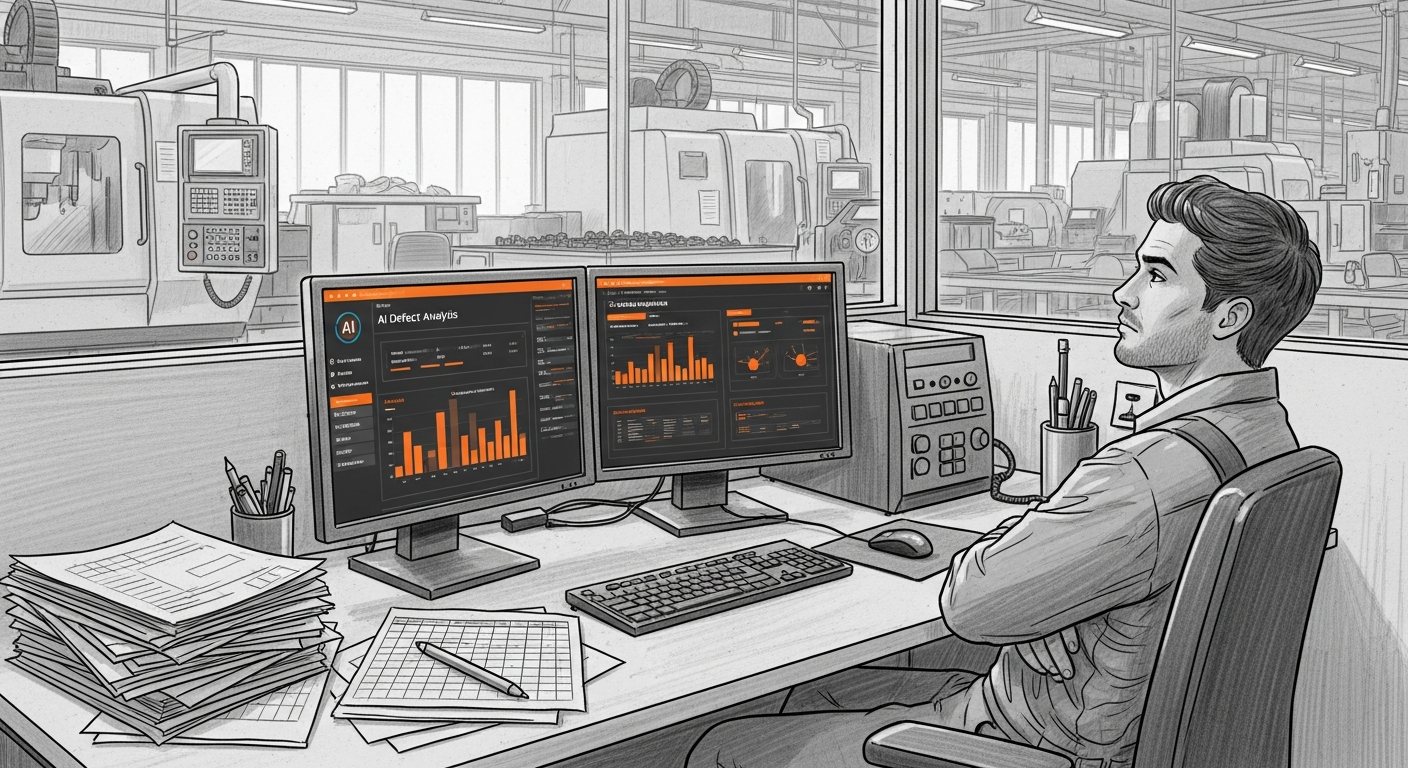
그 30분을 18년 동안 매일 반복했습니다 — 품질팀장이 본 AI Agent
18년차 품질팀장이 매일 아침 30분씩 반복하던 데이터 분석을 AI Agent가 3분 만에 해냈습니다. 챗봇과는 완전히 다른 물건 — 직접 시스템에 접근해서 데이터를 꺼내고 분석하는 AI의 현장 도입기.
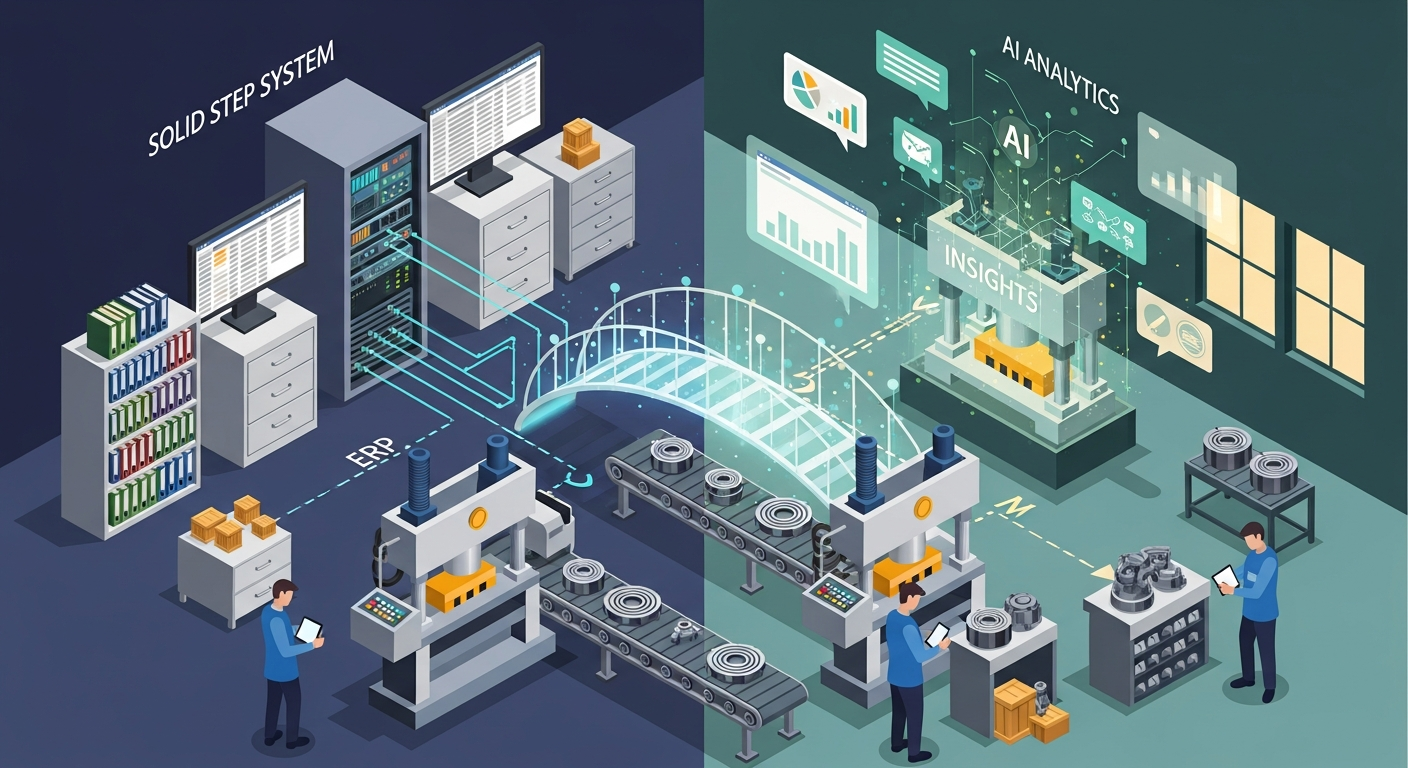
ERP 20년, 나는 왜 AI를 얹기로 했나
ERP 20년차 제조IT본부장의 고백: 3,200만 행의 데이터가 잠들어 있었다. ERP를 바꾸지 않고 AI를 얹자, 일주일 걸리던 불량 분석이 수 초로 줄었다.
Want to apply this in your factory?
MOAI helps manufacturing companies adopt AI tailored to their operations.
Talk to us →