Geoffrey Hinton
{{Short description|British-Canadian computer scientist (born 1947)}} {{Use British English|date=February 2023}} {{Use dmy dates|date=October 2024}} {{CS1 config|mode=cs1}} {{Infobox scientist | name = Geoffrey Hinton | honorific_suffix = {{post-nominals|country=CAN|CC|FRS|FRSC|size=100%}} | image = Geoffrey E. Hinton, 2024 Nobel Prize Laureate in Physics (cropped1).jpg | caption = Hinton giving [[Nobel lecture]] in 2024 | birth_name = Geoffrey Everest Hinton | birth_date = {{birth date and age|df=y|1947|12|6}} | birth_place = [[London]], [[England]], UK | death_date = | death_place = | education = {{ubl |[[King's College, Cambridge]] ([[Bachelor of Arts|BA]]) |[[University of Edinburgh]] ([[Doctor of Philosophy|PhD]])}} | known_for = {{Plainlist|
- Applications of [[backpropagation]]
- [[Boltzmann machine]]
- [[Restricted Boltzmann machine]]
- [[Deep learning]]
- [[Deep belief network]]
- [[Knowledge distillation]] ("Dark knowledge")
- [[Capsule neural network]]s
- [[Mixture of experts]]
- [[Product of experts]]
- [[Time delay neural network]]
- [[t-SNE]]
- [[AlexNet]]
- [[Dilution (neural networks)|Dropout]]}} | spouse = {{ubl |Joanne |{{marriage|Rosalind Zalin||1994|end=died}} |{{marriage|Jacqueline Ford|1997|2018|end=died}}}} | father = [[H. E. Hinton]] | relatives = {{hlist |[[Colin Clark (economist)|Colin Clark]] (uncle) |[[George Boole]] (great-great-grandfather) |[[Mary Everest Boole]] (great-great-grandmother) |[[George Everest]] (great-great-granduncle) |[[Joan Hinton]] (cousin)}} | awards = {{Plainlist|
- [[Rumelhart Prize]] (2001)
- [[Turing Award]] (2018)
- [[Dickson Prize]] (2021)
- [[Princess of Asturias Award]] (2022)
- [[Nobel Prize in Physics]] (2024)
- [[VinFuture Prize]] (2024)
- [[Queen Elizabeth Prize for Engineering]] (2025)
- [[Sandford Fleming Medal]] (2025)}} | fields = {{Plainlist|
- [[Machine learning]]
- [[Psychology]]
- [[Artificial intelligence]]
- [[Cognitive science]]
- [[Computer science]]}} | workplaces = {{Plainlist|
- [[University of Toronto]]
- [[Google]]
- [[Carnegie Mellon University]]
- [[University College London]]
- [[University of California, San Diego]]}} | doctoral_advisor = [[Christopher Longuet-Higgins]] | academic_advisors = | doctoral_students = {{Flatlist|
- [[Richard Zemel]]
- [[Brendan Frey]]
- [[Radford M. Neal]]
- [[Yee Whye Teh]]
- [[Ruslan Salakhutdinov]]
- [[Ilya Sutskever]]
- [[Alex Krizhevsky]]
- [[Peter Fitzhugh Brown|Peter Brown]]}} | notable_students = {{Flatlist|
- [[Yann LeCun]]
- [[Peter Dayan]]
- [[Max Welling]]
- [[Zoubin Ghahramani]]
- [[Alex Graves (computer scientist)|Alex Graves]]}} | thesis_title = Relaxation and Its Role in Vision | thesis_year = 1977 | thesis_url = http://hdl.handle.net/1842/8121 | website = {{URL|https://www.cs.toronto.edu/~hinton/|Official website}} }} '''Geoffrey Everest Hinton''' (born 6 December 1947) is a British-Canadian [[computer scientist]], [[cognitive science|cognitive scientist]], [[cognitive psychology|cognitive psychologist]] and [[Nobel Prize in Physics|Nobel Prize]] laureate known for his work on [[artificial neural networks]], which earned him the title "the Godfather of AI". He is University Professor Emeritus at the [[University of Toronto]].
From 2013 to 2023, he divided his time working for [[Google Brain]] and the University of Toronto before publicly announcing his departure from Google in May 2023, citing concerns about the many risks of [[artificial intelligence]] (AI) technology.{{Cite web |last=Douglas Heaven |first=Will |date=1 May 2023 |title=Deep learning pioneer Geoffrey Hinton quits Google |url=https://www.technologyreview.com/2023/05/01/1072478/deep-learning-pioneer-geoffrey-hinton-quits-google/ |url-status=live |archive-url=https://web.archive.org/web/20230501125621/https://www.technologyreview.com/2023/05/01/1072478/deep-learning-pioneer-geoffrey-hinton-quits-google/ |archive-date=1 May 2023 |access-date=1 May 2023 |website=[[MIT Technology Review]] |language=en-US}}{{cite news |last1=Taylor |first1=Josh |last2=Hern |first2=Alex |title='Godfather of AI' Geoffrey Hinton quits Google and warns over dangers of misinformation |url=https://www.theguardian.com/technology/2023/may/02/geoffrey-hinton-godfather-of-ai-quits-google-warns-dangers-of-machine-learning |access-date=8 October 2024 |work=The Guardian |date=2 May 2023}} In 2017, he co-founded and became the chief scientific advisor of the [[Vector Institute (Canada)|Vector Institute]] in Toronto.{{cite journal |last=Hernandez |first=Daniela |date=7 May 2013 |title=The Man Behind the Google Brain: Andrew Ng and the Quest for the New AI |url=https://www.wired.com/wiredenterprise/2013/05/neuro-artificial-intelligence/all/ |url-status=live |journal=[[Wired (website)|Wired]] |language=en-US |archive-url=https://web.archive.org/web/20140208231937/http://www.wired.com/wiredenterprise/2013/05/neuro-artificial-intelligence/all/ |archive-date=8 February 2014 |access-date=10 May 2013}}{{cite web |title=Geoffrey E. Hinton – Google AI |url=https://ai.google/research/people/GeoffreyHinton |url-status=live |archive-url=https://web.archive.org/web/20191109185858/https://ai.google/research/people/GeoffreyHinton/ |archive-date=9 November 2019 |access-date=15 June 2018 |website=Google AI |language=en-US}}
With [[David Rumelhart]] and [[Ronald J. Williams]], Hinton was co-author of a highly cited paper published in 1986 that popularised the [[backpropagation]] algorithm for training multi-layer neural networks,{{Cite journal |last1=Rumelhart |first1=David E. |last2=Hinton |first2=Geoffrey E. |last3=Williams |first3=Ronald J. |date=9 October 1986 |title=Learning representations by back-propagating errors |journal=[[Nature (journal)|Nature]] |language=en-US |volume=323 |issue=6088 |pages=533–536 |bibcode=1986Natur.323..533R |doi=10.1038/323533a0 |issn=1476-4687 |s2cid=205001834}} although they were not the first to propose the approach.{{Cite journal |last1=Schmidhuber |first1=Jürgen |author-link=Jürgen Schmidhuber |date=1 January 2015 |title=Deep learning in neural networks: An overview |journal=[[Neural Networks (journal)|Neural Networks]] |language=en-US |volume=61 |pages=85–117 |arxiv=1404.7828 |bibcode=2015NN.....61...85S |doi=10.1016/j.neunet.2014.09.003 |pmid=25462637 |s2cid=11715509}} Hinton is viewed as a leading figure in the [[deep learning]] community.{{refn|{{Cite web |last=Mannes |first=John |date=14 September 2017 |title=Geoffrey Hinton was briefly a Google intern in 2012 because of bureaucracy – TechCrunch |url=https://techcrunch.com/2017/09/14/geoffrey-hinton-was-briefly-a-google-intern-in-2012-because-of-bureaucracy/ |access-date=28 March 2018 |website=[[TechCrunch]] |language=en-US |archive-date=17 March 2020 |archive-url=https://web.archive.org/web/20200317122459/https://techcrunch.com/2017/09/14/geoffrey-hinton-was-briefly-a-google-intern-in-2012-because-of-bureaucracy/ |url-status=live }}{{Cite news |last=Somers |first=James |date=29 September 2017 |title=Progress in AI seems like it's accelerating, but here's why it could be plateauing |language=en-US |work=[[MIT Technology Review]] |url=https://www.technologyreview.com/s/608911/is-ai-riding-a-one-trick-pony/ |url-status=live |access-date=28 March 2018 |archive-url=https://web.archive.org/web/20180520005817/https://www.technologyreview.com/s/608911/is-ai-riding-a-one-trick-pony/ |archive-date=20 May 2018}}{{Cite web |last=Sorensen |first=Chris |date=2 November 2017 |title=How U of T's 'godfather' of deep learning is reimagining AI |url=https://www.utoronto.ca/news/how-u-t-s-godfather-deep-learning-reimagining-ai |url-status=live |archive-url=https://web.archive.org/web/20190406190804/https://www.utoronto.ca/news/how-u-t-s-godfather-deep-learning-reimagining-ai |archive-date=6 April 2019 |access-date=28 March 2018 |website=University of Toronto News |language=en-US}}{{Cite news |last=Sorensen |first=Chris |date=3 November 2017 |title='Godfather' of deep learning is reimagining AI |language=en-US |work=[[Phys.org]] |url=https://phys.org/news/2017-11-godfather-deep-reimagining-ai.html |url-status=live |access-date=28 March 2018 |archive-url=https://web.archive.org/web/20190413185347/https://phys.org/news/2017-11-godfather-deep-reimagining-ai.html |archive-date=13 April 2019}}{{Cite news |last=Lee |first=Adrian |date=18 March 2016 |title=Geoffrey Hinton, the 'godfather' of deep learning, on AlphaGo |language=en-US |work=[[Maclean's]] |url=http://www.macleans.ca/society/science/the-meaning-of-alphago-the-ai-program-that-beat-a-go-champ/ |access-date=28 March 2018 |archive-date=6 March 2020 |archive-url=https://web.archive.org/web/20200306045825/https://www.macleans.ca/society/science/the-meaning-of-alphago-the-ai-program-that-beat-a-go-champ/ |url-status=live }}}} The image-recognition milestone of the [[AlexNet]] designed in collaboration with his students [[Alex Krizhevsky]]{{cite web |last=Gershgorn |first=Dave |date=18 June 2018 |title=The inside story of how AI got good enough to dominate Silicon Valley |url=https://qz.com/1307091/the-inside-story-of-how-ai-got-good-enough-to-dominate-silicon-valley/ |url-status=live |archive-url=https://web.archive.org/web/20191212224842/https://qz.com/1307091/the-inside-story-of-how-ai-got-good-enough-to-dominate-silicon-valley/ |archive-date=12 December 2019 |access-date=5 October 2018 |website=[[Quartz (website)|Quartz]] |language=en-US}} and [[Ilya Sutskever]] for the [[ImageNet challenge]] 2012{{Cite conference |last1=Krizhevsky |first1=Alex |last2=Sutskever |first2=Ilya |author-link2=Ilya Sutskever |last3=Hinton |first3=Geoffrey E. |date=3 December 2012 |title=ImageNet classification with deep convolutional neural networks |editor=F. Pereira |editor2=C. J. C. Burges |editor3=L. Bottou |editor4=K. Q. Weinberger |book-title=NIPS'12: Proceedings of the 25th International Conference on Neural Information Processing Systems |volume=1 |url=http://dl.acm.org/citation.cfm?id=2999134.2999257 |url-status=live |publisher=Curran Associates |pages=1097–1105 |archive-url=https://web.archive.org/web/20191220014019/https://dl.acm.org/citation.cfm?id=2999134.2999257 |archive-date=20 December 2019 |access-date=13 March 2018}} was a breakthrough in the field of computer vision.{{Cite news |last=Allen |first=Kate |date=17 April 2015 |title=How a Toronto professor's research revolutionized artificial intelligence |language=en |work=[[Toronto Star]] |url=https://www.thestar.com/news/world/2015/04/17/how-a-toronto-professors-research-revolutionized-artificial-intelligence.html |access-date=13 March 2018 |archive-date=17 April 2015 |archive-url=https://web.archive.org/web/20150417192718/http://www.thestar.com/news/world/2015/04/17/how-a-toronto-professors-research-revolutionized-artificial-intelligence.html |url-status=live }}
Hinton received the 2018 [[Turing Award]], together with [[Yoshua Bengio]] and [[Yann LeCun]] for their work on deep learning.{{Cite news |last1=Chung |first1=Emily |date=27 March 2019 |title=Canadian researchers who taught AI to learn like humans win $1M award |url=https://www.cbc.ca/news/technology/turing-award-ai-deep-learning-1.5070415 |access-date=27 March 2019 |work=[[Canadian Broadcasting Corporation]] |language=en |archive-date=26 February 2020 |archive-url=https://web.archive.org/web/20200226061533/https://www.cbc.ca/news/technology/turing-award-ai-deep-learning-1.5070415 |url-status=live }} They are sometimes referred to as the "Godfathers of Deep Learning"{{Cite web|last=Ranosa|first=Ted|date=29 March 2019|title=Godfathers of AI Win this Year's Turing Award And $1 Million|url=https://www.techtimes.com/articles/240511/20190329/godfathers-of-ai-win-this-years-turing-award-and-1-million.htm|access-date=5 November 2020|website=Tech Times|language=en|archive-date=30 March 2019|archive-url=https://web.archive.org/web/20190330154545/https://www.techtimes.com/articles/240511/20190329/godfathers-of-ai-win-this-years-turing-award-and-1-million.htm|url-status=live}}{{Cite web |last=Shead |first=Sam |date=27 March 2019 |title=The 3 'Godfathers' of AI Have Won the Prestigious $1M Turing Prize |url=https://www.forbes.com/sites/samshead/2019/03/27/the-3-godfathers-of-ai-have-won-the-prestigious-1m-turing-prize/ |access-date=5 November 2020 |website=[[Forbes]] |language=en |archive-date=14 April 2020 |archive-url=https://web.archive.org/web/20200414050852/https://www.forbes.com/sites/samshead/2019/03/27/the-3-godfathers-of-ai-have-won-the-prestigious-1m-turing-prize/ |url-status=live }} and have continued to give public talks together.{{Cite web |last=Ray |first=Tiernan |date=9 March 2021 |title=Nvidia's GTC will feature deep learning cabal of LeCun, Hinton, and Bengio |url=https://www.zdnet.com/article/nvidias-gtc-will-feature-deep-learning-cabal-of-lecun-hinton-bengio/ |access-date=7 April 2021 |website=[[ZDNet]] |language=en |archive-date=19 March 2021 |archive-url=https://web.archive.org/web/20210319073448/https://www.zdnet.com/article/nvidias-gtc-will-feature-deep-learning-cabal-of-lecun-hinton-bengio/ |url-status=live }}{{cite web |date=18 November 2020 |title=50 Years at CMU: The Inaugural Raj Reddy Artificial Intelligence Lecture |url=https://www.cs.cmu.edu/events/raj-reddy-50 |access-date=2 March 2022 |website=Carnegie Mellon University |archive-date=2 March 2022 |archive-url=https://web.archive.org/web/20220302222721/https://www.cs.cmu.edu/events/raj-reddy-50 |url-status=live }} He was also awarded, along with [[John Hopfield]], the 2024 [[Nobel Prize in Physics]] for "foundational discoveries and inventions that enable [[machine learning]] with artificial neural networks".{{Cite web |title=Press release: The Nobel Prize in Physics 2024 |url=https://www.nobelprize.org/prizes/physics/2024/press-release/ |access-date=8 October 2024 |website=NobelPrize.org |language=en-US}}{{cite news |title=Geoffrey Hinton from University of Toronto awarded Nobel Prize in Physics |url=https://www.cbc.ca/news/science/nobel-prize-physics-2024-1.7344607 |access-date=8 October 2024 |agency=The Associated Press |publisher=CBC News |date=8 October 2024}}
In May 2023, Hinton announced his resignation from Google to be able to "freely speak out about the risks of A.I."{{Cite news |last=Metz |first=Cade |date=1 May 2023 |title='The Godfather of A.I.' Leaves Google and Warns of Danger Ahead |url=https://www.nytimes.com/2023/05/01/technology/ai-google-chatbot-engineer-quits-hinton.html |url-access=subscription |url-status=live |archive-url=https://web.archive.org/web/20230501153311/https://www.nytimes.com/2023/05/01/technology/ai-google-chatbot-engineer-quits-hinton.html |archive-date=1 May 2023 |access-date=1 May 2023 |work=[[The New York Times]] |language=en-US |issn=0362-4331}} He has voiced concerns about [[AI safety#Detecting malicious use|deliberate misuse by malicious actors]], [[Technological unemployment#Artificial intelligence|technological unemployment]], and [[existential risk from artificial general intelligence]].{{Cite episode | people=Jacobson, Dana (host); Silva-Braga, Brook (reporter); Frosst, Nick; Hinton, Geoffrey (guests) | date=25 March 2023 | title='Godfather of artificial intelligence' talks impact and potential of new AI | series=[[CBS Saturday Morning]] | season=12 | number=12 |url=https://www.cbsnews.com/video/godfather-of-artificial-intelligence-talks-impact-and-potential-of-new-ai/ | access-date=28 March 2023 | publication-place=New York City | publisher=CBS News | archive-date=28 March 2023 | archive-url=https://web.archive.org/web/20230328225221/https://www.cbsnews.com/video/godfather-of-artificial-intelligence-talks-impact-and-potential-of-new-ai/ | url-status=live | ref={{sfnref|Jacobson|Silva-Braga|2023}}}} He noted that establishing safety guidelines will require cooperation among those competing in use of AI in order to avoid the worst outcomes.{{Cite web |last=Erlichman |first=Jon |date=2024-06-14 |title='50-50 chance' that AI outsmarts humanity, Geoffrey Hinton says |url=https://www.bnnbloomberg.ca/business/economics/2024/06/14/50-50-chance-that-ai-outsmarts-humanity-geoffrey-hinton-says/ |access-date=2024-10-11 |website=BNN Bloomberg |language=en}} After receiving the Nobel Prize, he called for urgent research into [[AI safety]] to figure out how to control [[AI superintelligence|AI systems smarter than humans]].{{Cite web |last=Hetzner |first=Christiaan |title=New Nobel Prize winner, AI godfather Geoffrey Hinton, says he's proud his student fired OpenAI boss Sam Altman |url=https://fortune.com/2024/10/09/openai-sam-altman-geoffrey-hinton-nobel-prize-physics-ilya-sutskever-toronto/ |access-date=2024-10-11 |website=Fortune |language=en}}{{Cite web |last=Coates |first=Jessica |date=2024-10-09 |title=Geoffrey Hinton warns of AI's growing danger after Nobel Prize win |url=https://www.independent.co.uk/news/science/nobel-prize-university-of-toronto-british-nobel-prize-in-physics-google-b2626208.html |access-date=2024-10-11 |website=The Independent |language=en}}{{cite web |title=Geoffrey Hinton – Facts – 2024 |url=https://www.nobelprize.org/prizes/physics/2024/hinton/facts/ |website=NobelPrize.org |publisher=Nobel Prize Outreach AB |access-date=2024-12-24}}
== Education == Hinton was born on 6 December 1947{{Who's Who | year=2023|title=Hinton, Prof. Geoffrey Everest | id = U20261 | edition = 176th|publisher= [[Oxford University Press]]|author=|doi=10.1093/ww/9780199540884.013.20261}} in [[Wimbledon, London|Wimbledon]], England, and was educated at [[Clifton College]] in Bristol.{{Cite web |last=Onstad |first=Katrina |date=29 January 2018 |title=Mr. Robot |url=https://torontolife.com/life/ai-superstars-google-facebook-apple-studied-guy/ |access-date=24 December 2023 |website=Toronto Life |language=en-US}} In 1967, he matriculated as an undergraduate student at [[King's College, Cambridge]], and after repeatedly switching between different fields, like [[Natural Sciences (Cambridge)|natural sciences]], [[history of art]], and [[philosophy]], eventually graduated with a [[Bachelor of Arts]] degree in [[experimental psychology]] at the [[University of Cambridge]] in 1970.[https://www.cs.toronto.edu/~hinton/shortcv.pdf Curriculum Vitae Geoffrey E. Hinton] - website of the Department of Computer Science at the University of Toronto He spent a year apprenticing [[carpentry]] before returning to academic studies. From 1972 to 1975, he continued his study at the [[University of Edinburgh]], where he was awarded a [[Doctor of Philosophy|PhD]] in [[artificial intelligence]] in 1978 for research supervised by [[H. Christopher Longuet-Higgins|Christopher Longuet-Higgins]], who favored the [[Symbolic artificial intelligence|symbolic AI]] approach over the neural network approach.{{MathGenealogy|id=50071}}{{cite thesis |degree=PhD |website=Edinburgh Research Archive |publisher=University of Edinburgh |title=Relaxation and its role in vision |first=Geoffrey Everest |last=Hinton |url=https://era.ed.ac.uk/handle/1842/8121 |year=1977 |id={{EThOS|uk.bl.ethos.482889}} |oclc=18656113 |hdl=1842/8121 |access-date=30 March 2023 |archive-date=30 March 2023 |archive-url=https://web.archive.org/web/20230330050513/https://era.ed.ac.uk/handle/1842/8121 |url-status=live }} {{free access}}
== Career == After his PhD, Hinton initially worked at the [[University of Sussex]] and at the [[MRC Cognition and Brain Sciences Unit|MRC Applied Psychology Unit]]. After having difficulty getting funding in Britain, he worked in the US at the [[University of California, San Diego]] and [[Carnegie Mellon University]]. He was the founding director of the [[Gatsby Charitable Foundation]] Computational Neuroscience Unit at [[University College London]]. He {{as of |2001|alt=is currently}}{{Cite web |last=Hinton |first=Geoffrey E. |date=6 January 2020 |title=Curriculum Vitae |url=https://www.cs.toronto.edu/~hinton/fullcv.pdf |website=University of Toronto: Department of Computer Science |access-date=30 November 2016 |archive-date=23 July 2020 |archive-url=https://web.archive.org/web/20200723234128/http://www.cs.toronto.edu/~hinton/fullcv.pdf |url-status=live }} [[University Professor]] [[Emeritus]] in the [[University of Toronto Department of Computer Science|Department of Computer Science]] at the [[University of Toronto]], where he has been affiliated since 1987.{{Cite web |title=University of Toronto |url=https://discover.research.utoronto.ca/26059-geoffrey-e-hinton |access-date=9 October 2024 |website=discover.research.utoronto.ca}}
Upon arrival in Canada, Geoffrey Hinton was appointed at the [[Canadian Institute for Advanced Research]] (CIFAR) in 1987 as a Fellow in CIFAR's first research program, Artificial Intelligence, Robotics & Society.{{Cite web |title=How Canada has emerged as a leader in artificial intelligence |url=https://universityaffairs.ca/features/feature-article/canada-emerged-leader-artificial-intelligence/ |access-date=9 October 2024 |website=University Affairs |date=6 December 2017 |language=en-US}} In 2004, Hinton and collaborators successfully proposed the launch of a new program at CIFAR, "Neural Computation and Adaptive Perception"{{Cite web |title=Geoffrey Hinton Biography |url=https://cifar.ca/bios/geoffrey-hinton/ |access-date=8 October 2024 |website=CIFAR}} (NCAP), which today is named "Learning in Machines & Brains". Hinton would go on to lead NCAP for ten years.{{Cite web |title=Geoffrey E Hinton - A.M. Turing Award Laureate |url=https://amturing.acm.org/award_winners/hinton_4791679.cfm |access-date=9 October 2024 |website=amturing.acm.org}} Among the members of the program are [[Yoshua Bengio]] and [[Yann LeCun]], with whom Hinton would go on to win the [[Turing Award|ACM A.M. Turing Award]] in 2018.{{Cite web |title=2018 ACM A.M. Turing Award Laureates |url=https://awards.acm.org/about/2018-turing |access-date=9 October 2024 |website=awards.acm.org |language=en}} All three Turing winners continue to be members of the CIFAR Learning in Machines & Brains program.{{Cite web |title=CIFAR - Learning in Machines & Brains |url=https://cifar.ca/research-programs/learning-in-machines-brains/ |access-date=8 October 2024 |website=CIFAR}}
Hinton taught a free online course on Neural Networks on the education platform [[Coursera]] in 2012.{{Cite web |title=Neural Networks for Machine Learning |url=https://www.coursera.org/learn/neural-networks |archive-url=https://web.archive.org/web/20161231174321/https://www.coursera.org/learn/neural-networks |archive-date=31 December 2016 |access-date=30 December 2016 |website=University of Toronto}} He co-founded DNNresearch Inc. in 2012 with his two graduate students, Alex Krizhevsky and Ilya Sutskever, at the University of Toronto's department of computer science. In March 2013, Google acquired DNNresearch Inc. for $44 million, and Hinton planned to "divide his time between his university research and his work at Google".{{cite press release |title=U of T neural networks start-up acquired by Google |date=12 March 2013 |location=Toronto, ON |url=http://media.utoronto.ca/media-releases/u-of-t-neural-networks-start-up-acquired-by-google/ |access-date=13 March 2013 |url-status=live |archive-url=https://web.archive.org/web/20191008004030/https://media.utoronto.ca/media-releases/u-of-t-neural-networks-start-up-acquired-by-google/ |archive-date=8 October 2019}}{{Cite web |last=Kelly |first=Meghan |date=2013-03-12 |title=Google acquires voice and image research firm DNNresearch |url=https://venturebeat.com/big-data/google-dnnresearch/ |access-date=2024-12-29 |website=VentureBeat |language=en-US}}{{Cite web |last=Taylor |first=Chloe |title='The Godfather of A.I.' warns of 'nightmare scenario' where artificial intelligence begins to seek power |url=https://fortune.com/2023/05/02/godfather-ai-geoff-hinton-google-warns-artificial-intelligence-nightmare-scenario/ |access-date=2025-07-09 |website=Fortune |language=en}}
In May 2023, Hinton publicly announced his resignation from Google. He explained his decision, saying he wanted to "freely speak out about the risks of A.I." and added that part of him now regrets his life's work.
Notable former PhD students and [[postdoctoral research]]ers from his group include [[Peter Dayan]],{{cite web |author=Geoffrey Hinton |title=Geoffrey Hinton's postdocs |url=http://www.cs.toronto.edu/~hinton/postdocs.html |url-status=live |archive-url=https://web.archive.org/web/20201029090920/http://www.cs.toronto.edu/~hinton/postdocs.html |archive-date=29 October 2020 |access-date=11 September 2020 |website=University of Toronto}} Sam Roweis, [[Max Welling]], [[Richard Zemel]], [[Brendan Frey]], [[Radford M. Neal]], [[Yee Whye Teh]], [[Ruslan Salakhutdinov]], [[Ilya Sutskever]], [[Yann LeCun]],{{Cite web |title=Yann LeCun's Research and Contributions |url=http://yann.lecun.com/ex/research/index.html |url-status=live |archive-url=https://web.archive.org/web/20180303025413/http://yann.lecun.com/ex/research/index.html |archive-date=3 March 2018 |access-date=13 March 2018 |website=yann.lecun.com}} [[Alex Graves (computer scientist)|Alex Graves]], [[Zoubin Ghahramani]], and [[Peter Fitzhugh Brown]].{{Cite web |title=A conversation with Renaissance Technologies CEO Peter Brown |url=https://www.goldmansachs.com/insights/goldman-sachs-exchanges/09-11-2023-peter-brown.html |access-date=21 October 2024 |website=goldmansachs.com}}
== Research == Hinton's research concerns the use of neural networks for [[machine learning]], [[memory]], [[perception]], and symbol processing. He has written or co-written more than 200 [[peer review|peer-review]]ed publications.{{Google scholar id}}{{Scopus id}}
In the 1980s, Hinton was part of the "Parallel Distributed Processing" group at Carnegie Mellon University, which included notable scientists like [[Terrence Sejnowski]], [[Francis Crick]], [[David Rumelhart]], and [[James McClelland (psychologist)|James McClelland]]. This group favoured the [[Connectionism|connectionist]] approach during the [[AI winter]]. Their findings were published in a two-volume set.{{cite book |url=https://mitpress.mit.edu/9780262680530/parallel-distributed-processing-volume-1/ |title=Parallel Distributed Processing: Explorations in the Microstructure of Cognition: Foundations |date=29 July 1987 |publisher=MIT Press |isbn=978-0-262-68053-0 |volume=1}}{{cite book |url=https://mitpress.mit.edu/9780262631105/parallel-distributed-processing-volume-2/ |title=Parallel Distributed Processing: Explorations in the Microstructure of Cognition: Psychological and Biological Models |date=29 July 1987 |publisher=MIT Press |isbn=978-0-262-63110-5 |volume=2}} The connectionist approach adopted by Hinton suggests that capabilities in areas like logic and grammar can be encoded into the parameters of neural networks, and that neural networks can learn them from data. [[Symbolic artificial intelligence|Symbolists]] on the other side advocated for explicitly programming [[Knowledge representation and reasoning|knowledge]] and [[Rule-based system|rules]] into AI systems.
In 1985, Hinton co-invented [[Boltzmann machine]]s with David Ackley and Terry Sejnowski.Ackley, David H; Hinton Geoffrey E; Sejnowski, Terrence J (1985), "A learning algorithm for Boltzmann machines", Cognitive science, Elsevier, 9 (1): 147–169 His other contributions to neural network research include [[distributed representation]]s, [[time delay neural network]], [[Mixture of experts|mixtures of experts]], [[Helmholtz machines]] and [[product of experts]].{{cite web |last=Hinton |first=Geoffrey E. |title=Geoffrey E. Hinton's Publications in Reverse Chronological Order |url=http://www.cs.toronto.edu/~hinton/papers.html |url-status=live |archive-url=https://web.archive.org/web/20200418123425/http://www.cs.toronto.edu/~hinton/papers.html |archive-date=18 April 2020 |access-date=15 September 2010}} An accessible introduction to Geoffrey Hinton's research can be found in his articles in ''[[Scientific American]]'' in September 1992 and October 1993.{{cite web| url = https://www.scientificamerican.com/author/geoffrey-e-hinton/| title = Stories by Geoffrey E. Hinton in Scientific American| website = [[Scientific American]]| access-date = 17 October 2019| archive-date = 17 October 2019| archive-url = https://web.archive.org/web/20191017230552/https://www.scientificamerican.com/author/geoffrey-e-hinton/| url-status = live}} In 1995, Hinton and colleagues proposed the wake-sleep algorithm, involving a neural network with separate pathways for recognition and generation, being trained with alternating "wake" and "sleep" phases.{{Cite journal |last1=Hinton |first1=Geoffrey |last2=Dayan |first2=Peter |last3=Frey |first3=Brendan |last4=Neal |first4=Radford |date=1995-04-03 |title=The wake-sleep algorithm for unsupervised neural networks |url=https://www.cs.toronto.edu/~hinton/absps/ws.pdf |journal=[[Science (journal)|Science]] |doi=10.1126/science.7761831 }} In 2007, Hinton coauthored an [[unsupervised learning]] paper titled ''Unsupervised learning of image transformations''.{{Cite journal |last1=Memisevic |first1=Roland |last2=Hinton |first2=Geoffrey |date=2006 |title=Unsupervised Learning of Image Transformations |url=http://www.cs.toronto.edu/~rfm/pubs/gbmTR.pdf |journal=IEEE CVPR}} In 2008, he developed the visualization method [[t-SNE]] with Laurens van der Maaten.{{Cite web |title=An Introduction to t-SNE with Python Example |url=https://www.kdnuggets.com/an-introduction-to-t-sne-with-python-example |access-date=22 June 2024 |website=KDNuggets |language=en-US}}{{Cite journal |last1=van der Maaten |first1=Laurens |last2=Hinton |first2=Geoffrey |date=2008 |title=Visualizing Data using t-SNE |url=https://www.jmlr.org/papers/volume9/vandermaaten08a/vandermaaten08a.pdf |journal=Journal of Machine Learning Research}}[[File:Deep Thinkers on Deep Learning.jpg|thumb|upright=1.2|In 2016, from left to right,[[Russ Salakhutdinov]], [[Richard S. Sutton]], Geoffrey Hinton, [[Yoshua Bengio]], and [[Steve Jurvetson]]]]While Hinton was a postdoc at UC San Diego, David Rumelhart, Hinton and [[Ronald J. Williams]] applied the [[Backpropagation|backpropagation algorithm]] to multi-layer neural networks. Their experiments showed that such networks can learn useful [[Knowledge representation|internal representations]] of data. In a 2018 interview,{{cite book |last=Ford |first=Martin |title=Architects of Intelligence: The truth about AI from the people building it |date=2018 |publisher=Packt Publishing |isbn=978-1-78913-151-2}} Hinton said that "David Rumelhart came up with the basic idea of backpropagation, so it's his invention". Although this work was important in popularising backpropagation, it was not the first to suggest the approach. Reverse-mode [[automatic differentiation]], of which backpropagation is a special case, was proposed by [[Seppo Linnainmaa]] in 1970, and [[Paul Werbos]] proposed to use it to train neural networks in 1974.
In 2017, Hinton co-authored two [[open access|open-access]] research papers about [[capsule neural network]]s, extending the concept of "capsule" introduced by Hinton in 2011. The architecture aims to better model part-whole relationships within objects in visual data.{{Cite magazine |last=Simonite |first=Tom |title=Google's AI Wizard Unveils a New Twist on Neural Networks |url=https://www.wired.com/story/googles-ai-wizard-unveils-a-new-twist-on-neural-networks/ |access-date=2025-12-28 |magazine=Wired |language=en-US |issn=1059-1028}}{{Cite web |last=Geib |first=Claudia |date=11 February 2017 |title=We've finally created an AI network that's been decades in the making |url=https://futurism.com/weve-finally-created-an-ai-network-thats-been-decades-in-the-making |url-status=live |archive-url=https://web.archive.org/web/20171109022809/https://futurism.com/weve-finally-created-an-ai-network-thats-been-decades-in-the-making/ |archive-date=9 November 2017 |access-date=3 May 2023 |website=Futurism}} In 2021, Hinton presented GLOM, a speculative architecture idea also aiming to improve image understanding by modeling part-whole relationships in neural networks.{{Cite web |last= |first= |date=2021-04-16 |title=Geoffrey Hinton has a hunch about what's next for AI |url=https://www.technologyreview.com/2021/04/16/1021871/geoffrey-hinton-glom-godfather-ai-neural-networks/ |access-date=2025-12-28 |website=MIT Technology Review |language=en}} In 2021, Hinton co-authored a widely cited paper proposing a framework for [[contrastive learning]] in computer vision.{{Cite journal |last1=Chen |first1=Ting |last2=Kornblith |first2=Simon |last3=Norouzi |first3=Mohammad |last4=Hinton |first4=Geoffrey |date=2020-07-13 |title=A simple framework for contrastive learning of visual representations |url=https://dl.acm.org/doi/10.5555/3524938.3525087 |journal=ICML |series= |volume= 119|pages= 1597–1607|doi=}} The technique involves pulling together representations of [[Image augmentation|augmented]] versions of the same image, and pushing apart dissimilar representations.
At the 2022 [[Conference on Neural Information Processing Systems]] (NeurIPS), Hinton introduced a new learning algorithm for neural networks that he calls the "Forward-Forward" algorithm. The idea is to replace the traditional forward-backwards passes of backpropagation with two forward passes, one with positive (i.e. real) data and the other with negative data that could be generated solely by the network.{{cite arXiv |eprint=2212.13345 |class=cs.LG |first1=Geoffrey |last1=Hinton |title=The Forward-Forward Algorithm: Some Preliminary Investigations |year=2022}}{{Cite web |date=16 December 2022 |title=Hinton's Forward Forward Algorithm is the New Way Ahead for Neural Networks |url=https://analyticsindiamag.com/hintons-forward-forward-algorithm-is-the-new-way-ahead-for-neural-networks/ |access-date=22 June 2024 |website=Analytics India Magazine}} The Forward-Forward algorithm is well-suited for what Hinton calls "mortal computation", where the knowledge learned isn't transferable to other systems and thus dies with the hardware, as can be the case for certain [[analog computer]]s used for machine learning.{{cite arXiv |eprint=2212.13345 |class=cs.LG |first1=Geoffrey |last1=Hinton |title=The Forward-Forward Algorithm: Some Preliminary Investigations |date=2022}}
== Honours and awards == Hinton is a [[Fellow of the Association for the Advancement of Artificial Intelligence|Fellow of the US Association for the Advancement of Artificial Intelligence]] (FAAAI) since 1990.{{Cite web |title=Elected AAAI Fellows |url=https://aaai.org/about-aaai/aaai-awards/the-aaai-fellows-program/elected-aaai-fellows/#1990 |access-date= |website=AAAI |language=en-US}} He was elected a [[Fellow of the Royal Society of Canada]] (FRSC) in 1996,[https://rsc-src.ca/en/geoffrey-hinton-frsc-awarded-2024-nobel-prize-in-physics Geoffrey Hinton, FRSC, Awarded 2024 Nobel Prize in Physics] - website of the [[Royal Society of Canada]] and then a [[List of Fellows of the Royal Society elected in 1998|Fellow of the Royal Society of London (FRS) in 1998]].{{cite web|archive-url=https://web.archive.org/web/20151103005016/https://royalsociety.org/people/geoffrey-hinton-11624/ |archive-date=3 November 2015 |url=https://royalsociety.org/people/geoffrey-hinton-11624/ |title=Professor Geoffrey Hinton FRS |website=[[Royal Society]] |location=London |author= |year=1998 }} One or more of the preceding sentences incorporates text from the royalsociety.org website where: {{blockquote|"All text published under the heading 'Biography' on Fellow profile pages is available under [[Creative Commons license|Creative Commons Attribution 4.0 International License]]." --{{cite web|url=https://royalsociety.org/about-us/terms-conditions-policies/ |title=Royal Society Terms, conditions and policies |access-date=2016-03-09 |url-status=live |archive-url=https://web.archive.org/web/20161111170346/https://royalsociety.org/about-us/terms-conditions-policies/ |archive-date=11 November 2016 }}}} He was the first winner of the [[Rumelhart Prize]] in 2001.{{cite web |title=Current and Previous Recipients |url=http://rumelhartprize.org/?page_id=12 |archive-url=https://web.archive.org/web/20170302000053/http://rumelhartprize.org/?page_id=12 |archive-date=2 March 2017 |website=The David E. Rumelhart Prize}} According to the Royal Society: {{centered pull quote|Geoffrey Hinton is distinguished for his work on artificial neural nets, especially how they can be designed to learn without the aid of a human teacher. This may well be the start of autonomous intelligent brain-like machines. He has compared effects of brain damage with effects of losses in such a net, and found striking similarities with human impairment, such as for recognition of names and losses of categorisation. His work includes studies of mental imagery, and inventing puzzles for testing originality and creative intelligence.{{Cite web |title=Professor Geoffrey Hinton FRS |url=https://royalsociety.org/people/geoffrey-hinton-11624/ |access-date=2026-01-02 |website=The Royal Society |language=en}} }}
In 2001, Hinton was awarded an honorary [[Doctor of Science]] (DSc) degree from the [[University of Edinburgh]].{{cite news |date=2 April 2019 |title=Distinguished Edinburgh graduate receives ACM A.M. Turing Award |newspaper=The University of Edinburgh |url=https://www.ed.ac.uk/informatics/news-events/stories/2019/distinguished-edinburgh-graduate-receives-acm-tur |access-date=9 April 2019 |archive-date=14 July 2019 |archive-url=https://web.archive.org/web/20190714210622/https://www.ed.ac.uk/informatics/news-events/stories/2019/distinguished-edinburgh-graduate-receives-acm-tur |url-status=live }} He was awarded as [[American Academy of Arts and Sciences|International Honorary Member of the American Academy of Arts and Sciences]] in 2003.{{Cite web |date= 26 April 2025|title=Geoffrey E. Hinton |url=https://www.amacad.org/person/geoffrey-e-hinton |access-date= |website=American Academy of Arts and Sciences |language=en}} Also, in this year he was elected a Fellow of the US [[Cognitive Science Society]].{{Cite web |title=Fellows |url=https://cognitivesciencesociety.org/fellows/ |access-date= |website=Cognitive Science Society |language=en-US}} He was the 2005 recipient of the [[IJCAI Award for Research Excellence]] lifetime-achievement award.{{Cite web |title=IJCAI-22 Award for Research Excellence |url=https://www.ijcai.org/awards |access-date=5 August 2021 |website=[[International Joint Conference on Artificial Intelligence]] |archive-date=20 December 2020 |archive-url=https://web.archive.org/web/20201220182849/https://www.ijcai.org/awards/ |url-status=live }} He was awarded the 2011 [[Gerhard Herzberg Canada Gold Medal for Science and Engineering|Herzberg Canada Gold Medal for Science and Engineering]].{{cite news |date=14 February 2011 |title=Artificial intelligence scientist gets M prize |work=[[CBC News]] |url=https://www.cbc.ca/news/science/artificial-intelligence-scientist-gets-1m-prize-1.1034093 |access-date=14 February 2011 |archive-date=17 February 2011 |archive-url=https://web.archive.org/web/20110217152259/http://www.cbc.ca/technology/story/2011/02/14/science-herzberg-hinton-artificial-intelligence.html |url-status=live }} In that same year, he also was awarded an honorary DSc degree from the [[University of Sussex]] In 2012, he received the Canada Council [[Killam Prize]] in Engineering. In 2013, he was awarded an honorary doctorate from the [[Université de Sherbrooke]].{{cite web |date=19 February 2014 |title=Geoffrey Hinton, keystone researcher in artificial intelligence, visits the Université de Sherbrooke |url=https://www.usherbrooke.ca/actualites/relations-medias/communiques/communiques-details/c/24638/ |archive-url=https://web.archive.org/web/20210221112606/https://www.usherbrooke.ca/actualites/relations-medias/communiques/communiques-details/c/24638/ |archive-date=21 February 2021 |website=[[Université de Sherbrooke]] }} Hinton was elected an Honorary Foreign Member of the Spanish [[Royal Academy of Engineering (Spain)|Royal Academy of Engineering]] in 2015.
[[File:SD 2025 - Geoffrey Hinton 01.jpg|thumb|Hinton at [[Conference on Neural Information Processing Systems|NeurIPS]] 2025|upright=0.8]]
In 2016, Hinton was elected an [[National Academy of Engineering|International Member of the US National Academy of Engineering]] "for contributions to the theory and practice of artificial neural networks and their application to speech recognition and computer vision".{{cite web |date=8 February 2016 |title=National Academy of Engineering Elects 80 Members and 22 Foreign Members |url=https://www.nae.edu/Projects/MediaRoom/20095/149240/149788.aspx |website=[[National Academy of Engineering]] |access-date=13 February 2016 |archive-date=13 May 2018 |archive-url=https://web.archive.org/web/20180513233137/https://www.nae.edu/Projects/MediaRoom/20095/149240/149788.aspx |url-status=live }}{{Cite web |title=Professor Geoffrey E. Hinton |url=https://www.nae.edu/149909/Professor-Geoffrey-E-Hinton |access-date= |website=National Academy of Engineering |language=en}} He received the 2016 [[IEEE/RSE Wolfson James Clerk Maxwell Award]].{{cite web |title=2016 IEEE Medals and Recognitions Recipients and Citations |url=https://www.ieee.org/about/awards/2016_ieee_medal_and_recognition_recipients_and_citations_list.pdf |archive-url=https://web.archive.org/web/20161114212051/https://www.ieee.org/about/awards/2016_ieee_medal_and_recognition_recipients_and_citations_list.pdf |archive-date=14 November 2016 |access-date={{Format date|2016|07|07}} |website=[[Institute of Electrical and Electronics Engineers]]}} In 2016, he furthermore won the [[BBVA Foundation Frontiers of Knowledge Award]] in the Information and Communication Technologies category, "for his pioneering and highly influential work" to endow machines with the ability to learn.{{cite web |date=17 January 2017 |title=The BBVA Foundation bestows its award on the architect of the first machines capable of learning the way people do |url=https://www.bbva.com/en/bbva-foundation-bestows-award-architect-first-machines-capable-learning-way-people/ |website=BBVA Foundation |access-date=21 February 2021 |archive-date=4 December 2020 |archive-url=https://web.archive.org/web/20201204145219/https://www.bbva.com/en/bbva-foundation-bestows-award-architect-first-machines-capable-learning-way-people/ |url-status=live }}
Together with [[Yann LeCun]] and [[Yoshua Bengio]], Hinton won the 2018 [[Turing Award]] for conceptual and engineering breakthroughs that have made deep neural networks a critical component of computing.{{cite web |date=27 March 2019 |title=Vector Institutes Chief Scientific Advisor Dr.Geoffrey Hinton Receives ACM A.M. Turing Award Alongside Dr.Yoshua Bengio and Dr.Yann Lecun |url=https://vectorinstitute.ai/2019/03/27/vector-institutes-chief-scientific-advisor-dr-geoffrey-hinton-receives-acm-a-m-turing-award-alongside-dr-yoshua-bengio-and-dr-yann-lecun/ |website=Vector Institute for Artificial Intelligence |access-date=27 March 2019 |archive-date=27 March 2019 |archive-url=https://web.archive.org/web/20190327122930/https://vectorinstitute.ai/2019/03/27/vector-institutes-chief-scientific-advisor-dr-geoffrey-hinton-receives-acm-a-m-turing-award-alongside-dr-yoshua-bengio-and-dr-yann-lecun/ |url-status=live }}{{cite news |last=Metz |first=Cade |date=27 March 2019 |title=Three Pioneers in Artificial Intelligence Win Turing Award |work=[[The New York Times]] |url=https://www.nytimes.com/2019/03/27/technology/turing-award-hinton-lecun-bengio.html |access-date=27 March 2019 |archive-date=27 March 2019 |archive-url=https://web.archive.org/web/20190327103100/https://www.nytimes.com/2019/03/27/technology/turing-award-hinton-lecun-bengio.html |url-status=live }}{{cite web |title= Fathers of the Deep Learning Revolution Receive ACM A.M. Turing Award – Bengio, Hinton and LeCun Ushered in Major Breakthroughs in Artificial Intelligence |url= https://www.acm.org/media-center/2019/march/turing-award-2018 |access-date= 27 March 2019 |work= [[Association for Computing Machinery]] |date= 27 March 2019 |archive-date= 27 March 2019 |archive-url= https://web.archive.org/web/20190327123259/https://www.acm.org/media-center/2019/march/turing-award-2018 |url-status= live }} Also in 2018, he became a [[Companion of the Order of Canada]] (CC).{{cite web |date=27 December 2018 |title=Governor General Announces 103 New Appointments to the Order of Canada, December 2018. |url=https://www.gg.ca/en/media/news/2018/governor-general-announces-103-new-appointments-order-canada |archive-url=https://web.archive.org/web/20191119172458/https://www.gg.ca/en/media/news/2018/governor-general-announces-103-new-appointments-order-canada |archive-date=19 November 2019 |access-date=7 June 2020 |website=[[The Governor General of Canada]]}} In 2021, he received the [[Dickson Prize]] in Science from the Carnegie Mellon University{{Cite web|url=https://www.cmu.edu/dickson-prize/past-winners/index.html|title=Past Winners – Dickson Prize in Science – Carnegie Mellon University|first=Carnegie Mellon|last=University|website=www.cmu.edu}} and in 2022 the [[Princess of Asturias Awards|Princess of Asturias Award]] in the Scientific Research category, along with [[Yann LeCun]], [[Yoshua Bengio]], and [[Demis Hassabis]].{{Cite web |year=2022 |title=Geoffrey Hinton, Yann LeCun, Yoshua Bengio and Demis Hassabis – Laureates – Princess of Asturias Awards |url=https://www.fpa.es/en/princess-of-asturias-awards/laureates/2022-geoffrey-hinton-yann-lecun-yoshua-bengio-and-demis-hassabis.html?especifica=0&idCategoria=0&anio=2022&especifica=0 |access-date=3 May 2023 |website=[[Princess of Asturias Awards]] |language=en |archive-date=15 June 2022 |archive-url=https://web.archive.org/web/20220615111116/https://www.fpa.es/en/princess-of-asturias-awards/laureates/2022-geoffrey-hinton-yann-lecun-yoshua-bengio-and-demis-hassabis.html?especifica=0&idCategoria=0&anio=2022&especifica=0 |url-status=live }} In the same year, Hinton received an Honorary [[Doctor of Science|DSc]] degree from the [[University of Toronto]]. In 2023, he was named an [[ACM Fellow]],{{Cite web |title=Geoffrey E Hinton |url=https://awards.acm.org/award-recipients/hinton_4791679 |access-date=26 January 2024 |website=awards.acm.org |language=en}} elected an [[National Academy of Sciences|International Member of the US National Academy of Sciences]],{{Cite web |title=Geoffrey E. Hinton |url=https://www.nasonline.org/directory-entry/geoffrey-e-hinton-c2tmwf/ |access-date= |website=National Academy of Sciences |language=en-US}} and received [[Lifeboat Foundation]]'s 2023 Guardian Award along with Ilya Sutskever.{{Cite web |title=Lifeboat Foundation Guardian Award 2023: Geoffrey Hinton & Ilya Sutskever: Teacher and Student |url=https://lifeboat.com/ex/guardian2023 |access-date=2025-03-03 |website=Lifeboat Foundation |language=en}}
In 2024, he was jointly awarded the [[Nobel Prize in Physics]] with [[John Hopfield]] "for foundational discoveries and inventions that enable machine learning with artificial neural networks."{{Cite journal |last=McClelland |first=James L. |date=2025-04-17 |title=Profile of John Hopfield and Geoffrey Hinton: 2024 Nobel laureates in physics |url=https://www.wikidata.org/wiki/Q134052937 |journal=Proceedings of the National Academy of Sciences of the United States of America |volume=122 |issue=16 |article-number=e2423094122 |doi=10.1073/PNAS.2423094122|doi-access=free |pmid=40244659 |pmc=12037045 |bibcode=2025PNAS..12223094M }} His development of the [[Boltzmann machine]] was explicitly mentioned in the citation.{{Cite AV media |url=https://www.youtube.com/watch?v=SBGG4WNweEc |title=Announcement of the 2024 Nobel Prize in Physics |date=8 October 2024 |last=Nobel Prize |access-date=8 October 2024 |via=YouTube}} When the ''[[New York Times]]'' reporter Cade Metz asked Hinton to explain in simpler terms how the Boltzmann machine could "pretrain" backpropagation networks, Hinton quipped that [[Richard Feynman]] reportedly said: "Listen, buddy, if I could explain it in a couple of minutes, it wouldn't be worth the Nobel Prize."{{cite news |last1=Metz |first1=Cade |title=How Does It Feel to Win a Nobel Prize? Ask the 'Godfather of A.I.' |url=https://www.nytimes.com/2024/10/08/technology/nobel-prize-geoffrey-hinton-ai.html |access-date=10 October 2024 |work=The New York Times |date=October 8, 2024}} That same year, he received the [[VinFuture Prize]] grand award alongside [[Yoshua Bengio]], [[Yann LeCun]], [[Jen-Hsun Huang]], and [[Fei-Fei Li]] for groundbreaking contributions to [[neural networks]] and [[deep learning]] algorithms.{{Cite web |date=December 7, 2024 |title=The VinFuture 2024 Grand Prize honours 5 scientists for transformational contributions to the advancement of deep learning |url=https://vietnamnews.vn/Society/1688552/the-vinfuture-2024-grand-prize-honours-5-scientists-for-transformational-contributions-to-the-advancement-of-deep-learning.html |website=[[Việt Nam News]]}}
German AI researcher [[Jürgen Schmidhuber]] contended that Hinton and others in the field did not appropriately credit existing research, and argued that foundational work by [[Paul Werbos]] and [[Shun'ichi Amari|Shun-Ichi Amari]] in the 1970s on backpropagation and neural networks was insufficiently acknowledged.{{Cite web |last=Wadhwa |first=Vivek |title=The controversy surrounding AI pioneer Geoffrey Hinton’s Nobel Prize misses the point |url=https://fortune.com/2024/10/10/controversy-ai-pioneer-geoffrey-hinton-nobel-prize-tech/ |access-date=2026-02-08 |website=Fortune |language=en}}{{Cite news |last=Taylor |first=Josh |date=2023-05-07 |title=Rise of artificial intelligence is inevitable but should not be feared, ‘father of AI’ says |url=https://www.theguardian.com/technology/2023/may/07/rise-of-artificial-intelligence-is-inevitable-but-should-not-be-feared-father-of-ai-says |access-date=2026-02-08 |work=The Guardian |language=en-GB |issn=0261-3077}}
In 2025 he was awarded the [[Queen Elizabeth Prize for Engineering]] jointly with [[Yoshua Bengio]], [[Bill Dally]], [[John Hopfield]], [[Yann LeCun]], [[Jen-Hsun Huang]] and [[Fei-Fei Li]].{{Cite web|url=https://qeprize.org/winners/modern-machine-learning|title=Modern Machine Learning|website=Queen Elizabeth Prize for Engineering}}{{Cite AV media |url=https://www.youtube.com/watch?v=0zXSrsKlm5A |title=The Minds of Modern AI: Jensen Huang, Geoffrey Hinton, Yann LeCun & the AI Vision of the Future |date=2025-11-06 |last=FT Live |access-date=2025-11-09 |via=YouTube}} He was also awarded the [[King Charles III Coronation Medal]].{{Cite web |title=Geoffrey Hinton |url=https://www.gg.ca/en/honours/recipients/5431-3303 |access-date=2025-08-12 |website=The Governor General of Canada |language=en}} In 2025, he was also named the recipient of the [[Sandford Fleming Medal]], awarded by the Royal Canadian Institute for Science for excellence in science communication.{{cite web |last=Boyce |first=Carrie |date=9 February 2025 |title=RCIScience Announces Professor Geoffrey Hinton as latest Sandford Fleming Medal Recipient |url=https://www.rciscience.ca/news/professor-geoffrey-hinton-latest-fleming-medal-recipient |website=Royal Canadian Institute for Science |access-date=12 March 2026}} == Views == === Risks of artificial intelligence === {{See also|AI safety}} {{external media | float = right | video1 = [https://www.youtube.com/watch?v=qrvK_KuIeJk Geoffrey Hinton shares his thoughts on AI's benefits and dangers], [[60 Minutes]] YouTube video | video2 = }} In 2023, Hinton expressed concerns about the rapid [[progress of AI]]. He had previously believed that [[artificial general intelligence]] (AGI) was "30 to 50 years or even longer away." However, in a March 2023 interview with [[CBS]], he said that "general-purpose AI" might be fewer than 20 years away and could bring about changes "comparable in scale with the [[Industrial Revolution|industrial revolution]] or [[Electrification|electricity]]."
In an interview with ''[[The New York Times]]'' published on 1 May 2023, Hinton announced his resignation from Google so he could "talk about the dangers of AI without considering how this impacts Google."{{cite tweet|number=1652993570721210372|user=geoffreyhinton|title=In the NYT today, Cade Metz implies that I left Google so that I could criticize Google. Actually, I left so that I could talk about the dangers of AI without considering how this impacts Google. Google has acted very responsibly.|author=Hinton, Geoffrey|date=1 May 2023|access-date=2 May 2023}} He noted that "a part of him now regrets his life's work".
In early May 2023, Hinton said in an interview with the BBC that AI might soon surpass the information capacity of the human brain. He described some of the risks posed by these chatbots as "quite scary". Hinton explained that chatbots can learn independently and share knowledge, so that whenever one copy acquires new information, it is automatically disseminated to the entire group, allowing AI chatbots to accumulate knowledge far beyond the capacity of any individual.{{Cite news |last1=Kleinman |first1=Zoe |last2=Vallance |first2=Chris |date=2 May 2023 |title=AI 'godfather' Geoffrey Hinton warns of dangers as he quits Google |work=[[BBC News]] |url=https://www.bbc.com/news/world-us-canada-65452940 |access-date=2 May 2023 |archive-date=2 May 2023 |archive-url=https://web.archive.org/web/20230502132025/https://www.bbc.com/news/world-us-canada-65452940 |url-status=live }} In 2025, he said "My greatest fear is that, in the long run, it'll turn out that these kind of digital beings we're creating are just a better form of intelligence than people. […] We'd no longer be needed. […] If you want to know how it's like not to be the apex intelligence, ask a chicken.{{cite interview |last=Hinton |first=Geoffrey |subject-link= |title=Humans 'no longer needed' – Godfather of AI |url=https://www.youtube.com/watch?v=uuOPOO90NBo&t=1770 |access-date=May 31, 2025 |publisher=RNZ |location= |date=May 27, 2025 |interviewer-first=Guyon |interviewer-last=Espiner |interviewer-link=Guyon Espiner |minutes=29,30}}
==== Existential risk from AGI ==== Hinton has expressed concerns about the possibility of an [[AI takeover]], stating that "it's not inconceivable" that [[Existential risk from artificial general intelligence|AI could "wipe out humanity"]]. Hinton said in 2023 that AI systems capable of [[Intelligent agent|intelligent agency]] would be useful for military or economic purposes.{{cite interview | first=Geoffrey | last=Hinton | date=25 March 2023 | title=Full interview: 'Godfather of artificial intelligence' talks impact and potential of AI | interviewer-first=Brook | interviewer-last=Silva-Braga | interviewer-link=Brook Silva-Braga | publication-place=New York City | publisher=[[CBS News]]| via=YouTube | url=https://www.youtube.com/watch?v=qpoRO378qRY | language=en | archive-date=2 May 2023 | archive-url=https://web.archive.org/web/20230502013344/https://www.youtube.com/watch?v=qpoRO378qRY | url-status=live | time=31:45 | ref={{sfnref|Hinton|Silva-Braga|2023}}}} Excerpts were broadcast in {{harvtxt|Jacobson|Silva-Braga|2023}}, but the full interview was only published online. He worries that generally intelligent AI systems could "create sub-goals" that are [[AI alignment|unaligned]] with their programmers' interests.{{sfn|Hinton|Silva-Braga|2023|at=[https://www.youtube.com/watch?v=qpoRO378qRY&t=1915 31:55]}} He says that AI systems may become [[AI alignment#Power-seeking and instrumental strategies|power-seeking]] or prevent themselves from being shut off, not because programmers intended them to, but because those sub-goals are [[Instrumental convergence|useful for achieving later goals]]. In particular, Hinton says "we have to think hard about how to control" AI systems capable of [[Intelligence explosion|self-improvement]].{{sfn|Hinton|Silva-Braga|2023|at=[https://www.youtube.com/watch?v=qpoRO378qRY&t=2148 35:48]}}
==== Catastrophic misuse ==== Hinton reports concerns about deliberate misuse of AI by malicious actors, stating that "it is hard to see how you can prevent the bad actors from using [AI] for bad things." In 2017, Hinton called for an international ban on [[lethal autonomous weapon]]s.{{Cite web |title=Call for an International Ban on the Weaponization of Artificial Intelligence |url=https://techlaw.uottawa.ca/bankillerai |access-date=1 May 2023 |website=University of Ottawa: Centre for Law, Technology and Society |language=en |archive-date=8 April 2023 |archive-url=https://web.archive.org/web/20230408224742/https://techlaw.uottawa.ca/bankillerai |url-status=live }} In 2025, in an interview, Hinton cited the use of AI by bad actors to create lethal viruses one of the greatest existential threats posed in the short term. "It just requires one crazy guy with a grudge...you can now create new viruses relatively cheaply using AI. And you don't need to be a very skilled molecular biologist to do it."{{Cite AV media |url=https://www.youtube.com/watch?v=giT0ytynSqg&t=972 |title=Godfather of AI: I Tried to Warn Them, But We've Already Lost Control! Geoffrey Hinton |date=2025-06-16 |last=The Diary Of A CEO |minutes= |time= |access-date=2025-08-06 |via=YouTube}}
==== Economic impacts ==== Hinton was previously optimistic about the economic effects of AI, noting in 2018 that: "The phrase 'artificial general intelligence' carries with it the implication that this sort of single robot is suddenly going to be smarter than you. I don't think it's going to be that. I think more and more of the routine things we do are going to be replaced by AI systems."{{cite web |last=Wiggers |first=Kyle |date=17 December 2018 |title=Geoffrey Hinton and Demis Hassabis: AGI is nowhere close to being a reality |url=https://venturebeat.com/2018/12/17/geoffrey-hinton-and-demis-hassabis-agi-is-nowhere-close-to-being-a-reality/ |website=[[VentureBeat]] |access-date=21 July 2022 |archive-date=21 July 2022 |archive-url=https://web.archive.org/web/20220721121538/https://venturebeat.com/2018/12/17/geoffrey-hinton-and-demis-hassabis-agi-is-nowhere-close-to-being-a-reality/ |url-status=live }} Hinton had also argued that AGI would not make humans redundant: "[AI in the future is] going to know a lot about what you're probably going to want to do... But it's not going to replace you."
In 2023, however, Hinton became "worried that AI technologies will in time upend the job market" and [[Technological unemployment|take away more than just "drudge work"]]. He said in 2024 that the [[British government]] would have to establish a [[universal basic income]] to deal with the impact of AI on inequality.{{Cite web |title=AI 'godfather' says universal basic income will be needed |url=https://www.bbc.com/news/articles/cnd607ekl99o |access-date=15 June 2024 |website=www.bbc.com |date=18 May 2024 |language=en-GB}} In Hinton's view, AI will boost productivity and generate more wealth. But unless the government intervenes, it will only make the rich richer and hurt the people who might lose their jobs. "That's going to be very bad for society," he said.{{Cite web |last=Varanasi |first=Lakshmi |date=18 May 2024 |title=AI 'godfather' Geoffrey Hinton says he's 'very worried' about AI taking jobs and has advised the British government to adopt a universal basic income |url=https://africa.businessinsider.com/news/ai-godfather-geoffrey-hinton-says-hes-very-worried-about-ai-taking-jobs-and-has/jfsv9lc |access-date=15 June 2024 |website=Business Insider Africa |language=en}}
At Christmas 2024, he had become somewhat more pessimistic, saying there was a "10 to 20 per cent chance" that AI would cause human extinction within the next three decades (he had previously suggested a 10% chance, without a timescale).{{cite news| last=Milmo | first=Dan | title='Godfather of AI' shortens odds of the technology wiping out humanity over next 30 years |newspaper=The Guardian | date=27 December 2024 | url=https://www.theguardian.com/technology/2024/dec/27/godfather-of-ai-raises-odds-of-the-technology-wiping-out-humanity-over-next-30-years}} He expressed surprise at the speed with which AI was advancing, and said that most experts expected AI to advance, probably in the next 20 years, to be "smarter than people ... a scary thought. ... So just leaving it to the profit motive of large companies is not going to be sufficient to make sure they develop it safely. The only thing that can force those big companies to do more research on safety is government regulation." Another "godfather of AI", [[Yann LeCun]], disagreed, saying AI "could actually save humanity from extinction".
=== Politics === Hinton is a [[socialism|socialist]].{{cite news |last=Hern |first=Alex |date=4 May 2023 |title=Bernie Sanders, Elon Musk and White House Seeking My Help, Says 'Godfather of AI' |url=https://www.theguardian.com/technology/2023/may/04/bernie-sanders-elon-musk-and-white-house-seeking-my-help-says-godfather-of-ai |work=The Guardian |access-date=1 May 2025}} He moved from the US to Canada in part due to disillusionment with [[Ronald Reagan]]–era politics and disapproval of military funding of artificial intelligence.
In August 2024, Hinton co-authored a letter with [[Yoshua Bengio]], [[Stuart J. Russell|Stuart Russell]], and [[Lawrence Lessig]] in support of [[SB 1047]], a California AI safety bill that would require companies training models which cost more than US$100 million to perform risk assessments before deployment. They said the legislation was the "bare minimum for effective regulation of this technology."{{Cite magazine |last1=Pillay |first1=Tharin |last2=Booth |first2=Harry |date=7 August 2024 |title=Exclusive: Renowned Experts Pen Support for California's Landmark AI Safety Bill |url=https://time.com/7008947/california-ai-bill-letter/ |access-date=21 August 2024 |magazine=TIME |language=en}}{{Cite web |title=Letter from renowned AI experts |url=https://safesecureai.org/experts |access-date=21 August 2024 |website=SB 1047 – Safe & Secure AI Innovation |language=en-US}}
== Personal life == Hinton's first wife, Rosalind Zalin, died of [[ovarian cancer]] in 1994; his second wife, Jacqueline "Jackie" Ford, died of [[pancreatic cancer]] in 2018.{{Cite magazine |last=Rothman |first=Joshua |date=2023-11-13 |title=Why the Godfather of A.I. Fears What He's Built |url=https://www.newyorker.com/magazine/2023/11/20/geoffrey-hinton-profile-ai |access-date=2025-07-29 |magazine=The New Yorker |language=en-US |issn=0028-792X |archive-url=https://archive.today/20240825094048/https://www.newyorker.com/magazine/2023/11/20/geoffrey-hinton-profile-ai |archive-date=25 August 2024}}{{cite web |last1=Scanlan |first1=Chip |title=How a reporter prepped to understand A.I. and the man who helped invent it |url=https://nieman.harvard.edu/stories/profiles-artificial-intelligence-interviewing-geoffrey-hinton-story-structure/|website=[[Nieman Foundation]]|date=6 June 2024|access-date=26 October 2024|type=Has the full 2023 New Yorker article with annotations}}
Hinton is the great-great-grandson of the mathematician and educator [[Mary Everest Boole]] and her husband, the logician [[George Boole]].{{Cite news |last=Martin |first=Alexander |date=18 March 2021 |title=Geoffrey Hinton: The story of the British 'Godfather of AI' – who's not sat down since 2005 |url=https://news.sky.com/story/the-story-of-the-british-godfather-of-ai-whos-not-sat-down-since-2005-12249571 |access-date=7 April 2021 |work=[[Sky News]] |language=en |archive-date=19 March 2021 |archive-url=https://web.archive.org/web/20210319130219/https://news.sky.com/story/the-story-of-the-british-godfather-of-ai-whos-not-sat-down-since-2005-12249571 |url-status=live }} George Boole's work eventually became one of the foundations of modern computer science. Another great-great-grandfather of his was the surgeon and author [[James Hinton (surgeon)|James Hinton]],{{Cite web |last=Roberts |first=Siobhan |date=27 March 2004 |title=The Isaac Newton of logic |url=https://www.theglobeandmail.com/technology/science/the-isaac-newton-of-logic/article18262363/ |access-date=3 May 2023 |website=[[The Globe and Mail]] |archive-date=3 May 2023 |archive-url=https://web.archive.org/web/20230503191425/https://www.theglobeandmail.com/technology/science/the-isaac-newton-of-logic/article18262363/ |url-status=live }} who was the father of the mathematician [[Charles Howard Hinton]].
Hinton's father was the [[Entomology|entomologist]] [[H. E. Hinton|Howard Hinton]].{{cite journal|last1=Salt|first1=George|title=Howard Everest Hinton. 24 August 1912-2 August 1977|journal=[[Biographical Memoirs of Fellows of the Royal Society]]|volume=24|year=1978|pages=150–182|issn=0080-4606|doi=10.1098/rsbm.1978.0006|doi-access=free|title-link=H. E. Hinton|issue=24 |s2cid=73278532 }} His middle name comes from another relative, [[George Everest]], the [[Surveyor General of India]] after whom the [[Mount Everest|mountain]] is named.{{cite news|last1=Smith|first1=Craig S.|title=The Man Who Helped Turn Toronto into a High-Tech Hotbed|url=https://www.nytimes.com/2017/06/23/world/canada/the-man-who-helped-turn-toronto-into-a-high-tech-hotbed.html|access-date=27 June 2017|work=[[The New York Times]]|date=23 June 2017|archive-date=27 January 2020|archive-url=https://web.archive.org/web/20200127035044/https://www.nytimes.com/2017/06/23/world/canada/the-man-who-helped-turn-toronto-into-a-high-tech-hotbed.html|url-status=live}} He is the nephew of the economist [[Colin Clark (economist)|Colin Clark]],{{cite news|last1=Shute|first1=Joe|title=The 'Godfather of AI' on making machines clever and whether robots really will learn to kill us all?|url=https://www.telegraph.co.uk/technology/2017/08/26/godfather-ai-making-machines-clever-whether-robots-really-will/|access-date=20 December 2017|work=[[The Daily Telegraph]]|date=26 August 2017|archive-date=27 December 2017|archive-url=https://web.archive.org/web/20171227183600/http://www.telegraph.co.uk/technology/2017/08/26/godfather-ai-making-machines-clever-whether-robots-really-will/|url-status=live}} and nuclear physicist [[Joan Hinton]], one of the two female physicists at the [[Manhattan Project]], was his first cousin once removed.{{cite AV media | url=https://www.youtube.com/watch?v=giT0ytynSqg | time=01:20:40 | title=Godfather of AI: I Tried to Warn Them, But We've Already Lost Control! Geoffrey Hinton | via=YouTube | date=16 June 2025 | access-date=21 June 2025 | publisher=[[The Diary of a CEO]]}}
Hinton injured his back at age 19, which makes sitting painful for him. He has dealt with depression throughout his life.{{Cite web|url=https://torontolife.com/deep-dives/geoffrey-hinton-sounding-alarm-artificial-intelligence/|title=Why Geoffrey Hinton is sounding the alarm about AI|date=16 November 2023|website=Toronto Life| author=Luc Rinaldi}}
== References ==
{{cite thesis |degree=PhD |first=Richard Stanley|last=Zemel |title=A minimum description length framework for unsupervised learning |publisher=University of Toronto |year=1994 |oclc=222081343 |id={{ProQuest|304161918}}}}
{{cite thesis |degree=PhD |first=Brendan John|last=Frey |title=Bayesian networks for pattern classification, data compression, and channel coding |publisher=University of Toronto |year=1998 |oclc=46557340 |id={{ProQuest|304396112}}}}
{{cite thesis |degree=PhD |first=Radford|last=Neal |title=Bayesian learning for neural networks |publisher=University of Toronto |year=1995 |oclc=46499792 |id={{ProQuest|304260778}}}}
{{cite thesis|last1=Whye Teh|first1=Yee|title=Bethe free energy and contrastive divergence approximations for undirected graphical models|year=2003|hdl=1807/122253|url=https://tspace.library.utoronto.ca/handle/1807/122253|website=utoronto.ca|publisher=University of Toronto|id={{ProQuest|305242430}}|oclc=56683361|degree=PhD|language=en|access-date=30 March 2023|archive-date=30 March 2023|archive-url=https://web.archive.org/web/20230330050513/https://tspace.library.utoronto.ca/handle/1807/122253|url-status=live}}
{{cite thesis |degree=PhD |first=Ruslan|last=Salakhutdinov |title=Learning deep generative models |publisher=University of Toronto |year=2009 |oclc=785764071 |isbn=978-0-494-61080-0|id={{ProQuest|577365583}}}}
{{cite thesis |last1=Sutskever |first1=Ilya |title=Training Recurrent Neural Networks |year=2013 |hdl=1807/36012 |url=https://tspace.library.utoronto.ca/handle/1807/36012 |website=utoronto.ca |publisher=University of Toronto |id={{ProQuest|1501655550}} |oclc=889910425 |degree=PhD |language=en |access-date=30 March 2023 |archive-date=26 March 2023 |archive-url=https://web.archive.org/web/20230326022642/https://tspace.library.utoronto.ca/handle/1807/36012 |url-status=live }}
== Further reading == {{Commons category}} {{Wikiquote}} {{Scholia|author}}
- {{cite magazine |authorlink=Joshua Rothman |last=Rothman |first=Joshua |title=Why the Godfather of A.I. Fears What He's Built |magazine=[[The New Yorker]] |date=2023-11-20 |pages=29–39 |url=https://www.newyorker.com/magazine/2023/11/20/geoffrey-hinton-profile-ai }}
== External links ==
- {{INSPIRE-HEP author}} {{FRS 1998}} {{Nobel Prize in Physics}} {{2024 Nobel Prize winners}} {{Turing Award laureates}} {{Princess of Asturias Award for Technical and Scientific Research}} {{Existential risk from artificial intelligence}} {{Authority control}}
{{DEFAULTSORT:Hinton, Geoffrey}} [[Category:Artificial intelligence researchers]] [[Category:British computer scientists]] [[Category:British socialists]] [[Category:Canadian computer scientists]] [[Category:Canadian Nobel laureates]] [[Category:Canadian socialists]] [[Category:Nobel laureates in Physics]] [[Category:Companions of the Order of Canada]] [[Category:Fellows of the Association for the Advancement of Artificial Intelligence]] [[Category:Fellows of the Association for Computing Machinery]] [[Category:Google employees]] [[Category:Living people]] [[Category:Machine learning researchers]] [[Category:Academic staff of the University of Toronto]] [[Category:Academic staff of the University of Toronto Faculty of Arts and Science]] [[Category:Canada Research Chairs]] [[Category:1947 births]] [[Category:Carnegie Mellon University faculty]] [[Category:Rumelhart Prize laureates]] [[Category:Alumni of King's College, Cambridge]] [[Category:Alumni of the University of Edinburgh]] [[Category:Fellows of the Cognitive Science Society]] [[Category:Turing Award laureates]] [[Category:People from Wimbledon, London]] [[Category:Foreign associates of the National Academy of Engineering]] [[Category:Hinton family|Geoffrey]] [[Category:Canadian fellows of the Royal Society]] [[Category:People educated at Clifton College]] [[Category:Artificial intelligence industry in Canada]]
From MOAI Insights
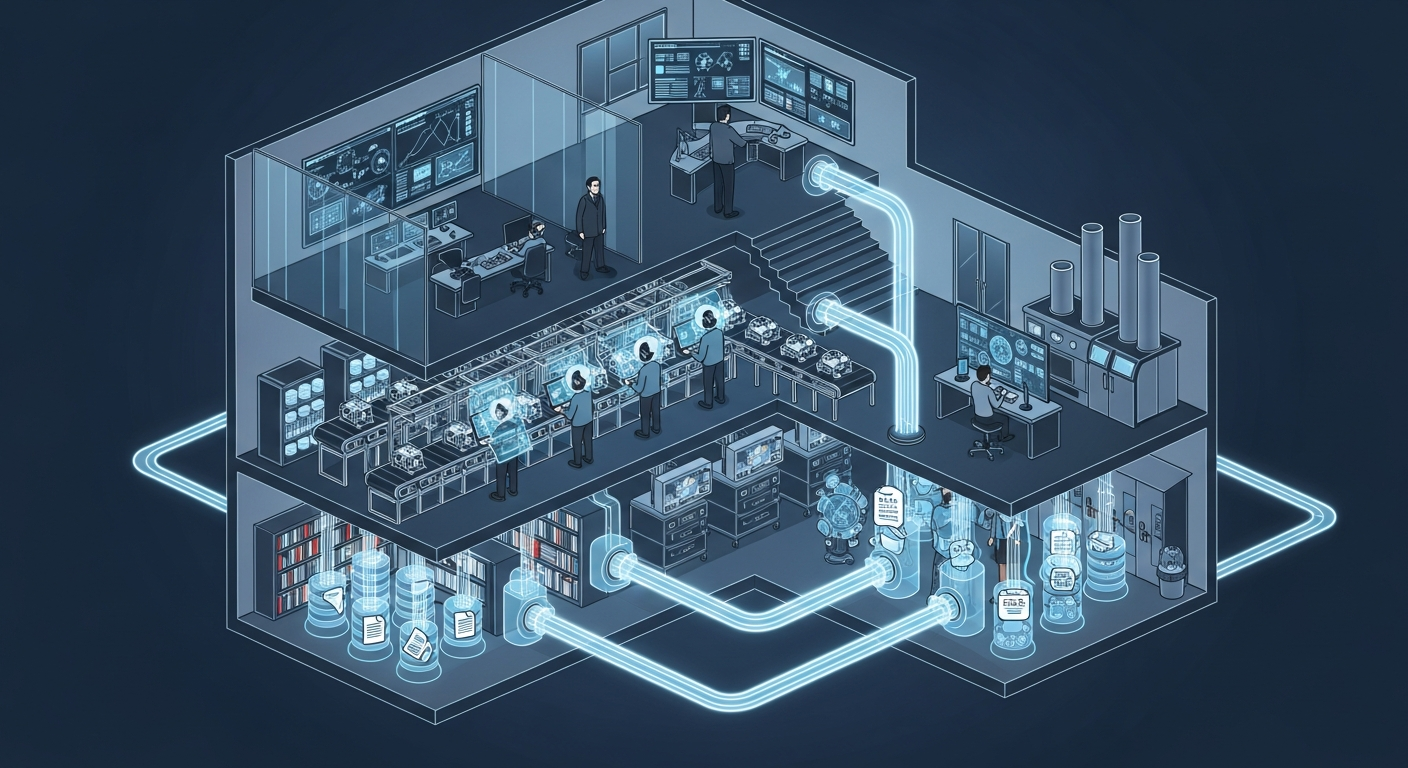
공장의 뇌는 어떻게 생겼는가 — 제조운영 AI 아키텍처 해부
지식관리, 업무자동화, 의사결정지원 — 따로 보면 다 있던 것들입니다. 제조 AI의 진짜 차이는 이 셋이 순환하면서 '우리 공장만의 지능'을 만든다는 데 있습니다.
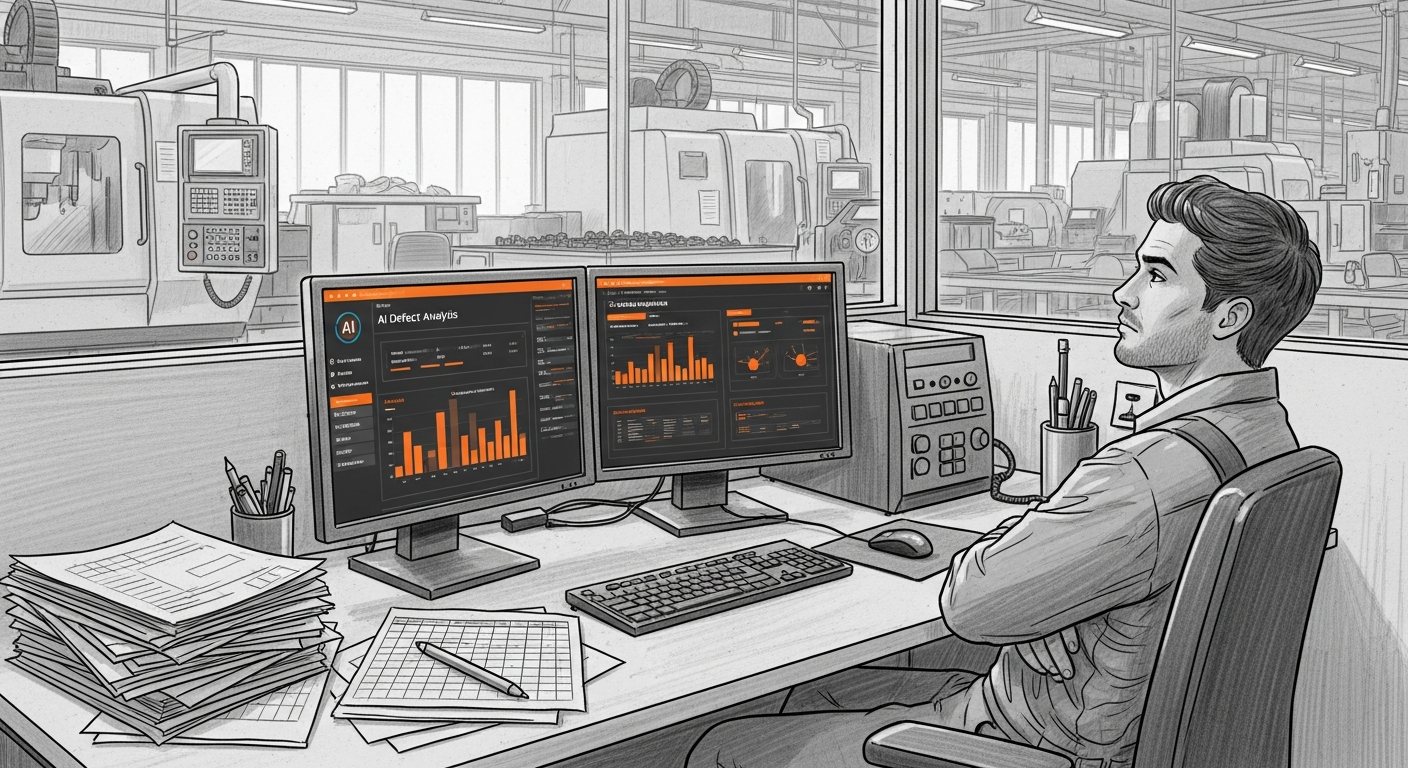
그 30분을 18년 동안 매일 반복했습니다 — 품질팀장이 본 AI Agent
18년차 품질팀장이 매일 아침 30분씩 반복하던 데이터 분석을 AI Agent가 3분 만에 해냈습니다. 챗봇과는 완전히 다른 물건 — 직접 시스템에 접근해서 데이터를 꺼내고 분석하는 AI의 현장 도입기.
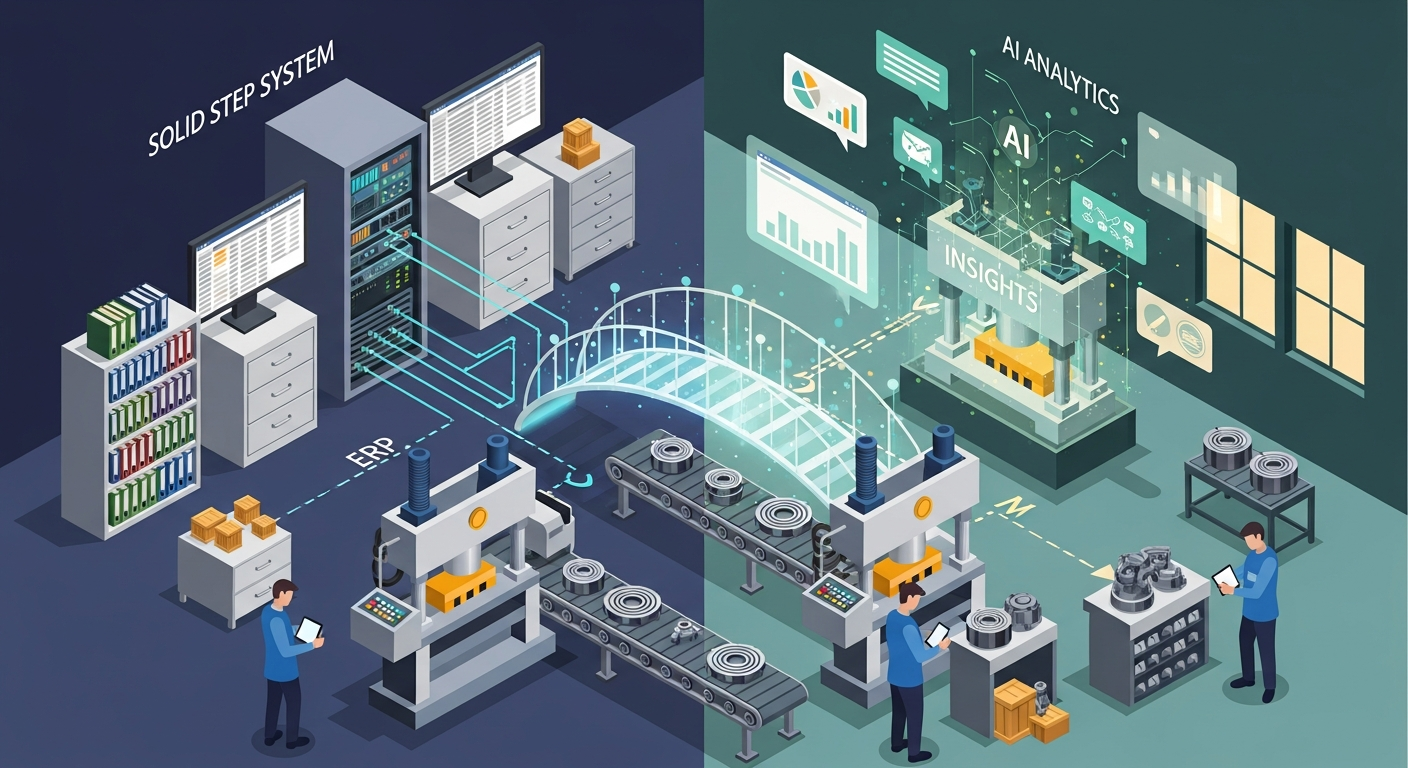
ERP 20년, 나는 왜 AI를 얹기로 했나
ERP 20년차 제조IT본부장의 고백: 3,200만 행의 데이터가 잠들어 있었다. ERP를 바꾸지 않고 AI를 얹자, 일주일 걸리던 불량 분석이 수 초로 줄었다.
Want to apply this in your factory?
MOAI helps manufacturing companies adopt AI tailored to their operations.
Talk to us →