Industrial internet of things
{{short description|Devices networked together with computers' industrial applications}} {{History of technology sidebar}} The '''industrial Internet of things''' ('''IIoT''') refers to interconnected sensors, instruments, and other devices networked together with computers' industrial applications, including manufacturing and energy management. This connectivity allows for data collection, exchange, and analysis, potentially facilitating improvements in productivity and efficiency as well as other economic benefits.{{Cite journal|last1=Boyes|first1=Hugh|last2=Hallaq|first2=Bil|last3=Cunningham|first3=Joe|last4=Watson|first4=Tim|date=October 2018|title=The industrial internet of things (IIoT): An analysis framework|journal=Computers in Industry|volume=101|pages=1–12|doi=10.1016/j.compind.2018.04.015|issn=0166-3615|doi-access=free}}{{Cite journal |last1=Brauner |first1=Philipp |last2=Dalibor |first2=Manuela |last3=Jarke |first3=Matthias |last4=Kunze |first4=Ike |last5=Koren |first5=István |last6=Lakemeyer |first6=Gerhard |last7=Liebenberg |first7=Martin |last8=Michael |first8=Judith |last9=Pennekamp |first9=Jan |last10=Quix |first10=Christoph |last11=Rumpe |first11=Bernhard |date=2022-02-15 |title=A Computer Science Perspective on Digital Transformation in Production |journal=ACM Transactions on Internet of Things |volume=3 |issue=2 |pages=15:1–15:32 |doi=10.1145/3502265 |s2cid=246883126 |issn=2691-1914|doi-access=free }} The IIoT is an evolution of a [[distributed control system]] (DCS) that allows for a higher degree of automation by using [[cloud computing]] to refine and optimize the process controls.
==Overview== {{multiple image | align = right | direction = vertical | width = 200 | image1 = IIoT_Architecture.png | alt1 = IIoT Architecture | caption1 = IIoT Architecture | image2 = Purdue Reference Model vs IoT Reference Model.png | alt2 = Purdue Reference Model vs IoT Reference Model | caption2 = Purdue Enterprise Reference Architecture model on the left and IoT Reference Model on the right | image3 = Purdue model with IIoT.png | alt3 = Purdue model with IIoT | caption3 = Approximate correspondence between levels in the Purdue model and the basic structure of the IoT }} The IIoT is enabled by technologies such as [[cybersecurity]], [[cloud computing]], [[edge computing]], [[Mobile technology|mobile technologies]], [[Machine to machine|machine-to-machine]], [[3D printing]], advanced [[robotics]], [[big data]], [[Internet of things]], [[Radio-frequency identification|RFID]] technology, and [[cognitive computing]].{{Cite web|url=https://www.researchgate.net/figure/Technologies-for-industry-40_fig1_319944621|title=Figure 2-Technologies for industry 4.0.|website=ResearchGate|access-date=2018-10-08}}{{Cite web|url=https://www.iotworldtoday.com/2017/05/18/why-edge-computing-iiot-requirement/|title=Why Edge Computing Is an IIoT Requirement: How edge computing is poised to jump-start the next industrial revolution.|website=iotworldtoday.com|access-date=2019-06-03}} Five of the most important ones are described below:
*[[Cyber-physical system]]s (CPS): the basic technology platform for [[Internet of things|IoT]] and IIoT and therefore the main enabler to connect physical machines that were previously disconnected. CPS integrates the dynamics of the physical process with those of software and communication, providing abstractions and modeling, design, and analysis techniques. *[[Cloud computing]]: With cloud computing IT services and resources can be uploaded to and retrieved from the Internet as opposed to a direct connection to a server. Files can be kept on cloud-based storage systems rather than on local storage devices.{{Cite news|url=https://www.investopedia.com/terms/c/cloud-computing.asp|title=Cloud Computing|author=Investopedia Staff|date=2011-01-18|work=Investopedia|access-date=2018-10-08}} *[[Edge computing]]: A [[distributed computing]] paradigm which brings [[computer data storage]] closer to the location where it is needed.{{Cite web|url=https://www.cloudwards.net/what-is-edge-computing/|title=What is Edge Computing: The Network Edge Explained|last=Hamilton|first=Eric|website=cloudwards.net|date=31 December 2018 |access-date=2019-05-14}} In contrast to [[cloud computing]], edge computing refers to [[Decentralization#Technological decentralization|decentralized]] data processing at the edge of the network.{{Cite web|url=https://www.aisoma.de/what-is-edge-computing/|title=What is Edge Computing?|date=9 April 2019 |access-date=2019-05-14}} The industrial internet requires more of an [[edge computing|edge]]-plus-[[cloud computing|cloud]] architecture rather than one based on purely centralized cloud; in order to transform productivity, products and services in the industrial world. *[[Big data]] analytics: Big data analytics is the process of examining large and varied data sets, or big data.{{Cite news|url=https://searchbusinessanalytics.techtarget.com/definition/big-data-analytics|title=What is big data analytics? - Definition from WhatIs.com|work=SearchBusinessAnalytics|access-date=2018-10-08}} *[[Artificial intelligence]] and [[machine learning]]: Artificial intelligence (AI) is a field within computer science in which intelligent machines are created that work and react like humans.{{Cite news|url=https://www.techopedia.com/definition/190/artificial-intelligence-ai|title=What is Artificial Intelligence (AI)? - Definition from Techopedia|work=Techopedia.com|access-date=2018-10-08}} Machine learning is a core part of AI, allowing software to more accurately predict outcomes without explicitly being programmed.{{Cite news|url=https://searchenterpriseai.techtarget.com/definition/machine-learning-ML|title=What is machine learning (ML)? - Definition from WhatIs.com|work=SearchEnterpriseAI|access-date=2018-10-08}} It is also possible to combine artificial intelligence with edge computing in order to provide industrial edge intelligence solutions.F. Foukalas and A. Tziouvaras, [https://ieeexplore.ieee.org/document/9328189 "Edge Artificial Intelligence for Industrial Internet of Things Applications: An Industrial Edge Intelligence Solution"] There are many use-cases using AI with IIoT, to name a few: [[condition monitoring]] and [[predictive maintenance]],{{Cite journal |last1=Cakir |first1=Mustafa |last2=Guvenc |first2=Mehmet Ali |last3=Mistikoglu |first3=Selcuk |date=2021-01-01 |title=The experimental application of popular machine learning algorithms on predictive maintenance and the design of IIoT based condition monitoring system |url=https://linkinghub.elsevier.com/retrieve/pii/S0360835220306252 |journal=Computers & Industrial Engineering |volume=151 |article-number=106948 |doi=10.1016/j.cie.2020.106948 |issn=0360-8352|url-access=subscription }} process optimization,{{Cite journal |last1=Mateo |first1=Federico Walas |last2=Redchuk |first2=Andrés |date=2022-09-17 |title=Artificial Intelligence as a Process Optimization Driver under Industry 4.0 Framework and the Role of IIoT, a Bibliometric Analysis |url=https://www.worldscientific.com/doi/10.1142/S2424862222500130 |journal=Journal of Industrial Integration and Management |volume=09 |issue=3 |language=en |pages=357–372 |doi=10.1142/S2424862222500130 |issn=2424-8622|url-access=subscription }} [[Federated learning|federate learning]]{{Cite journal |last1=Fan |first1=Hongbin |last2=Huang |first2=Changbing |last3=Liu |first3=Yining |date=2023 |title=Federated Learning-Based Privacy-Preserving Data Aggregation Scheme for IIoT |journal=IEEE Access |volume=11 |pages=6700–6707 |doi=10.1109/ACCESS.2022.3226245 |bibcode=2023IEEEA..11.6700F |issn=2169-3536|doi-access=free }}...
===Architecture=== IIoT systems are usually conceived as a layered modular architecture of digital technology.{{Cite journal|last1=Yoo|first1=Youngjin|last2=Henfridsson|first2=Ola|last3=Lyytinen|first3=Kalle|date=2010-12-01|title=Research Commentary---The New Organizing Logic of Digital Innovation: An Agenda for Information Systems Research|url=http://dl.acm.org/citation.cfm?id=1923779.1923786|journal=Information Systems Research|volume=21|issue=4|pages=724–735|doi=10.1287/isre.1100.0322|issn=1526-5536|url-access=subscription}} The device layer refers to the physical components: CPS, sensors or machines. The network layer consists of physical network buses, cloud computing and communication protocols that aggregate and transport the data to the service layer, which consists of applications that manipulate and combine data into information that can be displayed on the driver dashboard. The top-most stratum of the stack is the content layer or the user interface.{{Cite journal|last1=Hylving|first1=Lena|last2=Schultze|first2=Ulrike|date=2013-01-01|title=Evolving The Modular Layered Architecture in Digital Innovation: The Case of the Car's Instrument Cluster|url=https://www.researchgate.net/publication/270782497|journal=International Conference on Information Systems (ICIS 2013): Reshaping Society Through Information Systems Design|volume=2}} {| class="wikitable" |+Layered Modular Architecture In IIoT !Content layer |User interface devices (e.g. computer screens, PoS stations, tablets, smart glasses, smart surfaces) |- !Service layer |Applications, software to analyze data and transform it into actionable information |- !Network layer |Communications protocols, [[Wi-Fi]], [[Bluetooth]], [[LoRa]], [[Cellular network|cellular]] |- !Device layer |Hardware: CPS, machines, sensors |}
==History== The history of the IIoT begins with the invention of the [[programmable logic controller]] (PLC) by [[Richard E. Morley]] in 1968, which was used by [[General Motors]] in their automatic transmission manufacturing division.{{cite web|title=The father of invention: Dick Morley looks back on the 40th anniversary of the PLC|url=http://www.automationmag.com/features/the-father-of-invention-dick-morley-looks-back-on-the-40th-anniversary-of-the-plc.html|access-date=10 May 2017|archive-url=https://web.archive.org/web/20190609030841/https://www.automationmag.com/features/the-father-of-invention-dick-morley-looks-back-on-the-40th-anniversary-of-the-plc.html|archive-date=9 June 2019|url-status=dead}} These PLCs allowed for fine control of individual elements in the manufacturing chain. In 1975, [[Honeywell]] and [[Yokogawa]] introduced the world's first DCSs, the TDC 2000 and the CENTUM system, respectively.{{cite news |last1=McMahon |first1=Terrence K. |title=Three decades of DCS technology |url=https://www.controlglobal.com/articles/2005/227/ |access-date=27 November 2018 |work=Control Global |date=18 April 2005 }}{{cite web |title=Evolution of industrial control systems |url=https://pacetoday.com.au/evolution-of-industrial-control-systems/ |website=PACE |access-date=27 November 2018 |date=4 December 2013}} These DCSs were the next step in allowing flexible process control throughout a plant, with the added benefit of backup redundancies by distributing control across the entire system, eliminating a singular point of failure in a central control room.
With the introduction of [[Ethernet]] in 1980, people began to explore the concept of a network of smart devices as early as 1982, when a modified [[Coca-Cola|Coke]] machine at [[Carnegie Mellon University]] became the first Internet-connected appliance,{{cite web |url=https://www.cs.cmu.edu/~coke/history_long.txt |title=The "Only" Coke Machine on the Internet |website=[[Carnegie Mellon University]] |access-date=10 November 2014}} able to report its inventory and whether newly loaded drinks were cold.{{cite journal |url=http://www.informationweek.com/strategic-cio/executive-insights-and-innovation/internet-of-things-done-wrong-stifles-innovation/a/d-id/1279157 |title=Internet of Things Done Wrong Stifles Innovation |journal=[[InformationWeek]] |date=7 July 2014 |access-date=10 November 2014}} As early as in 1994, greater industrial applications were envisioned, as Reza Raji described the concept in [[IEEE Spectrum]] as "[moving] small packets of data to a large set of nodes, so as to integrate and automate everything from home appliances to entire factories".{{cite news |last=Raji |first=RS |title=Smart networks for control |newspaper=IEEE Spectrum |date=June 1994|volume=31 |issue=6 |pages=49–55 |doi=10.1109/6.284793 }}
The concept of the Internet of things first became popular in 1999, through the Auto-ID Center at MIT and related market-analysis publications.Analyst Anish Gaddam interviewed by Sue Bushell in ''Computerworld'', on 24 July 2000 ("M-commerce key to ubiquitous internet") Radio-frequency identification ([[RFID]]) was seen by Kevin Ashton (one of the founders of the original Auto-ID Center) as a prerequisite for the Internet of things at that point.{{cite web |first=P. |last=Magrassi |author-link=Paolo Magrassi |title=Why a Universal RFID Infrastructure Would Be a Good Thing |work=Gartner research report G00106518 |date=2 May 2002 |url=https://www.gartner.com/doc/356347/universal-rfid-infrastructure-good-thing}} If all objects and people in daily life were equipped with identifiers, computers could manage and inventory them.{{cite web |first1=P. |last1=Magrassi |first2=T |last2=Berg |title=A World of Smart Objects |work=Gartner research report R-17-2243 |date=12 August 2002 |url=http://www.gartner.com/DisplayDocument?id=366151|archive-url=https://web.archive.org/web/20031003090617/http://www3.gartner.com/DisplayDocument?id=366151|url-status=dead|archive-date=October 3, 2003}}{{cite web|title=Internet of Things — An action plan for Europe |url=http://ec.europa.eu/information_society/policy/rfid/documents/commiot2009.pdf |date=18 June 2009 |id=COM(2009) 278 final |author=Commission of the European Communities }}{{cite news |last1=Wood |first1=Alex |title=The internet of things is revolutionizing our lives, but standards are a must |url=https://www.theguardian.com/media-network/2015/mar/31/the-internet-of-things-is-revolutionising-our-lives-but-standards-are-a-must |newspaper=The Guardian |date=31 March 2015}} Besides using RFID, the tagging of things may be achieved through such technologies as [[near field communication]], [[barcodes]], [[QR codes]] and [[digital watermarking]].{{cite web |work=Techvibes |url=http://www.techvibes.com/blog/from-m2m-to-the-internet-of-things-viewpoints-from-europe-2011-07-07 |title=From M2M to The Internet of Things: Viewpoints From Europe |date=7 July 2011 |access-date=11 May 2017 |archive-url=https://web.archive.org/web/20131024003031/http://www.techvibes.com/blog/from-m2m-to-the-internet-of-things-viewpoints-from-europe-2011-07-07 |archive-date=24 October 2013 |url-status=dead }}{{cite web |first=Lara |last=Sristava |publisher=European Commission Internet of Things Conference in Budapest |date=16 May 2011 |url=https://www.youtube.com/watch?v=CJdNq7uSddM |title=The Internet of Things – Back to the Future (Presentation) |via=YouTube}}
The current conception of the IIoT arose after the emergence of cloud technology in 2002, which allows for the storage of data to examine for historical trends, and the development of the [[OPC Unified Architecture]] protocol in 2006, which enabled secure, remote communications between devices, programs, and data sources without the need for human intervention or interfaces.
One of the first consequences of implementing the industrial internet of things (by equipping objects with minuscule identifying devices or machine-readable identifiers) would be to create instant and ceaseless inventory control.{{cite web |first1=P. |last1=Magrassi |first2=A. |last2=Panarella |first3=N. |last3=Deighton |first4=G. |last4=Johnson |title=Computers to Acquire Control of the Physical World |work=Gartner research report T-14-0301 |date=28 September 2001 |url=https://www.gartner.com/doc/341674/computers-acquire-control-physical-world}}{{cite web |work=Casaleggio Associati |url=http://www.slideshare.net/casaleggioassociati/the-evolution-of-internet-of-things |title=The Evolution of Internet of Things |date=February 2011}}{{Request quotation |date=August 2014}} Another benefit of implementing an IIoT system is the ability to create a [[digital twin]] of the system. Using this digital twin allows for further optimization of the system by allowing for experimentation with new data from the cloud without having to halt production or sacrifice safety, as the new processes can be refined virtually until they are ready to be implemented. A digital twin can also serve as a training ground for new employees who won't have to worry about real impacts on the live system.{{cite news |last1=Bacidore |first1=Mike |title=The Connected Plant enables the digital twin |url=https://www.controlglobal.com/industrynews/2017/hug-7/ |access-date=27 November 2018 |work=Control Global |date=20 June 2017 }}
==Standards and frameworks== IoT frameworks help support the interaction between "things" and allow for more complex structures like [[distributed computing]] and the development of [[distributed applications]].
- [[IBM]] has announced{{when|date=September 2023}} cognitive IoT, which combines traditional IoT with machine intelligence and learning, contextual information, industry-specific models and natural language processing.{{Cite web|url=https://www.gigabitmagazine.com/company/ibm-and-cognitive-computing-revolution|title=IBM and the cognitive computing revolution|website=www.gigabitmagazine.com|access-date=2019-09-18}}{{Dead link|date=January 2023 |bot=InternetArchiveBot |fix-attempted=yes }}
- The [[XMPP Standards Foundation]] (XSF) is creating{{when|date=September 2023}} such a framework called Chatty Things, which is a fully open, vendor-independent standard using [[XMPP]] to provide a distributed, scalable, and secure infrastructure.{{cite web |url=http://wiki.xmpp.org/web/Tech_pages/IoT_systems |title=Tech pages/IoT systems |access-date=26 June 2015}}
- [[REST]] is a scalable architecture which allows for things to communicate over Hypertext Transfer Protocol and is easily adopted for IoT applications to provide communication from a thing to a central web server.{{cite book |author= |title=Taiwan Information Strategy, Internet and E-Commerce Development Handbook - Strategic Information, Regulations, Contacts |url=https://books.google.com/books?id=sO8RDQAAQBAJ&pg=PA82 |publisher=IBP USA |page=82 |date=September 8, 2016 |isbn=978-1514521021}}
- [[MQTT]] is a publish-subscribe architecture on top of TCP/IP which allows for bi-directional communication between a thing and a MQTT broker.{{Cite web|url=https://www.designnews.com/automation-motion-control/edge-devices-leverage-mqtt-iiot-connectivity/81695819561420|title=Edge Devices Leverage MQTT for IIoT Connectivity|last=Presher|first=Al|date=2019-09-04|website=Design News|access-date=2019-09-18}}
- [[Node-RED]] is an open-source software designed by [[IBM]] to connect APIs, hardware, and online services.
- [[Open Platform Communications|OPC]] is a series of standards designed by the OPC Foundation to connect computer systems to automated devices.
- OMG [[Data Distribution Service]] (DDS) - is open international middleware standard directly addressing ''publish-subscribe'' communications for ''real-time and embedded systems''.{{Cite web |title=The Industrial Internet of Things Connectivity Framework |url=https://www.iiconsortium.org/iicf/ |access-date=2022-11-29 |website=Industry IoT Consortium }}{{Cite web |title=Data Distribution Service (DDS) {{!}} Object Management Group |url=https://www.omg.org/omg-dds-portal/ |access-date=2022-11-29 |website=www.omg.org}}
- The [[Industrial Internet Consortium|Industrial Internet Consortium's]] (IIC) Industrial Internet Reference Architecture (IIRA) and the German [[Industry 4.0]] are independent efforts to create a defined standard for IIoT-enabled facilities.{{cite news|title=The State of the Industrial Internet of Things {{!}} Automation World|url=https://www.automationworld.com/article/topics/industrial-internet-things/state-industrial-internet-things|access-date=26 May 2017|work=www.automationworld.com}}
==Application and industries== The term industrial internet of things is often encountered in the manufacturing industries, referring to the industrial subset of the IoT. Potential benefits of the industrial internet of things include improved productivity, improved reliability, analytics and the transformation of the workplace.{{cite web |last1=Daugherty |first1=Paul |last2=Negm |first2=Walid |last3=Banerjee |first3=Prith |last4=Alter |first4=Allan |title=Driving Unconventional Growth through the Industrial Internet of Things |url=https://www.accenture.com/mz-en/_acnmedia/Accenture/next-gen/reassembling-industry/pdf/Accenture-Driving-Unconventional-Growth-through-IIoT.pdf |website=Accenture |access-date=17 March 2016 |archive-date=8 March 2021 |archive-url=https://web.archive.org/web/20210308173826/https://www.accenture.com/mz-en/_acnmedia/Accenture/next-gen/reassembling-industry/pdf/Accenture-Driving-Unconventional-Growth-through-IIoT.pdf |url-status=dead }}{{Cite web |last=Eriksson |first=Nicole Gläser |date=2018-08-17 |title=How IoT Helps in Manufacturing |url=https://iot.telenor.com/industry-insights/how-iot-helps-in-manufacturing/ |access-date=2026-01-26 |website=Telenor IoT |language=en-US}} The potential of growth by implementing IIoT is predicted to generate $15 trillion of global GDP by 2030.{{cite web|last1=Zurier|first1=Steve|title=Five IIoT companies prove value of Internet-connected manufacturing|url=http://internetofthingsagenda.techtarget.com/feature/Five-IIoT-companies-prove-value-of-internet-connected-manufacturing|website=IoT Agenda|access-date=11 May 2017}}
While connectivity and data acquisition are imperative for IIoT, they are not the end goals, but rather the foundation and path to something bigger. Of all the technologies, [[predictive maintenance]] is an "easier” application, as it is applicable to existing assets and management systems. Intelligent maintenance systems can reduce unexpected downtime and increase productivity, which is projected to save up to 12% over scheduled repairs, reduce overall maintenance costs up to 30%, and eliminate breakdowns up to 70%, according to some studies.{{cite web |work=Accenture |title=Industrial Internet Insights Report |url=https://www.accenture.com/us-en/_acnmedia/Accenture/next-gen/reassembling-industry/pdf/Accenture-Industrial-Internet-Changing-Competitive-Landscape-Industries.pdf |access-date=17 March 2016 |archive-date=8 March 2021 |archive-url=https://web.archive.org/web/20210308081408/https://www.accenture.com/us-en/_acnmedia/Accenture/next-gen/reassembling-industry/pdf/Accenture-Industrial-Internet-Changing-Competitive-Landscape-Industries.pdf |url-status=dead }} [[Cyber-physical system]]s (CPS) are the core technology of industrial big data and they will be an interface between human and the cyber world.
Integration of [[Sensor|sensing]] and [[Actuator|actuation]] systems connected to the Internet can optimize energy consumption as a whole.{{cite IETF |last1=Ersue |first1=M. |last2=Romascanu |first2=D. |last3=Schoenwaelder |first3=J. |last4=Sehgal |first4=A. |title=Management of Networks with Constrained Devices: Use Cases |rfc=7548 |date=May 2015}} It is expected that IoT devices will be integrated into all forms of energy consuming devices (switches, power outlets, bulbs, televisions, etc.) and be able to communicate with the utility supply company in order to effectively balance [[Electricity generation|power generation]] and energy usage.{{cite IETF |last1=Parello |first1=J. |last2=Claise |first2=B. |last3=Schoening |first3=B. |last4=Quittek |first4=J. |title=Energy Management Framework |rfc=7326 |date=September 2014 }} Besides home based energy management, the IIoT is especially relevant to the [[Smart Grid]] since it provides systems to gather and act on energy and power-related information in an automated fashion with the goal to improve the efficiency, reliability, economics, and sustainability of the production and distribution of electricity. Using [[advanced metering infrastructure]] (AMI) devices connected to the Internet backbone, electric utilities can not only collect data from end-user connections, but also manage other distribution automation devices like transformers and reclosers.
As of 2016, other real-world applications include incorporating smart LEDs to direct shoppers to empty parking spaces or highlight shifting traffic patterns, using sensors on water purifiers to alert managers via computer or smartphone when to replace parts, attaching RFID tags to safety gear to track personnel and ensure their safety, embedding computers into power tools to record and track the torque level of individual tightenings, and collecting data from multiple systems to enable the simulation of new processes.
=== Automotive industry === Using IIoT in car manufacturing implies the digitalization of all elements of production. Software, machines, and humans are interconnected, enabling suppliers and manufacturers to rapidly respond to changing standards.{{Cite news|url=https://blog.flexis.com/the-impact-of-industry-4.0-on-the-automotive-industry|title=The Impact of Industry 4.0 on the Automotive Industry|last=Masters|first=Kristin|access-date=2018-10-08}} IIoT enables efficient and cost-effective production by moving data from the customers to the company's systems, and then to individual sections of the production process. With IIoT, new tools and functionalities can be included in the manufacturing process. For example, 3D printers simplify the way of shaping pressing tools by printing the shape directly from steel granulate.{{Citation|last=Volkswagen Group|title=Industry 4.0 in the Volkswagen Group|date=2015-08-20|url=https://www.youtube.com/watch?v=JTl8w6yAjds|access-date=2018-10-08}} These tools enable new possibilities for designing (with high precision). Customization of vehicles is also enabled by IIoT due to the modularity and connectivity of this technology. While in the past they worked separately, IIoT now enables humans and robots to cooperate. Robots take on heavy and repetitive activities, so the manufacturing cycles are quicker and the vehicle comes to the market more rapidly. Factories can quickly identify potential maintenance issues before they lead to downtime and many of them are moving to a 24-hour production plant, due to higher security and efficiency. The majority of automotive manufacturers companies have production plants in different countries, where different components of the same vehicle are built. IIoT makes it possible to connect these production plants to each other, creating the possibility to move within facilities. Big data can be visually monitored which enables companies to respond faster to fluctuations in production and demand.
=== Oil and gas industry === With IIOT support, large amounts of raw data can be stored and sent by the drilling gear and research stations for cloud storage and analysis.{{Cite book |last= Gilchrist |first= Alasdair| date=2016|title=Industry 4.0 - the industrial internet of things| doi=10.1007/978-1-4842-2047-4|publisher= Apress Media | isbn =978-1-4842-2046-7|s2cid= 29312206}} With IIOT technologies, the oil and gas industry has the capability to connect machines, devices, sensors, and people through interconnectivity, which can help companies better address fluctuations in demand and pricing, address cybersecurity, and minimize environmental impact.{{Cite web|url=https://fm.sap.com/campaigns/CRM-US17-1LE-LSMACTLI/index.html#OG|title=SAP|website=fm.sap.com|access-date=2018-10-08}}
Across the supply chain, IIOT can improve the maintenance process, the overall safety, and connectivity.{{Cite web|url=https://www.bdo.com/insights/industries/natural-resources/how-industry-4-0-is-transforming-the-oil-gas-sup|title=How Industry 4.0 Is Transforming the Oil & Gas Supply Chain |website=www.bdo.com|date=23 April 2018 |access-date=2018-10-08}} Drones can be used to detect possible oil and gas leaks at an early stage and at locations that are difficult to reach (e.g. offshore). They can also be used to identify weak spots in complex networks of pipelines with built-in thermal imaging systems. Increased connectivity (data integration and communication) can help companies with adjusting the production levels based on real-time data of inventory, storage, distribution pace, and forecasted demand. For example, a Deloitte report states that by implementing an IIOT solution integrating data from multiple internal and external sources (such as work management system, control center, pipeline attributes, risk scores, inline inspection findings, planned assessments, and leak history), thousands of miles of pipes can be monitored in real-time. This allows monitoring of pipeline threats, improving risk management, and providing situational awareness.{{cite web |title=2018 Tech Trends for the oil and gas industry |date=2018 |access-date=2018-10-08 |url=https://www2.deloitte.com/content/dam/Deloitte/us/Documents/energy-resources/us-tech-trends-oil-and-gas-industry.pdf |author=Deloitte Insights}}
Benefits also apply to specific processes of the oil and gas industry. The exploration process of oil and gas can be done more precisely with 4D models built by seismic imaging. These models map fluctuations in oil reserves and gas levels, they strive to point out the exact quantity of resources needed, and they forecast the lifespan of wells. The application of smart sensors and automated drillers gives companies the opportunity to monitor and produce more efficiently. Further, the storing process can also be improved with the implementation of IIOT by collecting and analyzing real-time data to monitor inventory levels and temperature control. IIOT can enhance the transportation process of oil and gas by implementing smart sensors and thermal detectors to give real-time geolocation data and monitor the products for safety reasons. These smart sensors can monitor the refinery processes, and enhance safety. The demand for products can be forecasted more precisely and automatically be communicated to the refineries and production plants to adjust production levels.
=== Agriculture industry === In the agriculture industry, IIoT helps farmers to make decisions about when to harvest. Sensors collect data about soil and weather conditions and propose schedules for fertilizing and irrigating.{{Cite web|title=What is IIoT? Definition and Details|url=https://www.paessler.com/it-explained/iiot|access-date=2020-10-06|website=www.paessler.com}} Some livestock farms implant microchips into animals. This allows the farmers not only to trace their animals, but also pull up information about the lineage, weight, or health.{{Cite web|last=Jeffries|first=Adrianne|date=2013-05-10|title=Internet of cows: technology could help track disease, but ranchers are resistant|url=https://www.theverge.com/2013/5/10/4316658/internet-of-cows-technology-offers-ways-to-track-livestock-but|access-date=2020-10-06|website=The Verge}}
=== PV industry === The integration of IIoT data in the photovoltaic (PV) industry can significantly enhance the efficiency, reliability, and performance of solar power systems.{{Cite book |last1=Kumar |first1=Nallapaneni Manoj |last2=Atluri |first2=Karthik |last3=Palaparthi |first3=Sriteja |chapter=Internet of Things (IoT) in Photovoltaic Systems |date=March 2018 |title=2018 National Power Engineering Conference (NPEC) |publisher=IEEE |pages=1–4 |doi=10.1109/NPEC.2018.8476807 |isbn=978-1-5386-3803-3}} IIoT with [[Artificial intelligence|AI]] data can be utilized for real-time monitoring, performance optimization, fault detection, diagnostics.{{Cite journal |last1=Mellit |first1=Adel |last2=Kalogirou |first2=Soteris |date=2021-06-01 |title=Artificial intelligence and internet of things to improve efficacy of diagnosis and remote sensing of solar photovoltaic systems: Challenges, recommendations and future directions |url=https://linkinghub.elsevier.com/retrieve/pii/S1364032121001830 |journal=Renewable and Sustainable Energy Reviews |volume=143 |article-number=110889 |doi=10.1016/j.rser.2021.110889 |bibcode=2021RSERv.14310889M |hdl=20.500.14279/22679 |issn=1364-0321|url-access=subscription |hdl-access=free }}
==Security== As the IIoT expands, new security concerns arise with it. Every new device or component that connects to the IIoT{{cite web|title=Sound the alarm: How to get serious about industrial IoT security - IoT Agenda|url=http://internetofthingsagenda.techtarget.com/blog/IoT-Agenda/Sound-the-alarm-How-to-get-serious-about-industrial-IoT-security|website=internetofthingsagenda.techtarget.com|access-date=11 May 2017}} can become a potential liability. Gartner estimates that by 2020, more than 25% of recognized attacks on enterprises will involve IoT-connected systems, despite accounting for less than 10% of IT security budgets.{{cite web|title=Gartner Says Worldwide IoT Security Spending to Reach $348 Million in 2016|url=http://www.gartner.com/newsroom/id/3291817|archive-url=https://archive.today/20160826232659/http://www.gartner.com/newsroom/id/3291817|url-status=dead|archive-date=August 26, 2016|access-date=11 May 2017}} Existing cybersecurity measures are vastly inferior for Internet-connected devices compared to their traditional computer counterparts,{{cite web|title=How infected IoT devices are used for massive DDoS attacks - Fedscoop|url=https://www.fedscoop.com/ddos-attacks-internet-of-things-cybersecurity/|website=Fedscoop|access-date=11 May 2017|date=26 September 2016}} which can allow for them to be hijacked for [[DDoS]]-based attacks by [[botnets]] like [[Mirai (malware)|Mirai]]. Another possibility is the infection of Internet-connected industrial controllers, like in the case of [[Stuxnet]], without the need for physical access to the system to spread the worm.{{cite web|title=IoT data security vulnerable as connected devices proliferate|url=http://internetofthingsagenda.techtarget.com/feature/IoT-data-security-vulnerable-as-connected-devices-proliferate|website=IoT Agenda|access-date=11 May 2017}}
Additionally, IIoT-enabled devices can allow for more “traditional” forms of cybercrime, as in the case of the 2013 [[Target Corporation|Target]] data breach, where information was stolen after hackers gained access to Target's networks via credentials stolen from a third party HVAC vendor.{{cite web|title=Target Hackers Broke in Via HVAC Company — Krebs on Security|url=https://krebsonsecurity.com/2014/02/target-hackers-broke-in-via-hvac-company/|website=krebsonsecurity.com|date=9 February 2014 |access-date=11 May 2017}} The pharmaceutical manufacturing industry has been slow to adopt IIoT advances because of security concerns such as these.{{cite news |last1=Mullin |first1=Rick |title=The drug plant of the future |url=https://cen.acs.org/articles/95/i21/drug-plant-future.html?h=-1739916665 |volume=95 |issue=21 |access-date=29 October 2018 |work=Chemical & Engineering News |date=22 May 2017}} One of the difficulties in providing security solutions in IIoT applications is the fragmented nature of the hardware.{{cite news |last1=Fogarty |first1=Kevin |title=Why IIoT Security Is So Difficult |url=https://semiengineering.com/why-iiot-security-is-so-difficult/ |access-date=31 October 2018 |work=Semiconductor Engineering |date=29 May 2018}} Consequently, security architectures are turning towards designs that are software-based or device-agnostic.{{cite news |last1=Dahad |first1=Nitin |title=Designer's Guide to IIoT Security |url=https://www.eetimes.com/document.asp?doc_id=1333674 |access-date=31 October 2018 |work=EETimes}}
Hardware-based approaches, like the use of [[data diodes]], are often used when connecting critical infrastructure.{{Cite web|title=Tactical Data Diodes in Industrial Automation and Control Systems|url=https://www.sans.org/reading-room/whitepapers/firewalls/tactical-data-diodes-industrial-automation-control-systems-36057}}
==See also== *[[Internet of things]]
==References== {{reflist|30em}} {{Industrial Revolution}} {{History of technology}} {{Western culture}}
[[Category:Internet of things]] [[Category:Industrial automation]] [[Category:Industrial computing]]
From MOAI Insights

디지털 트윈, 당신 공장엔 이미 있다 — 엑셀과 MES 사이 어딘가에
디지털 트윈은 10억짜리 3D 시뮬레이션이 아니다. 지금 쓰고 있는 엑셀에 좋은 질문 하나를 더하는 것 — 두 전문가가 중소 제조기업이 이미 가진 데이터로 예측하는 공장을 만드는 현실적 로드맵을 제시한다.
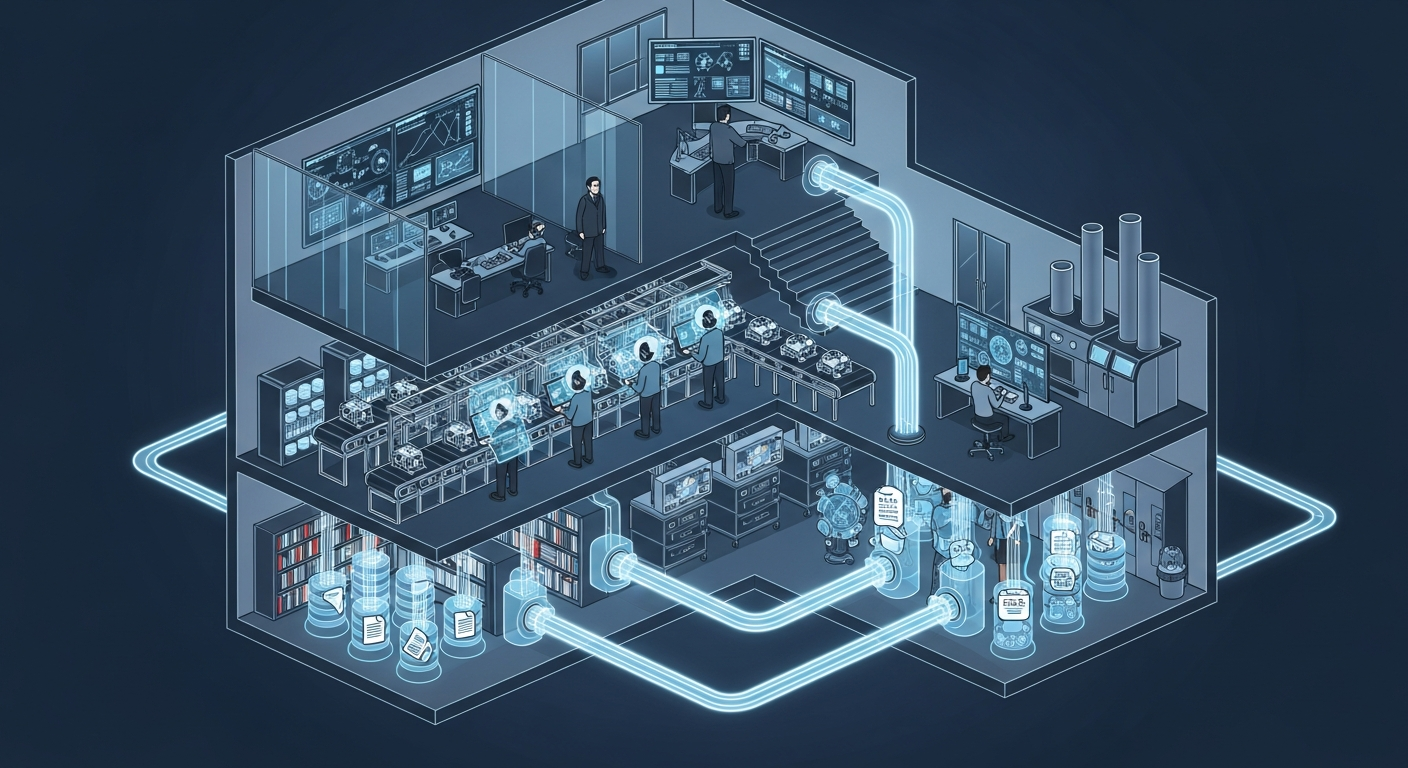
공장의 뇌는 어떻게 생겼는가 — 제조운영 AI 아키텍처 해부
지식관리, 업무자동화, 의사결정지원 — 따로 보면 다 있던 것들입니다. 제조 AI의 진짜 차이는 이 셋이 순환하면서 '우리 공장만의 지능'을 만든다는 데 있습니다.
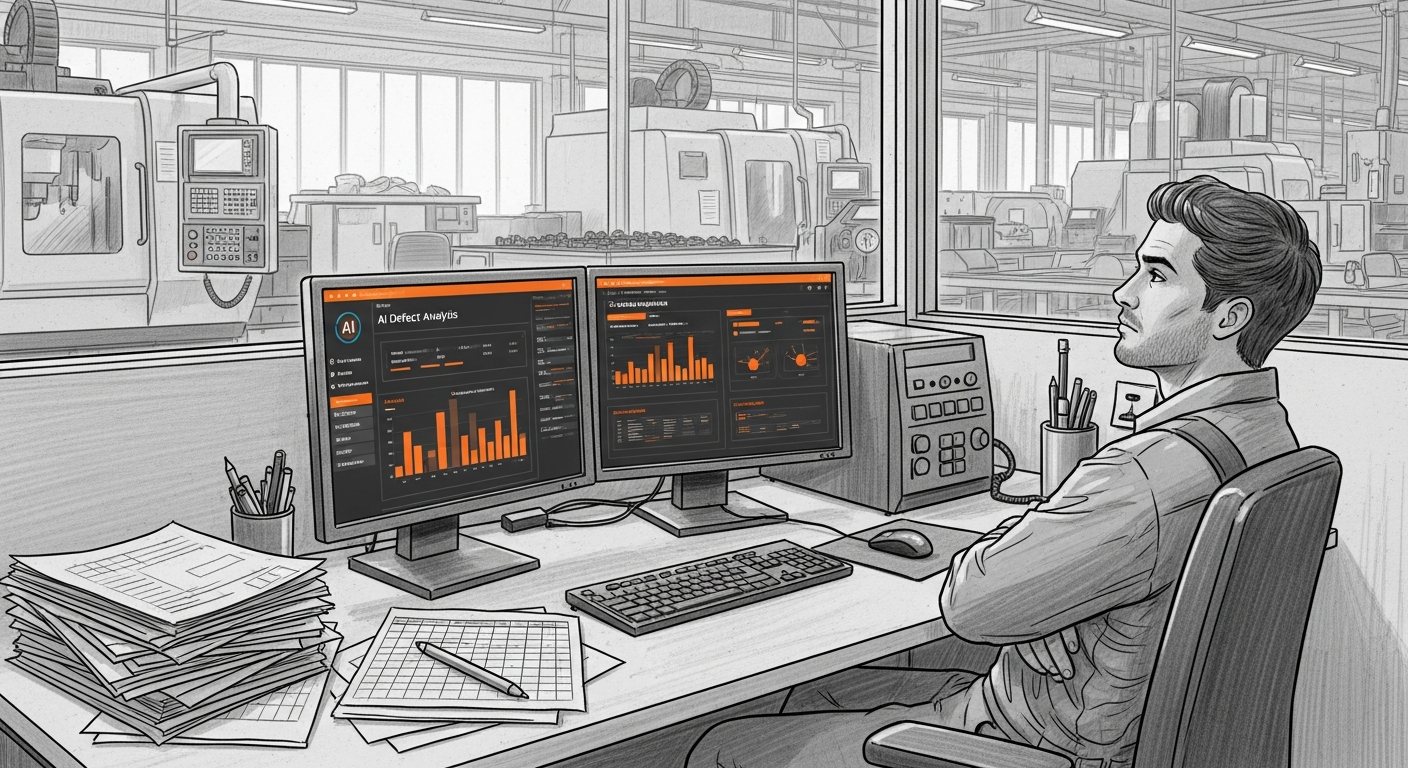
그 30분을 18년 동안 매일 반복했습니다 — 품질팀장이 본 AI Agent
18년차 품질팀장이 매일 아침 30분씩 반복하던 데이터 분석을 AI Agent가 3분 만에 해냈습니다. 챗봇과는 완전히 다른 물건 — 직접 시스템에 접근해서 데이터를 꺼내고 분석하는 AI의 현장 도입기.
Want to apply this in your factory?
MOAI helps manufacturing companies adopt AI tailored to their operations.
Talk to us →