Push–pull strategy
{{Short description|Business terminology}} {{Redirect|Push and pull}} [[File:CONWIP English.png|thumb|390x390px|The original meaning of push and pull, as used in [[operations management]], [[logistics]] and [[supply chain management]]. In the pull system production orders begin upon inventory reaching a certain level, while on the push system production begins based on demand (forecasted or actual demand). The [[CONWIP]] is a hybrid between a pure push and pure pull system.]]
In [[business strategy]], '''push strategies''' generally involve producers acting in anticipation of consumer [[Demand|demand]], while '''pull strategies''' involve producers acting in response to expressed demand. Push and pull strategies are widely used in [[logistics]], [[supply chain management]],{{cite book | title = Dictionary of International Trade – Handbook of the Global Trade Community | author = Edward G. Hinkelman & Sibylla Putzi | publisher = World Trade Press | year = 2005 | isbn = 978-1-885073-72-3 | url = https://books.google.com/books?id=vylCkqTg7H0C}} and [[marketing]].{{cite book |title= A Preface to Marketing Management |last= Peter |first= J. Paul |author2=James H. Donnelly |year= 2002 |publisher= McGraw-Hill Professional |isbn= 978-0-07-246658-4 |page= 132 |url= https://books.google.com/books?id=KhQjP6KZ9GQC}}{{cite book |title= The Art and Science of Marketing |last= Dowling |first= Grahame Robert |year= 2004 |publisher= Oxford University Press |isbn= 978-0-19-926961-7 |page= [https://archive.org/details/artscienceofmark0000dowl/page/266 266] |url= https://archive.org/details/artscienceofmark0000dowl|url-access= registration }}
== Supply-chain management ==
{{Main|Supply chain management}}
=== Complete definition === There are several definitions on the distinction between push and pull strategies. Liberopoulos (2013){{Citation|last=Liberopoulos|first=George|title=Production Release Control: Paced, WIP-Based or Demand-Driven? Revisiting the Push/Pull and Make-to-Order/Make-to-Stock Distinctions|date=2013|url=https://doi.org/10.1007/978-1-4614-6777-9_7|work=Handbook of Stochastic Models and Analysis of Manufacturing System Operations|pages=211–247|editor-last=Smith|editor-first=J. MacGregor|series=International Series in Operations Research & Management Science|volume=192|place=New York, NY|publisher=Springer|language=en|doi=10.1007/978-1-4614-6777-9_7|isbn=978-1-4614-6777-9|access-date=2021-05-02|editor2-last=Tan|editor2-first=Barış|url-access=subscription}} identifies three such definitions:
A pull system initiates production as a reaction to present demand, while a push system initiates production in anticipation of future demand.
In a pull system, production is triggered by actual demands for finished products, while in a push system, production is initiated independently of demands.
A pull system is one that explicitly limits the amount of WIP (works in progress) that can be in the system, while a push system has no explicit limit on the amount of WIP that can be in the system.
Other definitions are:
- ''Push'': As stated by Bonney et al. (1999) control information flow is in the same direction of goods flow
- ''Semi push'' or ''Push-pull'' : Succeeding node makes order request for preceding node. Preceding node reacts by replenishing from stock that is rebuilt every fixed period.
- ''Pull'' : Succeeding node makes order request for preceding node. Preceding node reacts by producing the order, which involves all internal operations, and replenishes when finished.
- ''Semi-pull'' or ''pull-push'' : Succeeding node makes order request for preceding node. Preceding node reacts by replenishing from stock that is rebuilt immediately. There are several levels of semi-pull systems as a node can have stock at several layers in an organization.{{cite journal|last1=J.|first1=Ashayeri|last2=R.P.|first2=Kampstra|title=Demand Driven Distribution: The Logistical Challenges and Opportunities|date=2005|issue=Department of Econometrics and Operations Research Tilburg University}}
=== Information flow=== With a push-based supply chain, products are pushed through the channel, from the production side up to the retailer. The manufacturer sets production at a level in accord with historical ordering patterns from [[retailer]]s. It takes longer for a push-based supply chain to respond to changes in demand, which can result in overstocking or bottlenecks and delays (the [[bullwhip effect]]), unacceptable [[service level]]s and product obsolescence.
In a pull-based supply chain, procurement, production and distribution are demand-driven rather than to forecast. However, a pull strategy does not always require [[make to order]] production. [[Toyota Motors Manufacturing]] is frequently used as an example of pull production, yet do not typically produce to order. They follow the "supermarket model" where limited inventory is kept on hand and is replenished as it is consumed.
A supply chain is almost always a combination of both push and pull, where the interface between the push-based stages and the pull-based stages is sometimes known as the ''push–pull boundary''.{{cite book | title = The Practice of Supply Chain Management | author = Terry P. Harrison, Hau L. Lee and John J. Neale | publisher = Springer | year = 2003 | isbn = 978-0-387-24099-2 | url = https://archive.org/details/practiceofsupply00terr | url-access = registration }} However, because of the subtle difference between pull production and make-to-order production, a more accurate name for this may be the ''[[customer order decoupling point]]''. An example of this is [[Dell, Inc.|Dell]]'s [[build to order]] supply chain. Inventory levels of individual components are determined by forecasting general demand, but final assembly is in response to a specific customer request. The decoupling point would then be at the beginning of the [[assembly line]].
=== Use of pull, push, and hybrid push-pull strategy ===
Harrison summarized when to use each one of the three supply chain strategies:
- A push based supply chain strategy is usually suggested for products with low demand uncertainty, as the forecast will provide a good indication of what to produce and keep in inventory, and also for products with high importance of [[economies of scale]] in reducing costs.
- A pull based supply chain strategy, usually suggested for products with high demand uncertainty and with low importance of [[economies of scale]]s, which means, aggregation does not reduce cost, and hence, the firm would be willing to manage the supply chain based on realized demand.
- A hybrid push–pull strategy, usually suggested for products which uncertainty in demand is high, while [[economies of scale]] are important in reducing production and delivery costs. An example of this strategy is the furniture industry, where production strategy has to follow a pull-based strategy, since it is impossible to make production decisions based on long-term forecasts. However, the distribution strategy needs to take advantage of economies of scale in order to reduce transportation cost, using a push-based strategy.
=== Examples in ''push'' and ''pull'' ===
Hopp and Spearman consider some of the most common systems found in industry and the literature and classify them as either push or pull
- ''[[Material requirements planning]]'' (MRP) is a push system because releases are made according to a master production schedule without regard to system status. Hence, no prior [[work in process]] (WIP) limit exists.
- ''Classic [[kanban]]'' is a pull system. The number of ''kanban'' cards establishes a fixed limit on WIP.
- The ''classic base stock system'' is a push system because there is no limit on the amount of work in process in the system. This is because backorders can increase beyond the basestock level.
- ''Installation stock'' is also a push system as are echelon stock systems because neither imposes a limit on the number of orders in the system.
- ''[[CONWIP|CONstant work in process]] (CONWIP)'' is a pull system because it limits WIP via cards similar to ''kanban''. An important difference from ''kanban'' from an implementation standpoint is that the cards are line specific rather than part number specific. However, from a push-pull perspective, CONWIP cards limit WIP in the same manner as ''kanban'' cards.
- (K, S) systems (proposed by Liberopoulos and Dallery{{Cite journal|last1=Liberopoulos|first1=George|last2=Dallery|first2=Yves|date=2002|title=Base stock versus WIP cap in single-stage make-to-stock production–inventory systems|url=http://link.springer.com/10.1023/A:1014503725395|journal=IIE Transactions|volume=34|issue=7|pages=627–636|doi=10.1023/A:1014503725395|s2cid=59469286|url-access=subscription}}) are pull systems if K <∞ and are push systems otherwise.
- POLCA systems proposed by Suri are pull systems because, like ''kanban'' and CONWIP, WIP is limited by cards.
- PAC systems proposed by Buzacott and Shanthikumar are pull systems when the number of process tags (which serve to limit WIP) is less than infinity.
- MRP with a WIP constraint (as suggested by Axsäter and Rosling) is a pull system.{{cite journal|last1=Hopp|first1=Wallace J.|last2=Spearman|first2=Mark L.|title=To pull or not to pull: what is the question?|journal=Manufacturing & Service Operations Management|volume=6|issue=2|pages=133–148|doi=10.1287/msom.1030.0028|year=2004|doi-access=free}} Liberopoulos (2013) also classifies common systems according to different definitions on the distinction between push and pull.
== Marketing ==
An advertising push strategy refers to a situation when a vendor advertises its product to gain audience awareness, while the pull strategy implies the aims to reach audiences which have shown existing interest in the product or information about it.{{cite journal|last1=Hosbond|first1=Jens Henrik|last2=Skov|first2=Mikael B.|date=15 November 2007|title=Micro mobility marketing: Two cases on location-based supermarket shopping trolleys|url=https://link.springer.com/content/pdf/10.1057/palgrave.jt.5750058.pdf|journal=Journal of Targeting, Measurement and Analysis for Marketing|volume=16|pages=68–77|doi=10.1057/palgrave.jt.5750058|via=Palgrave Macmillan Ltd|doi-access=free}}
== See also ==
- [[Supply and demand]]
- [[Digital marketing]]
- [[Publish/subscribe]]
- [[Issue tracking system]]
- [[Lean thinking]]
- [[Decision making]]
- [[Marketing strategy]]
- [[Marketing mix modeling]]
== References == {{reflist|2}}
{{DEFAULTSORT:Push-pull strategy}} [[Category:Supply chain management]] [[Category:Strategic management]]
From MOAI Insights

디지털 트윈, 당신 공장엔 이미 있다 — 엑셀과 MES 사이 어딘가에
디지털 트윈은 10억짜리 3D 시뮬레이션이 아니다. 지금 쓰고 있는 엑셀에 좋은 질문 하나를 더하는 것 — 두 전문가가 중소 제조기업이 이미 가진 데이터로 예측하는 공장을 만드는 현실적 로드맵을 제시한다.
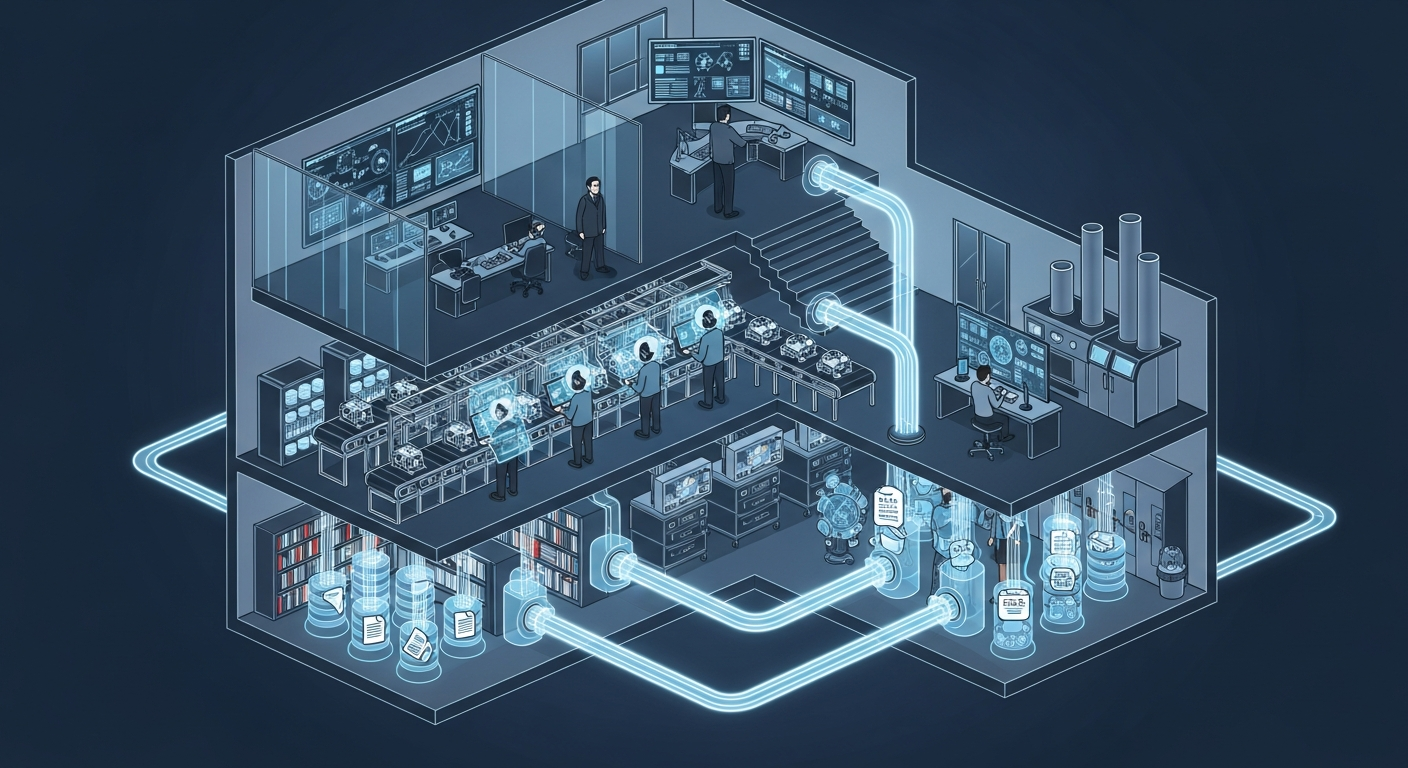
공장의 뇌는 어떻게 생겼는가 — 제조운영 AI 아키텍처 해부
지식관리, 업무자동화, 의사결정지원 — 따로 보면 다 있던 것들입니다. 제조 AI의 진짜 차이는 이 셋이 순환하면서 '우리 공장만의 지능'을 만든다는 데 있습니다.
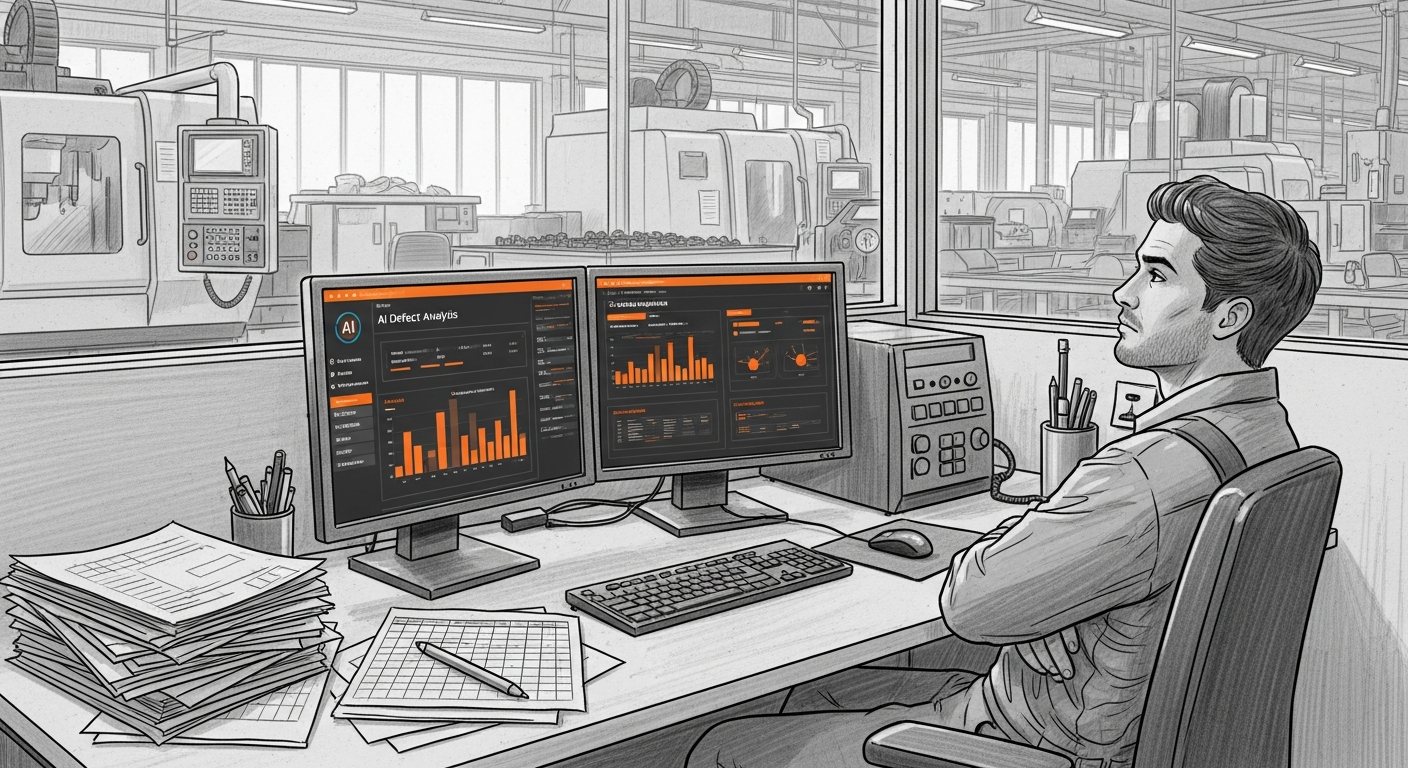
그 30분을 18년 동안 매일 반복했습니다 — 품질팀장이 본 AI Agent
18년차 품질팀장이 매일 아침 30분씩 반복하던 데이터 분석을 AI Agent가 3분 만에 해냈습니다. 챗봇과는 완전히 다른 물건 — 직접 시스템에 접근해서 데이터를 꺼내고 분석하는 AI의 현장 도입기.
Want to apply this in your factory?
MOAI helps manufacturing companies adopt AI tailored to their operations.
Talk to us →