First pass yield
{{Short description|Indicator of units from a process}} '''First-pass yield''' ('''FPY'''), also known as '''throughput yield''' ('''TPY'''), is defined as the number of units coming out of a process divided by the number of units going into that process over a specified period of time.{{Cite journal|last1=Zhu|first1=Li|last2=Johnsson|first2=Charlotta|last3=Varisco|first3=Martina|last4=Schiraldi|first4=Massimiliano M.|date=2018-01-01|title=Key performance indicators for manufacturing operations management – gap analysis between process industrial needs and ISO 22400 standard|journal=Procedia Manufacturing|series=Proceedings of the 8th Swedish Production Symposium (SPS 2018)|language=en|volume=25|pages=82–88|doi=10.1016/j.promfg.2018.06.060|issn=2351-9789|doi-access=free|hdl=2108/211506|hdl-access=free}}{{Cite web|title=Letter F - Quality Glossary of Terms, Acronyms & Definitions with Letter F {{!}} ASQ|url=https://asq.org/quality-resources/quality-glossary/f|access-date=2021-02-16|website=asq.org}}{{cite web|last=|first=|date=|title=Throughput Yield (TPY)|url=https://www.six-sigma-material.com/Throughput-Yield.html|archive-url=|archive-date=|accessdate=2020-06-04|website=Six Sigma Material|publisher=six-sigma-material.com}}
== Example == Consider the following:
You have a process that is divided into four sub-processes: A, B, C and D. Assume that you have 100 units entering process A. To calculate first time yield (FTY) you would:
#Calculate the yield (number out of step/number into step) of each step. #Multiply these together.
For example:
(# units leaving the process as good parts) / (# units put into the process) = FTY *100 units enter A and 90 leave as good parts. The FTY for process A is 90/100 = 0.9000 *90 units go into B and 80 leave as good parts. The FTY for process B is 80/90 = 0.8889 *80 units go into C and 75 leave as good parts. The FTY for C is 75/80 = 0.9375 *75 units go into D and 70 leave as good parts. The FTY for D is 70/75 = 0.9333
The total first time yield is equal to FTYofA * FTYofB * FTYofC * FTYofD or 0.9000 * 0.8889 * 0.9375 * 0.9333 = 0.7000.
You can also get the total process yield for the entire process by simply dividing the number of good units produced by the number going into the start of the process. In this case, 70/100 = 0.70 or 70% yield.
The same example using first pass yield (FPY) would take into account rework:
(# units leaving process A as good parts with no rework) / (# units put into the process) *100 units enter process A, 5 were reworked, and 90 leave as good parts. The FPY for process A is (90-5)/100 = 85/100 = 0.8500 *90 units go into process B, 0 are reworked, and 80 leave as good parts. The FPY for process B is (80-0)/90 = 80/90 = 0.8889 *80 units go into process C, 10 are reworked, and 75 leave as good parts. The FPY for process C is (75-10)/80 = 65/80 = 0.8125 *75 units go into process D, 8 are reworked, and 70 leave as good parts. The FPY for process D is (70-8)/75 = 62/75 = 0.8267
First pass yield is only used for an individual sub-process. Multiplying the set of processes would give you Rolling throughput yield (RTY). RTY is equal to FPYofA * FPYofB * FPYofC * FPYofD = 0.8500 * 0.8889 * 0.8125 * 0.8267 = 0.5075
Notice that the number of units going into each next process does not change from the original example, as that number of good units did, indeed, enter the next process. Yet the number of FPY units of each process counts only those that made it through the process as good parts that needed no rework to be good parts. The calculation of RTY, rolling throughput yield, shows how good the overall set of processes is at producing good overall output without having to rework units.
==See also== *[[Rolled throughput yield]] *[[Six Sigma]] *[[Statistical quality control]] *[[Quality management]]
==References==
{{DEFAULTSORT:First Pass Yield}} [[Category:Business terms]] [[Category:Statistical process control]] [[Category:Production planning]] [[Category:Six Sigma]]
From MOAI Insights

디지털 트윈, 당신 공장엔 이미 있다 — 엑셀과 MES 사이 어딘가에
디지털 트윈은 10억짜리 3D 시뮬레이션이 아니다. 지금 쓰고 있는 엑셀에 좋은 질문 하나를 더하는 것 — 두 전문가가 중소 제조기업이 이미 가진 데이터로 예측하는 공장을 만드는 현실적 로드맵을 제시한다.
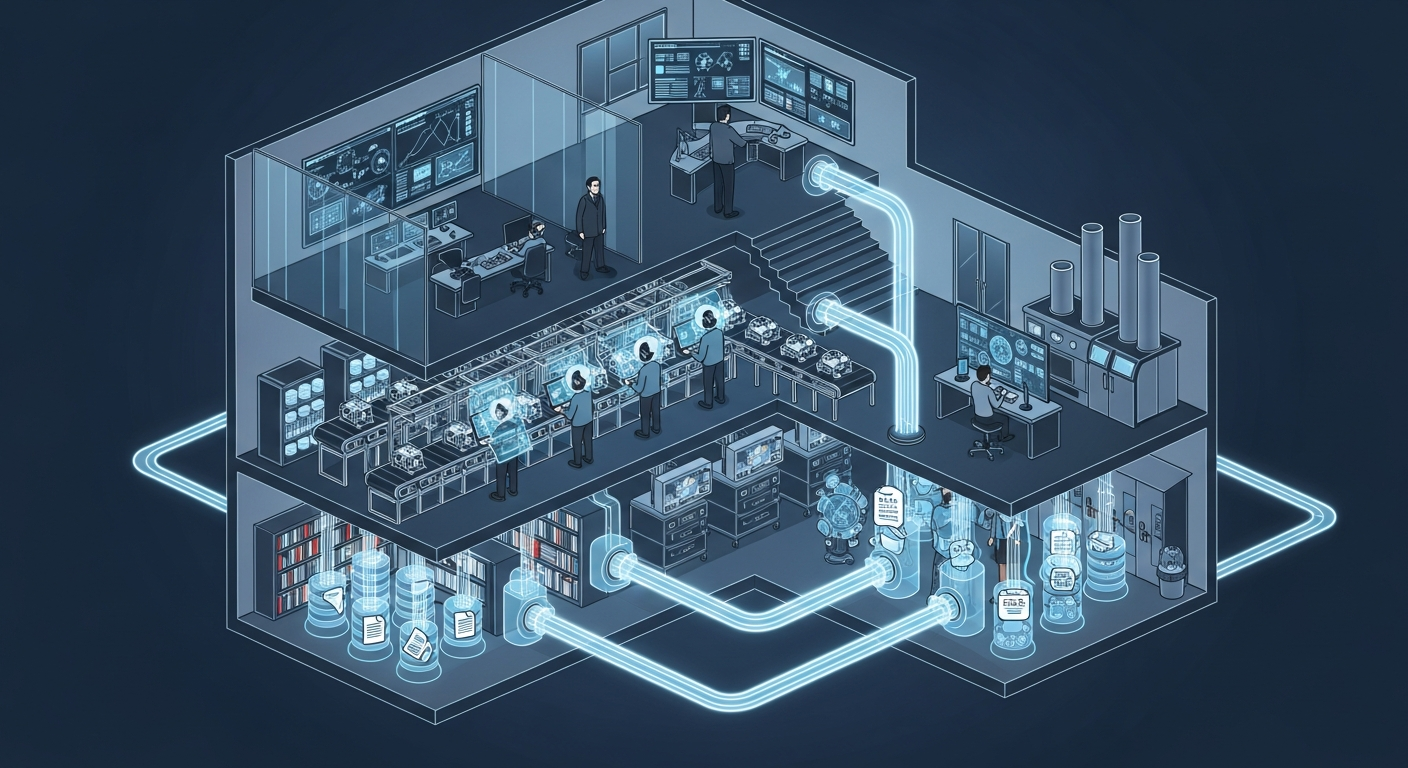
공장의 뇌는 어떻게 생겼는가 — 제조운영 AI 아키텍처 해부
지식관리, 업무자동화, 의사결정지원 — 따로 보면 다 있던 것들입니다. 제조 AI의 진짜 차이는 이 셋이 순환하면서 '우리 공장만의 지능'을 만든다는 데 있습니다.
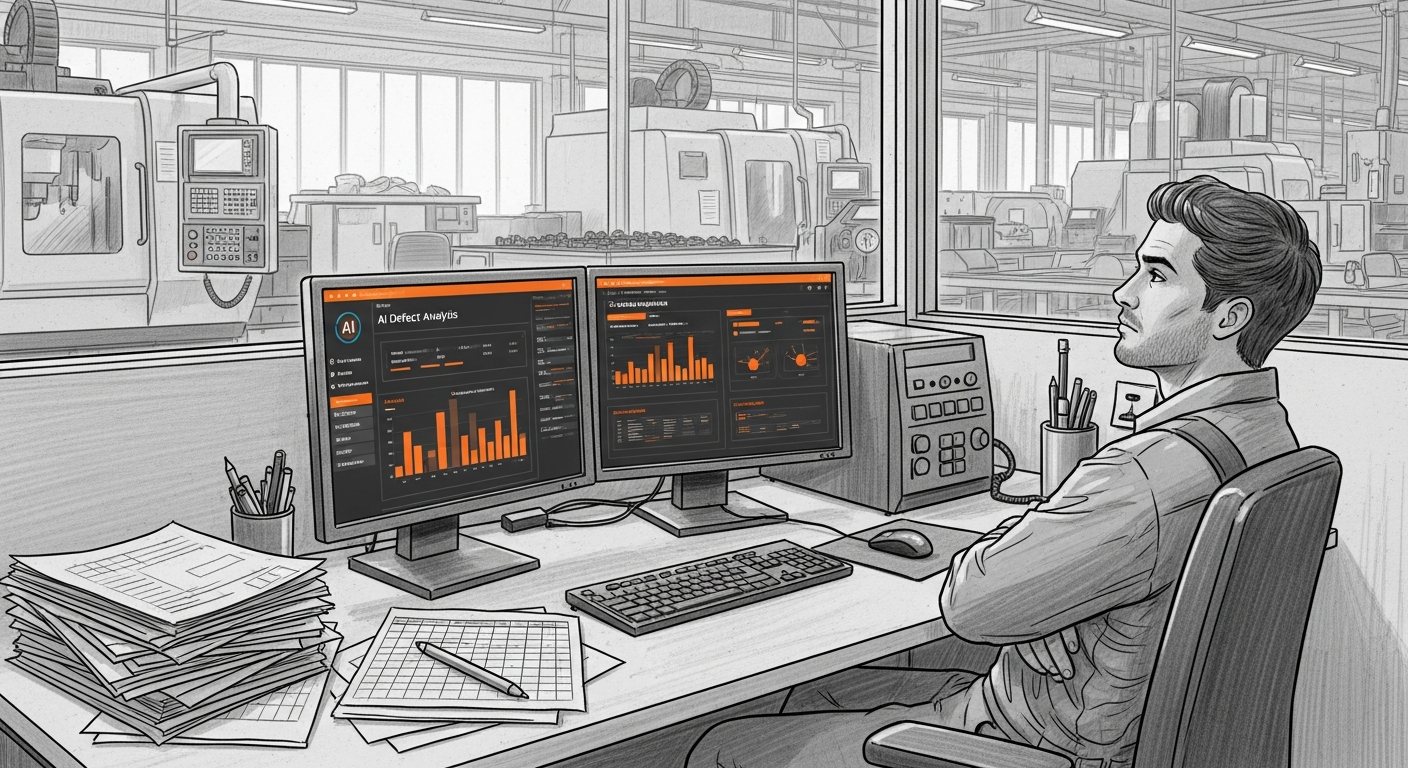
그 30분을 18년 동안 매일 반복했습니다 — 품질팀장이 본 AI Agent
18년차 품질팀장이 매일 아침 30분씩 반복하던 데이터 분석을 AI Agent가 3분 만에 해냈습니다. 챗봇과는 완전히 다른 물건 — 직접 시스템에 접근해서 데이터를 꺼내고 분석하는 AI의 현장 도입기.
Want to apply this in your factory?
MOAI helps manufacturing companies adopt AI tailored to their operations.
Talk to us →