Cloud computing
Cloud computing is defined by the [International Organization for Standardization](/wiki/international-organization-for-standardization) (ISO) as "a paradigm for enabling network access to a scalable and elastic pool of shareable physical or virtual resources with self-service provisioning and administration on demand". It is commonly referred to as "the cloud".
Characteristics
In 2011, the National Institute of Standards and Technology (NIST) identified five "essential characteristics" for cloud systems. Below are the exact definitions according to NIST:
- On-demand self-service: "A consumer can unilaterally provision computing capabilities, such as server time and network storage, as needed automatically without requiring human interaction with each service provider."
- Broad network access: "Capabilities are available over the network and accessed through standard mechanisms that promote use by heterogeneous thin or thick client platforms (e.g., mobile phones, tablets, laptops, and workstations)."
- Resource pooling: "The provider's computing resources are pooled to serve multiple consumers using a multi-tenant model, with different physical and virtual resources dynamically assigned and reassigned according to consumer demand."
- Rapid elasticity: "Capabilities can be elastically provisioned and released, in some cases automatically, to scale rapidly outward and inward commensurate with demand. To the consumer, the capabilities available for provisioning often appear unlimited and can be appropriated in any quantity at any time."
- Measured service: "Cloud systems automatically control and optimize resource use by leveraging a metering capability at some level of abstraction appropriate to the type of service (e.g., storage, processing, bandwidth, and active user accounts). Resource usage can be monitored, controlled, and reported, providing transparency for both the provider and consumer of the utilized service."
By 2023, the International Organization for Standardization (ISO) had expanded and refined the list.
History
The history of cloud computing extends to the 1960s, with the initial concepts of time-sharing becoming popularized via remote job entry (RJE). The "data center" model, where users submitted jobs to operators to run on mainframes, was predominantly used during this era. This period saw broad experimentation with making large-scale computing power more accessible through time-sharing, while optimizing infrastructure, platforms, and applications to improve efficiency for end users.
The "cloud" metaphor for virtualized services dates to 1994, when it was used by General Magic for the universe of "places" that mobile agents in the Telescript environment could "go". The metaphor is credited to David Hoffman, a General Magic communications specialist, based on its long-standing use in networking and telecom. The expression cloud computing became more widely known in 1996 when Compaq Computer Corporation drew up a business plan for future computing and the Internet. The company's ambition was to supercharge sales with "cloud computing-enabled applications". The business plan foresaw that online consumer file storage would likely be commercially successful. As a result, Compaq decided to sell server hardware to internet service providers.
In the 2000s, the application of cloud computing began to take shape with the establishment of Amazon Web Services (AWS) in 2002, which allowed developers to build applications independently. In 2006 Amazon Simple Storage Service, known as Amazon S3, and the Amazon Elastic Compute Cloud (EC2) were released. In 2008 NASA's development of the first open-source software for deploying private and hybrid clouds.
The following decade saw the launch of various cloud services. In 2010, Microsoft launched Microsoft Azure, and Rackspace Hosting and NASA initiated an open-source cloud-software project, OpenStack. IBM introduced the IBM SmartCloud framework in 2011, and Oracle announced the Oracle Cloud in 2012. In December 2019, Amazon launched AWS Outposts, a service that extends AWS infrastructure, services, APIs, and tools to customer data centers, co-location spaces, or on-premises facilities.
.png&width=800)
Source: Wikimedia Commons, CC BY-SA 4.0
Value proposition
Cloud computing can shorten time to market by offering pre-configured tools, scalable resources, and managed services, allowing users to focus on core business value rather than maintaining infrastructure. Cloud platforms can enable organizations and individuals to reduce upfront capital expenditures on physical infrastructure by shifting to an operational expenditure model, where costs scale with usage. Cloud platforms also offer managed services and tools, such as artificial intelligence, data analytics, and machine learning, which might otherwise require significant in-house expertise and infrastructure investment.
While cloud computing can offer cost advantages through effective resource optimization, organizations often face challenges such as unused resources, inefficient configurations, and hidden costs without proper oversight and governance. Many cloud platforms provide cost management tools, such as AWS Cost Explorer and Azure Cost Management, and frameworks like FinOps have emerged to standardize financial operations in the cloud. Cloud computing also facilitates collaboration, remote work, and global service delivery by enabling secure access to data and applications from any location with an internet connection.
Cloud providers offer various redundancy options for core services, such as managed storage and managed databases, though redundancy configurations often vary by service tier. Advanced redundancy strategies, such as cross-region replication or failover systems, typically require explicit configuration and may incur additional costs or licensing fees.
Cloud environments operate under a shared responsibility model, where providers are typically responsible for infrastructure security, physical hardware, and software updates, while customers are accountable for data encryption, identity and access management (IAM), and application-level security. These responsibilities vary depending on the cloud service model—Infrastructure as a Service (IaaS), Platform as a Service (PaaS), or Software as a Service (SaaS)—with customers typically having more control and responsibility in IaaS environments and progressively less in PaaS and SaaS models, often trading control for convenience and managed services.

Source: Wikimedia Commons, Public domain
Adoption and suitability
The decision to adopt cloud computing or maintain on-premises infrastructure depends on factors such as scalability, cost structure, latency requirements, regulatory constraints, and infrastructure customization.
Organizations with variable or unpredictable workloads, limited capital for upfront investments, or a focus on rapid scalability benefit from cloud adoption. Startups, SaaS companies, and e-commerce platforms often prefer the pay-as-you-go operational expenditure (OpEx) model of cloud infrastructure. Additionally, companies prioritizing global accessibility, remote workforce enablement, disaster recovery, and leveraging advanced services such as AI/ML and analytics are well-suited for the cloud. In recent years, some cloud providers have started offering specialized services for high-performance computing and low-latency applications, addressing some use cases previously exclusive to on-premises setups.
On the other hand, organizations with strict regulatory requirements, highly predictable workloads, or reliance on deeply integrated legacy systems may find cloud infrastructure less suitable. Businesses in industries like defense, government, or those handling highly sensitive data often favor on-premises setups for greater control and data sovereignty. Additionally, companies with ultra-low latency requirements, such as high-frequency trading (HFT) firms, rely on custom hardware (e.g., FPGAs) and physical proximity to exchanges, which most cloud providers cannot fully replicate.
Related Articles
From MOAI Insights

로봇은 왜 볼트를 떨어뜨리는가 — Physical AI가 공장에 필요한 진짜 이유
AI가 데이터 패턴만 외우는 시대는 끝나고 있다. 물리 법칙을 이해하는 Physical AI가 제조 현장에 왜 필요한지, KAIST 교수와 자동차 부품 공장 팀장이 볼트 하나를 놓고 이야기한다.

디지털 트윈, 당신 공장엔 이미 있다 — 엑셀과 MES 사이 어딘가에
디지털 트윈은 10억짜리 3D 시뮬레이션이 아니다. 지금 쓰고 있는 엑셀에 좋은 질문 하나를 더하는 것 — 두 전문가가 중소 제조기업이 이미 가진 데이터로 예측하는 공장을 만드는 현실적 로드맵을 제시한다.
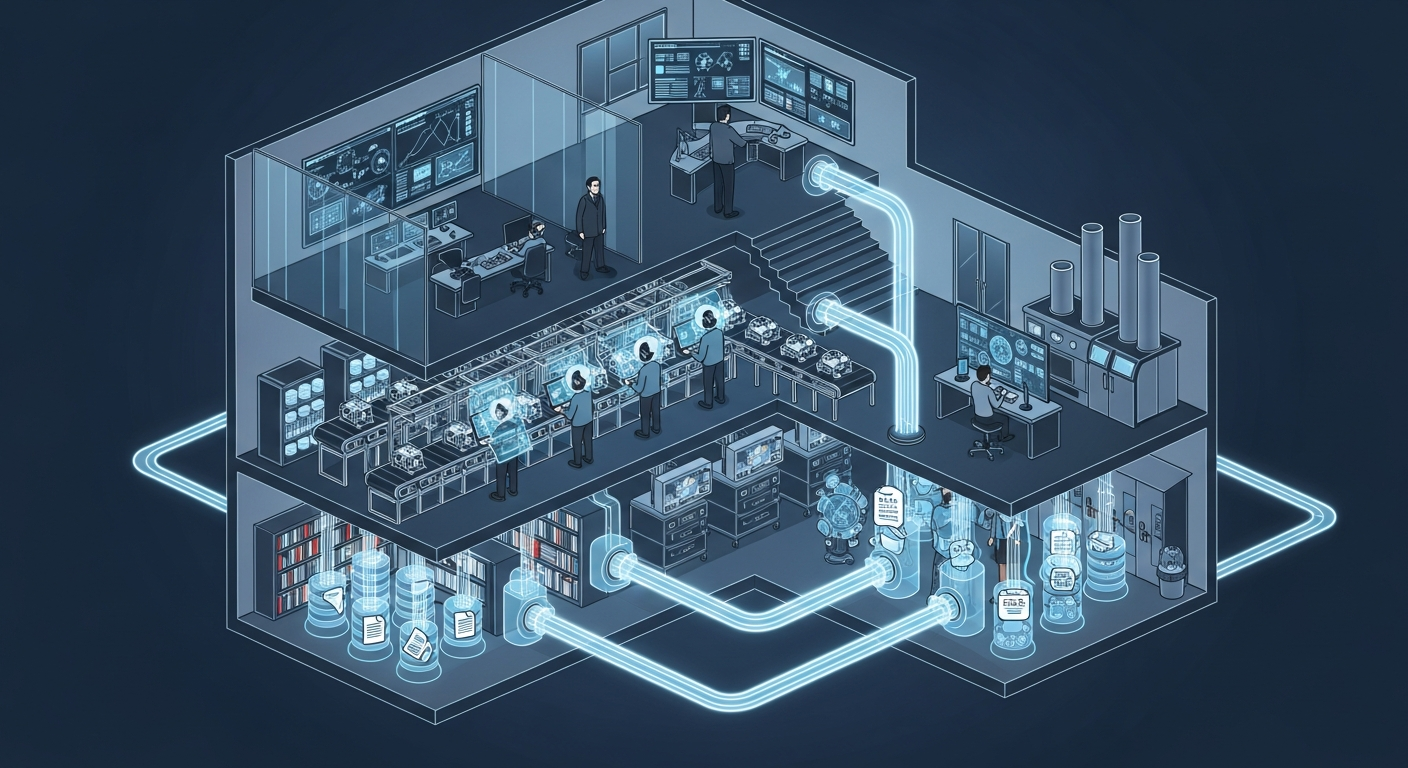
공장의 뇌는 어떻게 생겼는가 — 제조운영 AI 아키텍처 해부
지식관리, 업무자동화, 의사결정지원 — 따로 보면 다 있던 것들입니다. 제조 AI의 진짜 차이는 이 셋이 순환하면서 '우리 공장만의 지능'을 만든다는 데 있습니다.
Want to apply this in your factory?
MOAI helps manufacturing companies adopt AI tailored to their operations.
Talk to us →