Time domain
{{Short description|Analysis of math functions with respect to time}} In [[mathematics]] and [[signal processing]], the '''time domain''' is a representation of how a signal, function, or data set varies with time.{{Cite web |date=2024-07-17 |title=Time Domain Analysis vs Frequency Domain Analysis: A Guide and Comparison |url=https://resources.pcb.cadence.com/blog/2020-time-domain-analysis-vs-frequency-domain-analysis-a-guide-and-comparison |access-date=2025-02-16 |website=resources.pcb.cadence.com |language=en-US}} It is used for the analysis of [[function (mathematics)|mathematical functions]], physical [[signal (information theory)|signal]]s or [[time series]] of [[economics|economic]] or [[environmental statistics|environmental]] data.
In the time domain, the [[independent variable]] is time, and the [[dependent variable]] is the value of the signal. This contrasts with the [[frequency domain]], where the signal is represented by its constituent frequencies. For [[continuous-time]] signals, the value of the signal is defined for all [[real number]]s representing time. For [[Discrete time and continuous time|discrete-time]] signals, the value is known at discrete, often equally-spaced, time intervals.{{Cite web |title=Discrete Time Signal: Know Definition, Classification, Representation & Applications |url=https://testbook.com/electrical-engineering/discrete-time-signal |access-date=2025-02-16 |website=Testbook |language=en}} It is commonly visualized using a graph where the x-axis represents time and the y-axis represents the signal's value.{{Cite web |title=Definition of time domain |url=https://www.photonics.com/EDU/time_domain/d8234 |access-date=2025-02-16 |website=Photonics.com}} An [[oscilloscope]] is a common tool used to visualize real-world signals in the time domain.
Though most precisely referring to [[time in physics]], the term ''time domain'' may occasionally informally refer to [[Position (geometry)|position]] in [[space]] when dealing with [[Spatial frequency|spatial frequencies]], as a substitute for the more precise term ''spatial domain''.[[File:Fourier_transform_time_and_frequency_domains_(small).gif|frame|right|The [[Fourier transform]] relates the function in the time domain, shown in red, to the function in the frequency domain, shown in blue. The component frequencies, spread across the frequency spectrum, are represented as peaks in the frequency domain.]]
== Origin of term == The use of the contrasting terms ''time domain'' and ''[[frequency domain]]'' developed in U.S. [[communication engineering]] in the late 1940s, with the terms appearing together without definition by 1950.{{cite journal |first1=Y. W. |last1=Lee | first2=T. P. Jr. |last2=Cheatham |first3=J. B. |last3=Wiesner |year=1950 |title=Application of Correlation Analysis to the Detection of Periodic Signals in Noise |journal=Proceedings of the IRE |volume=38 |issue=10 |pages=1165–1171 |doi=10.1109/JRPROC.1950.233423 |s2cid=51671133 }} When an analysis uses the [[second]] or one of its multiples as a [[unit of measurement]], then it is in the time domain. When analysis concerns the reciprocal units such as [[Hertz]], then it is in the frequency domain.
== See also ==
- [[Frequency domain]]
- [[Fourier transform]]
- [[Laplace transform]]
- [[Blackman–Tukey transformation|Blackman–Tukey transform]]
== References == {{reflist}}
{{Statistics|analysis}}
[[Category:Time domain analysis]]
From MOAI Insights

디지털 트윈, 당신 공장엔 이미 있다 — 엑셀과 MES 사이 어딘가에
디지털 트윈은 10억짜리 3D 시뮬레이션이 아니다. 지금 쓰고 있는 엑셀에 좋은 질문 하나를 더하는 것 — 두 전문가가 중소 제조기업이 이미 가진 데이터로 예측하는 공장을 만드는 현실적 로드맵을 제시한다.
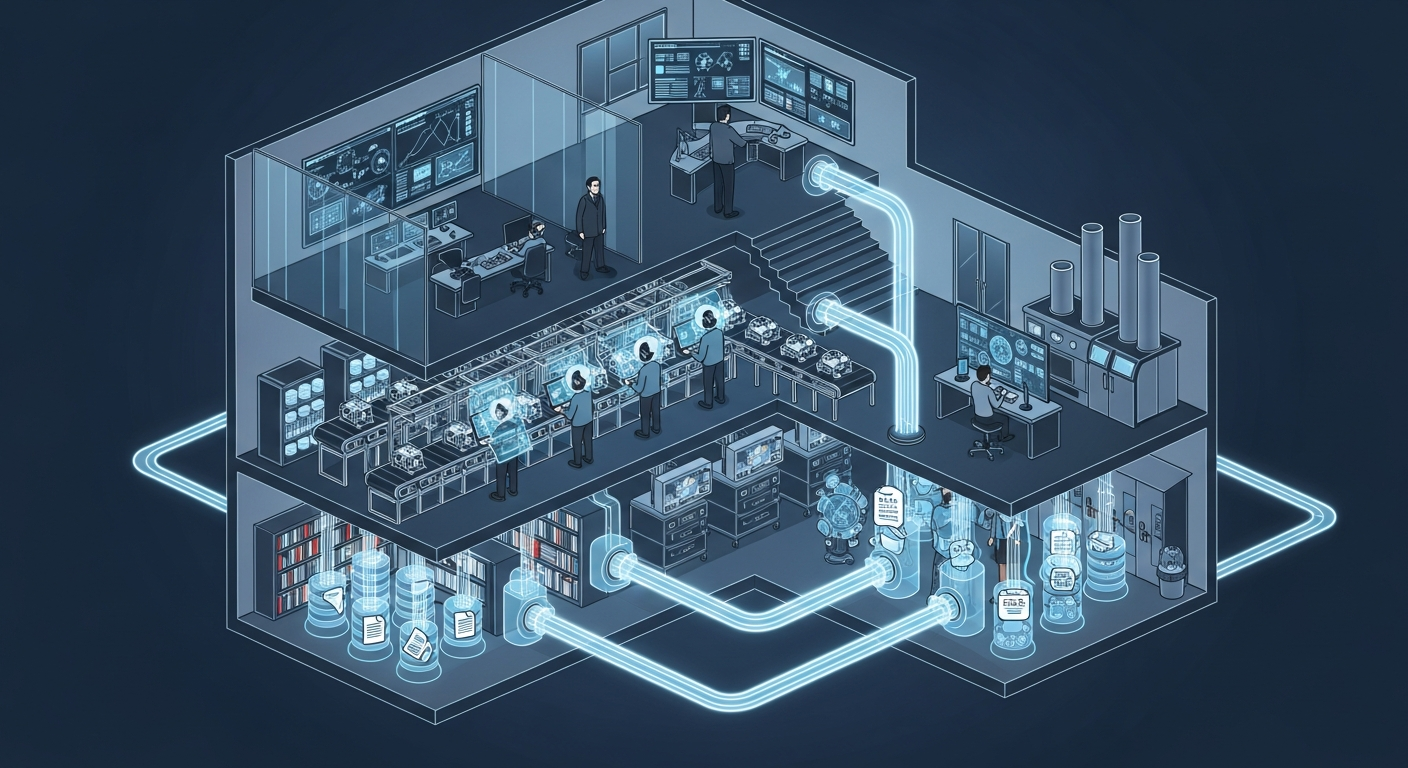
공장의 뇌는 어떻게 생겼는가 — 제조운영 AI 아키텍처 해부
지식관리, 업무자동화, 의사결정지원 — 따로 보면 다 있던 것들입니다. 제조 AI의 진짜 차이는 이 셋이 순환하면서 '우리 공장만의 지능'을 만든다는 데 있습니다.
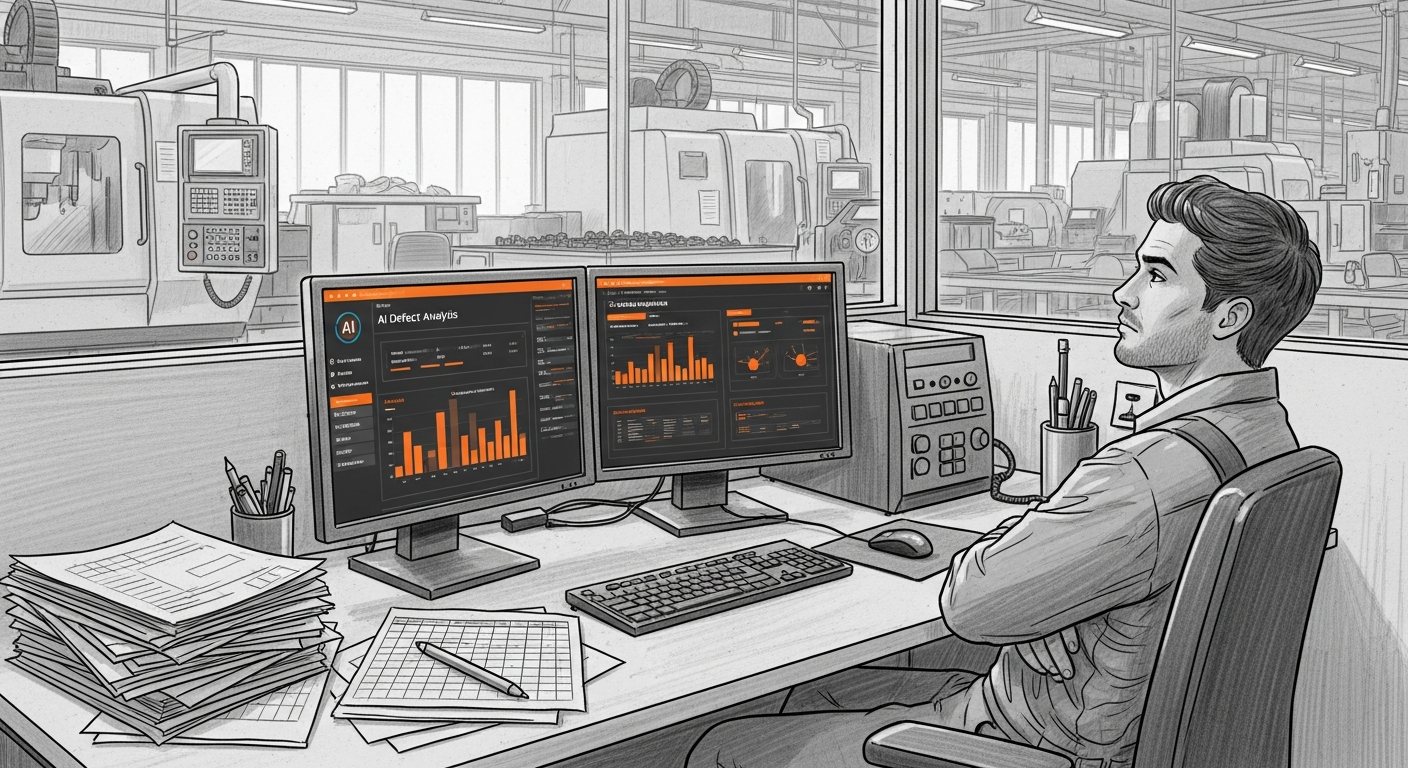
그 30분을 18년 동안 매일 반복했습니다 — 품질팀장이 본 AI Agent
18년차 품질팀장이 매일 아침 30분씩 반복하던 데이터 분석을 AI Agent가 3분 만에 해냈습니다. 챗봇과는 완전히 다른 물건 — 직접 시스템에 접근해서 데이터를 꺼내고 분석하는 AI의 현장 도입기.
Want to apply this in your factory?
MOAI helps manufacturing companies adopt AI tailored to their operations.
Talk to us →