Focused improvement
'''Focused improvement''' in the [[theory of constraints]] is an ensemble of activities aimed at elevating the performance of any system, especially a business system, with respect to its goal by eliminating its constraints one by one and by ''not'' working on non-constraints.{{Cite web|title = Focused improvement|url = http://informationquickfind.com/f/fo/focused_improvement.html|website = informationquickfind.com|accessdate = 2015-11-02|archive-date = 2016-03-04|archive-url = https://web.archive.org/web/20160304042314/http://informationquickfind.com/f/fo/focused_improvement.html|url-status = dead}}
Focused improvement can also be defined in simpler terms as a process that identifies the systems problems and then modifies the whole system in order to find the most cost effective, time saving and least disruptive solutions in order to optimize the system.
"Focused Improvement is the process of applying systematic problem solving methods to manufacturing. The process relies on aligning the correct method to the correct scenario".
== Development and Apparition == Focused improvement was developed as a working part of the Theory of Constraints management philosophy by [[Eliyahu M. Goldratt]] in his 1984 book titled ''[[The Goal (novel)|The Goal]]'', that is geared to help organizations continually achieve their goals. Unlike other popular performance improvement methods, such as [[Total quality management|TQM]] or [[Business process reengineering|reengineering]], '''F.I.''' focuses on solving real life problems and not on increasing the costs and distractions for the management's attention.
== Focused improvement V.S. Total Quality Management (TQM) == No general agreement has been reached about the characteristics of F.I. or TQM but to some extent we can observe similar traits in implementations of these processes.
=== Traits of Focused improvement ===
Identify the system's constraint(s).
Decide how to exploit the system's constraint(s).
Subordinate everything else to the above decision(s).
Elevate the system's constraint(s).
Communicate the new approach and move to the next improvement{{Cite web|title = Focused Improvements for Management Methods|url = http://www.manageprojectsbetter.com/focused-improvements.html|website = Mark Waldof Consulting LLC|accessdate = 2015-11-02}}
=== Traits of TQM ===
"Quality is defined by customers' requirements."
"Top management has direct responsibility for quality improvement."
"Increased quality comes from systematic analysis and improvement of work processes."
"Quality improvement is a continuous effort and conducted throughout the organization."
These two philosophies have the same main goal but they go about achieving it two different ways. The FI delivers short term results that can be translated into long term success if the process is repeated correctly without allowing it to lose momentum. The TQM has at its base client satisfaction but it only yields long term results. When choosing one of these two processes management has to take into account what are the company needs.
== Uses and potential == Products that are based on embedded computer systems has seen a rapid increase. During this time the features that are controlled or supported by software systems that are embedded have suffered an increase in their role becoming crucial. All these developments make it necessary to create and innovate new approaches for software process improvement that focus on improving specific product traits.{{Cite journal|title = Product Focused Process Improvement: Experiences of Applying the PROFES Improvement Methodology at DRÄGER|author=Adriana Bicego, Pieter Derks, Pasi Kuvaja, Dietmar Pfahl|citeseerx=10.1.1.136.8336|date=1999}}
Focused improvement can be used not only in business systems but in any type of system be it healthcare, education, waste management, space exploration systems ([[NASA]], etc.).
== Functioning principles == The FI is based on the [[Thinking processes (theory of constraints)|Five Thinking Processes]] that enable it to work in any cognitive system. The working principle of the five thinking processes is represented by the users ability to answer the following questions:
''What to change?''
''What to change it into?''
''How to cause the change?''
''Why Change?''
''How to maintain the process of ongoing improvement ?''
If all questions have an answer then the Focused improvement{{Cite web|title = focused improvement «|url = http://www.kcts.co.uk/blog/tag/focused-improvement|website = www.kcts.co.uk|accessdate = 2015-11-02|last = Oxton|first = Lee|archive-date = 2018-04-20|archive-url = https://web.archive.org/web/20180420203620/http://www.kcts.co.uk/blog/tag/focused-improvement|url-status = dead}} can be applied with relative ease
== Useful quotes ==
Source:{{Cite web |title=TPM Concepts and Literature Review |url=http://www.tpmconsulting.org/english_show.php?id=8 |accessdate=2015-11-02 |website=www.tpmconsulting.org}}
"Focused improvement includes all activities that maximize the [[Overall Equipment Effectiveness|overall effectiveness of equipment]], processes, and plants through uncompromising elimination of losses'''*''' and improvement of performance."Suzuki, T., Ed. (1994). TPM in Process Industries. Portland, OR, Productivity Press.Tajiri, M. and F. Gotoh (p.1992). TPM Implementation - A Japanese Approach. New York, McGraw Hill.
The objective of Focused Improvement is to assure that the equipment maintains a peak performance all the time.
"The fact is machines do virtually 100 percent of the product manufacturing work. The only thing we people do, whether we’re operators, technicians, engineers, or managers, is to tend to the needs of the machines in one way or another. The better our machines run, the more productive our shop floor, and the more successful our business."Leflar, J. (2001) p.15. Practical TPM. Portland, OR, Productivity Press.
The driving concept behind Focused Improvement is bringing your losses as close to zero as possible.
"Maximizing equipment effectiveness requires the complete elimination of failures, defects, and other negative phenomena – in other words, the wastes and losses incurred in equipment operation."Nakajima, S. (1988) p.19 Introduction to Total Productive Maintenance. Cambridge, MA, ProductivityPress.
== References == {{Reflist}}
{{DEFAULTSORT:Focused Improvement}} [[Category:Theory of constraints]]
From MOAI Insights

디지털 트윈, 당신 공장엔 이미 있다 — 엑셀과 MES 사이 어딘가에
디지털 트윈은 10억짜리 3D 시뮬레이션이 아니다. 지금 쓰고 있는 엑셀에 좋은 질문 하나를 더하는 것 — 두 전문가가 중소 제조기업이 이미 가진 데이터로 예측하는 공장을 만드는 현실적 로드맵을 제시한다.
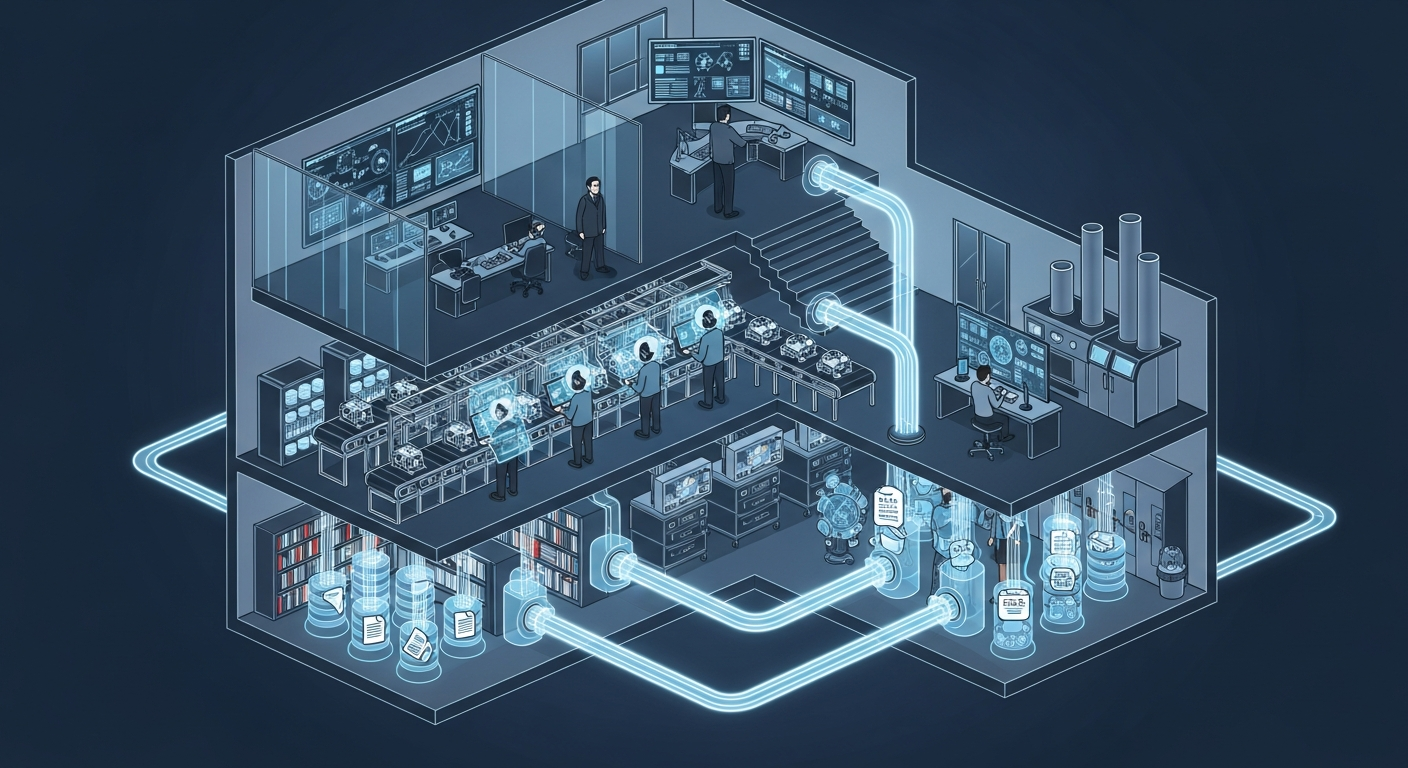
공장의 뇌는 어떻게 생겼는가 — 제조운영 AI 아키텍처 해부
지식관리, 업무자동화, 의사결정지원 — 따로 보면 다 있던 것들입니다. 제조 AI의 진짜 차이는 이 셋이 순환하면서 '우리 공장만의 지능'을 만든다는 데 있습니다.
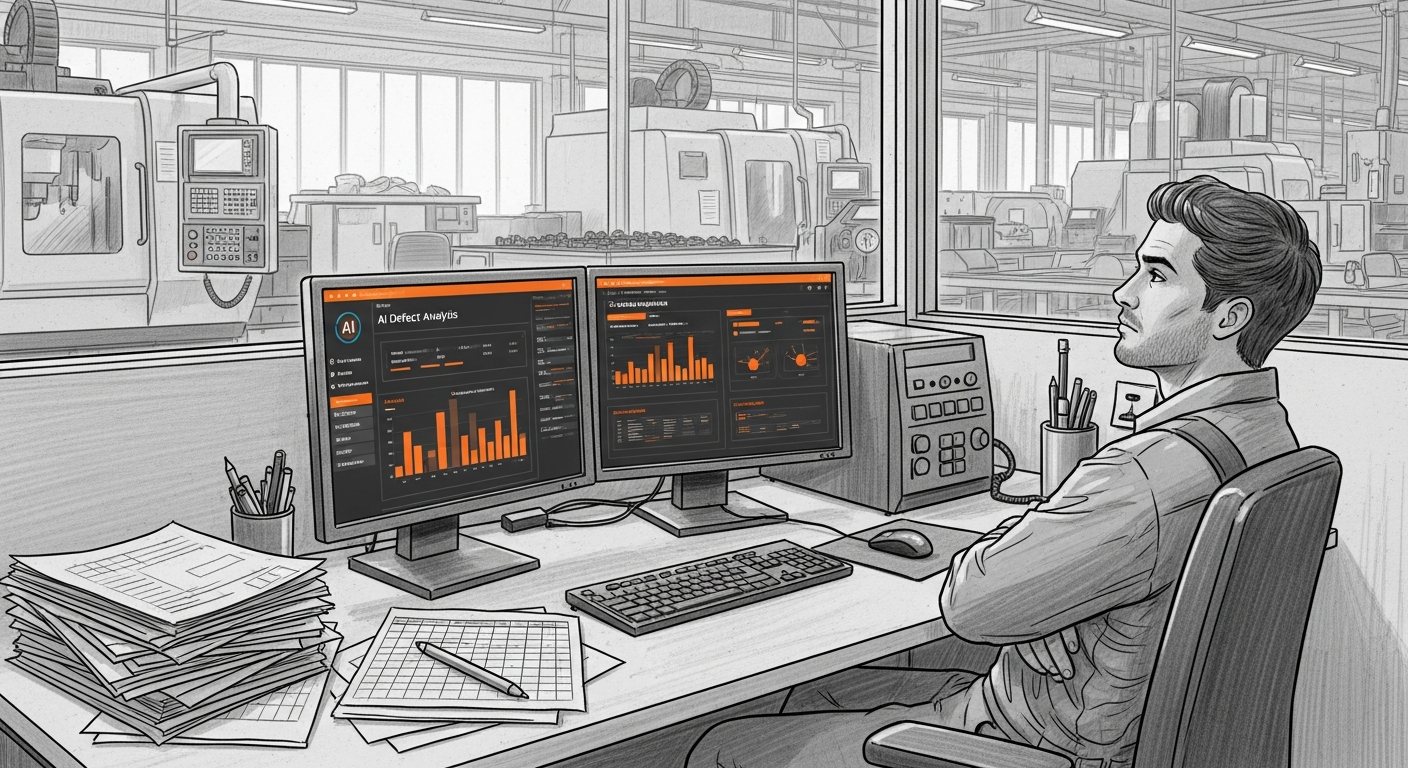
그 30분을 18년 동안 매일 반복했습니다 — 품질팀장이 본 AI Agent
18년차 품질팀장이 매일 아침 30분씩 반복하던 데이터 분석을 AI Agent가 3분 만에 해냈습니다. 챗봇과는 완전히 다른 물건 — 직접 시스템에 접근해서 데이터를 꺼내고 분석하는 AI의 현장 도입기.
Want to apply this in your factory?
MOAI helps manufacturing companies adopt AI tailored to their operations.
Talk to us →