Quality control
{{about|the project management process|the record label|Quality Control Music}} {{redirect|TQC}} {{Use dmy dates|date=July 2019}} {{short description|Processes that maintain quality at a constant level}} [[File:Fotothek df n-04 0000019.jpg|thumb|Quality inspector in a [[Volkseigener Betrieb]] sewing machine parts factory in Dresden, [[East Germany]], 1977]] [[File:Women workers checking 25-pounder artillery shells at the small arms factory of J & F Pool Ltd in Hayle, Cornwall, 1943. TR660.jpg|thumb|Munitions workers inspecting [[ML 3-inch mortar|3-inch mortar]] bombs, 1943]]
'''Quality control''' ('''QC''') is a process by which entities review the quality of all factors involved in [[Production (economics)|production]]. [[ISO 9000]] defines quality control as "a part of [[quality management]] focused on fulfilling quality requirements".ISO 9000:2005, Clause 3.2.10
This approach places emphasis on three aspects (enshrined in standards such as ISO 9001):{{cite web |url=http://www.praxiom.com/iso-9001.htm |title=ISO 9001 Translated Into Plain English |author=Praxiom Research Group Limited |publisher=Praxiom Research Group Limited |date=16 August 2017 |access-date=29 November 2017 |archive-date=2 December 2017 |archive-url=https://web.archive.org/web/20171202150849/http://www.praxiom.com/iso-9001.htm |url-status=dead }}{{cite book |title=Fundamentals of Industrial Quality Control |chapter=Chapter 1: Introduction |author=Aft, L.S. |publisher=CRC Press |pages=1–17 |year=1997 }}
Elements such as controls, job management, defined and well managed processes,{{cite web |url=http://www.nationalcallcenters.org/images/stories/InQueue/vol2no21.pdf |title=What the Call Center Industry Can Learn from Manufacturing: Part I |date=November 9, 2007 |author=Dennis Adsit |publisher=National Association of Call Centers |access-date=21 December 2012 |archive-date=4 July 2017 |archive-url=https://web.archive.org/web/20170704064643/http://www.nationalcallcenters.org/images/stories/InQueue/vol2no21.pdf |url-status=usurped }}{{cite web |url=http://www.nationalcallcenters.org/images/stories/InQueue/Vol2No22.pdf |archive-url=https://web.archive.org/web/20170704063943/http://www.nationalcallcenters.org/images/stories/InQueue/Vol2No22.pdf |archive-date=2017-07-04 |url-status=usurped |title=What the Call Center Industry Can Learn from Manufacturing: Part II |date=November 23, 2007 |author=Dennis Adsit |publisher=National Association of Call Centers |access-date=21 December 2012 }} performance and integrity criteria, and identification of records
Competence, such as knowledge, skills, experience, and qualifications
Soft elements, such as personnel, [[integrity]], [[confidence]], [[organizational culture]], [[motivation]], [[team spirit]], and quality relationships.
[[Inspection]] is a major component of quality control, where physical product is examined visually (or the end results of a service are analyzed). Product inspectors will be provided with lists and descriptions of unacceptable [[product defect]]s such as [[Fracture|cracks]] or surface [[wikt:blemish|blemish]]es for example.
== History and introduction == {{See also|History of technology}} Early [[stone tools]] such as [[anvil]]s had no holes and were not designed as [[interchangeable parts]]. [[Mass production]] established processes for the creation of parts and system with identical dimensions and design, but these processes are not uniform and hence some customers were unsatisfied with the result. Quality control separates the act of [[test method|testing]] [[product (business)|product]]s to uncover defects from the decision to allow or deny product release, which may be determined by fiscal constraints.{{cite book|last1=Shewhart|first1=Walter A. (Walter Andrew)|last2=Deming|first2=W. Edwards (William Edwards)|title=Statistical method from the viewpoint of quality control|date=1939|publisher=The Graduate School, The Department of Agriculture|location=Washington|pages=1–5|url=https://archive.org/stream/CAT10502416#page/2/mode/2up}} For contract work, particularly work awarded by government agencies, quality control issues are among the top reasons for not renewing a contract.{{cite web |url=http://www.opm.gov/fedclass/gs1910.pdf |archive-url=https://ghostarchive.org/archive/20221009/http://www.opm.gov/fedclass/gs1910.pdf |archive-date=2022-10-09 |url-status=live |title=Position Classification Standard for Quality Assurance Series, GS-1910 |date=March 1983 |publisher=US Office of Personnel Management |access-date=21 December 2012 }}
The simplest form of quality control was a sketch of the desired item. If the item did not match the sketch, the item was rejected, in a simple [[Go/no go]] procedure. However, manufacturers soon found it was difficult and costly to make parts be exactly like their depiction; hence around 1840 tolerance limits were introduced, wherein a design would function if its parts were measured to be within the limits. Quality was thus precisely defined using devices such as [[plug gauge]]s and [[ring gauge]]s. However, this did not address the problem of defective items; recycling or disposing of the [[waste]] adds to the cost of production, as does trying to reduce the defect rate. Various methods have been proposed to prioritize quality control issues and determine whether to leave them unaddressed or use [[quality assurance]] techniques to improve and stabilize production.
==Notable approaches== There is a tendency for individual consultants and organizations to name their own unique approaches to quality control—a few of these have ended up in widespread use:
{| class="wikitable" |+ |- ! Terminology !! Approximate year of first use !! Description |- | Statistical quality control (SQC) || 1930s || The application of statistical methods (specifically [[control chart]]s and [[acceptance sampling]]) to quality control{{Citation | editor-last = Juran | editor-first = Joseph M. | editor-link = Joseph M. Juran | year = 1995 | title = A History of Managing for Quality: The Evolution, Trends, and Future Directions of Managing for Quality | publisher = The [[American Society for Quality|American Society for Quality Control]] | location = [[Milwaukee|Milwaukee, Wisconsin]] | isbn = 9780873893411 | oclc = 32394752 | url-access = registration | url = https://archive.org/details/historyofmanagin0000unse }}{{rp|556}} |- | Total quality control (TQC) || 1956 || Popularized by [[Armand V. Feigenbaum]] in a [[Harvard Business Review]] article{{cite journal | last1 = Feigenbaum | first1 = Armand V. | author-link1 = Armand V. Feigenbaum | year = 1956 | title = Total Quality Control | journal = [[Harvard Business Review]] | location = [[Cambridge, Massachusetts]] | publisher = [[Harvard University Press]] | volume = 34 | issue = 6 | pages = 93–101 | issn = 0017-8012 | oclc = 1751795}} and book of the same name;{{citation |last=Feigenbaum |first=Armand Vallin |year=1961 |title=Total Quality Control |publisher=New York, McGraw-Hill |oclc=250573852}} stresses involvement of departments in addition to production (e.g., accounting, design, finance, human resources, marketing, purchasing, sales) |- | [[Statistical process control]] (SPC) || 1960s || The use of [[control chart]]s to monitor an individual industrial process and feed back performance to the operators responsible for that process; inspired by [[control system]]s |- | Company-wide quality control (CWQC) || 1968 || Japanese-style total quality control.{{Citation | last = Ishikawa | first = Kaoru | author-link = Kaoru Ishikawa | title = What Is Total Quality Control? The Japanese Way | edition = 1 | year = 1985 | publisher = [[Prentice-Hall]] | location = [[Englewood Cliffs, New Jersey]] | isbn = 978-0-13-952433-2 | oclc = 11467749 | pages = [https://archive.org/details/whatistotalquali00ishi/page/90 90–91] | url-access = registration | url = https://archive.org/details/whatistotalquali00ishi/page/90 }} |- | [[Total quality management]] (TQM) || 1985 || Quality movement originating in the [[United States Department of Defense]] that uses (in part) the techniques of statistical quality control to drive continuous organizational improvement{{Citation | last = Evans | first = James R. | last2 = Lindsay | first2 = William M. | year = 1999 | title = The Management and Control of Quality | edition = 4 | publisher = South-Western College Publications | location = [[Cincinnati|Cincinnati, Ohio]] | page = [https://archive.org/details/managementcontro0004evan/page/118 118] | isbn = 9780538882422 | oclc = 38475486 | quote = The term '''total quality management''', or '''TQM''', has been commonly used to denote the system of managing for total quality. (The term TQM was actually developed within the Department of Defense. It has since been renamed Total Quality Leadership, since leadership outranks management in military thought.) | url = https://archive.org/details/managementcontro0004evan/page/118 }} |- | [[Six Sigma]] (6σ) || 1986 || Statistical quality control applied to business strategy;{{cite web | url = http://www.motorolasolutions.com/web/Business/_Moto_University/_Documents/_Static_Files/What_is_SixSigma.pdf | title = What Is Six Sigma? | date = 2010-02-19 | publisher = Motorola University | location = [[Schaumburg, Illinois]] | page = 2 | access-date = 2013-11-24 | quote = When practiced as a management system, Six Sigma is a high performance system for executing business strategy. | url-status = dead | archive-url = https://web.archive.org/web/20131203031507/http://www.motorolasolutions.com/web/Business/_Moto_University/_Documents/_Static_Files/What_is_SixSigma.pdf | archive-date = 3 December 2013 | df = dmy-all }} originated by [[Motorola]] |- | [[Lean Six Sigma]] (L6σ)|| 2001 || Six Sigma applied with the principles of [[lean manufacturing]] and/or [[lean enterprise]]; originated by Wheat ''et al.''{{cite book |title=Leaning into Six Sigma: The Path to integration of Lean Enterprise and Six Sigma |author1=Wheat, B. |author2=Mills, C. |author3=Carnell, M. |publisher=Publishing Partners |pages=100 |year=2001 |isbn=9780971249103}} |}
==In project management== In [[project management]], quality control requires the project manager and/or the project team to inspect the accomplished work to ensure its alignment with the project scope.{{Cite web|last= Phillips |first= Joseph |title= Quality Control in Project Management |url= http://www.pmhut.com/quality-control-in-project-management |date=November 2008 |publisher=The Project Management Hut |access-date=21 December 2012 }} In practice, projects typically have a dedicated quality control team which focuses on this area.{{cite book |title=Project Quality Management: Why, What and How |author=Rose, K.H. |publisher=J. Ross Publishing |pages=224 |year=2014 |isbn=9781604271027}}
==See also== *[[Analytical quality control]] *[[Corrective and preventative action]] (CAPA) *[[Eight dimensions of quality]] *[[First article inspection]] (FAI) *[[Good Automated Manufacturing Practice|Good automated manufacturing practice]] (GAMP) *[[Good manufacturing practice]] *[[Quality assurance]] *[[Quality management framework]] *[[Standard operating procedure]] (SOP) *[[QA/QC]]
==References== {{Reflist}} *{{FS1037C MS188}}
==Further reading== *{{Citation | last = Radford | first = George S. | year = 1922 | title = The Control of Quality in Manufacturing | publisher = Ronald Press Co. | location = [[New York City|New York]] | oclc = 1701274 | url = https://archive.org/details/controlofquality00radf | access-date = 2013-11-16}} *{{Citation | last = Shewhart | first = Walter A. | author-link = Walter A. Shewhart | year = 1931 | title = Economic Control of Quality of Manufactured Product | publisher = D. Van Nostrand Co., Inc. | location = [[New York City|New York]] | oclc = 1045408}} *{{Citation | last = Juran | first = Joseph M. | author-link = Joseph M. Juran | year = 1951 | title = Quality-Control Handbook | publisher = [[McGraw-Hill]] | location = [[New York City|New York]] | oclc = 1220529}} *{{Citation | author = Western Electric Company | year = 1956 | title = Statistical Quality Control Handbook | edition = 1 | location = [[Indianapolis, Indiana]] | publisher = Western Electric Co. | oclc = 33858387| author-link = Western Electric Company | title-link = Statistical Quality Control }} *{{Citation | last = Feigenbaum | first = Armand V. | author-link = Armand V. Feigenbaum | year = 1961 | title = Total Quality Control | publisher = [[McGraw-Hill]] | location = [[New York City|New York]] | oclc = 567344}}
==External links== *[http://www.astm.org/Standards/quality-control-standards.html ASTM quality control standards]
{{Statistics|applications|state=expanded}} {{Authority control}}
[[Category:Quality control| ]] [[Category:Design for X]] [[Category:Quality management]] [[Category:Applied probability]]
Related Articles
From MOAI Insights

디지털 트윈, 당신 공장엔 이미 있다 — 엑셀과 MES 사이 어딘가에
디지털 트윈은 10억짜리 3D 시뮬레이션이 아니다. 지금 쓰고 있는 엑셀에 좋은 질문 하나를 더하는 것 — 두 전문가가 중소 제조기업이 이미 가진 데이터로 예측하는 공장을 만드는 현실적 로드맵을 제시한다.
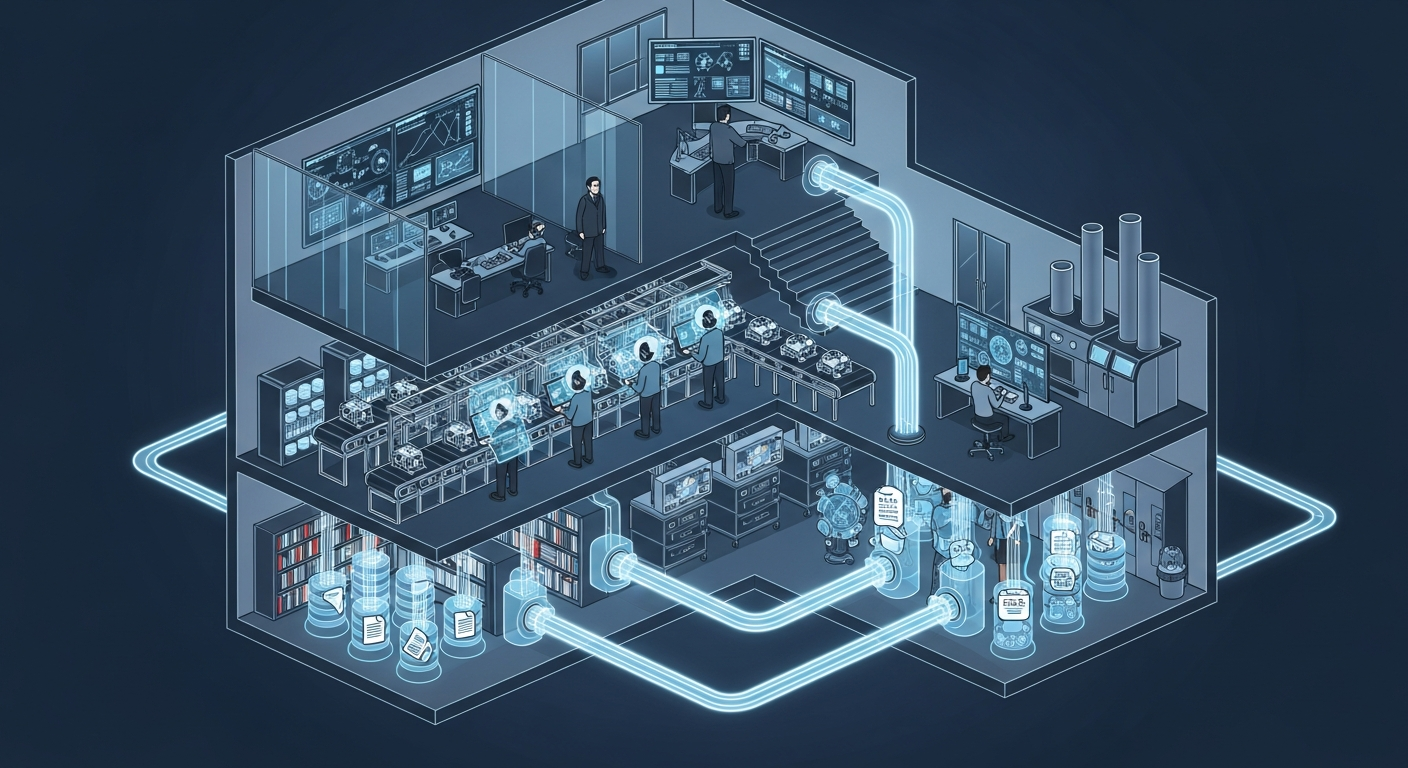
공장의 뇌는 어떻게 생겼는가 — 제조운영 AI 아키텍처 해부
지식관리, 업무자동화, 의사결정지원 — 따로 보면 다 있던 것들입니다. 제조 AI의 진짜 차이는 이 셋이 순환하면서 '우리 공장만의 지능'을 만든다는 데 있습니다.
그 30분을 18년 동안 매일 반복했습니다 — 품질팀장이 본 AI Agent
18년차 품질팀장이 매일 아침 30분씩 반복하던 데이터 분석을 AI Agent가 3분 만에 해냈습니다. 챗봇과는 완전히 다른 물건 — 직접 시스템에 접근해서 데이터를 꺼내고 분석하는 AI의 현장 도입기.
Want to apply this in your factory?
MOAI helps manufacturing companies adopt AI tailored to their operations.
Talk to us →