Technological advancement
Overview
Technological advancement refers to the process by which new technologies are invented, innovated, and diffused, thereby improving humanity's productive capacity and standard of living. It encompasses the transformation of scientific discoveries into practical applications and serves as a key driver of economic growth, social change, and cultural transformation. Technological advancement goes beyond the mere improvement of tools; it fundamentally alters the ways in which humans understand and interact with the world.
Historical Development
Ancient and Medieval Periods
The earliest technological advancements trace back to the crafting of stone tools, the use of fire, and the advent of agriculture. The Neolithic Revolution, occurring roughly 10,000 years ago, marked the transition from hunter-gatherer societies to agricultural communities, leading to sedentary living, population growth, and the emergence of urban civilizations.
Ancient civilizations saw the appearance of groundbreaking technologies including the wheel, writing, irrigation systems, and metallurgy. Mesopotamian cuneiform script, Egyptian pyramid construction techniques, and China's Four Great Inventions (paper, printing, gunpowder, and the compass) serve as representative examples of each civilization's technological prowess.
During the medieval period, advances in agricultural technology—watermills, windmills, the three-field system, and the heavy plow—strengthened Europe's economic foundations. Greek and Roman scientific knowledge transmitted through the Arab world would later form the basis of the Renaissance.
The Industrial Revolution
The First Industrial Revolution, which began in late 18th-century Britain, is considered the most dramatic turning point in the history of technological advancement. The invention and refinement of the steam engine drove the mechanization of the textile industry, mining, and transportation, while the establishment of the factory system made mass production possible.
The Second Industrial Revolution of the late 19th century introduced electricity, the internal combustion engine, mass steel production, and the chemical industry. During this period, the expansion of the telephone, telegraph, and railway networks revolutionized communication and transportation, connecting the world more closely than ever before.
The 20th Century and Beyond
The 20th century witnessed rapid technological advancement across diverse fields including aviation, nuclear energy, electronics, and computer science. In particular, the development of semiconductors, computers, and the internet from the 1960s onward—often called the Third Industrial Revolution or Digital Revolution—catalyzed the transition to an information society.
In the 21st century, the Fourth Industrial Revolution is underway, centered on artificial intelligence, big data, the Internet of Things (IoT), blockchain, and genetic engineering. These technologies are blurring the boundaries between the physical, digital, and biological worlds, transforming society at an unprecedented pace.
Theories of Technological Advancement
Linear and Nonlinear Models
Early theories of technological advancement proposed a linear model progressing from scientific research to technological development to commercialization. However, the nonlinear model, which accounts for the complex interplay of market demand, user feedback, and serendipitous discoveries, has gained greater acceptance as a more realistic description of how technology evolves.
Schumpeter's Creative Destruction
Economist Joseph Schumpeter described technological advancement as a process of creative destruction, in which existing industries and firms are dismantled while new industries and opportunities emerge. This theory emphasizes that technological innovation is the fundamental engine of economic fluctuation and growth.
Moore's Law
Moore's Law, articulated by Intel co-founder Gordon Moore in 1965, is the empirical observation that the number of transistors on integrated circuits doubles approximately every two years. This law has been used for decades to explain the exponential growth of computing technology, though discussions about its continued validity have emerged as physical limits are approached.
Technological Singularity
The technological singularity hypothesis, advocated by futurist Ray Kurzweil and others, posits that once artificial intelligence surpasses human intelligence, technological advancement will accelerate at an unpredictable and uncontrollable rate.
Economic Impact
Technological advancement is recognized as one of the most important factors in economic growth. In Robert Solow's neoclassical growth model, technological advancement is treated as the primary source of total factor productivity (TFP)—the residual growth not explained by increases in capital and labor inputs.
Key economic effects of technological advancement include:
- Productivity gains: Enabling greater output from the same level of inputs.
- Creation of new industries: New sectors such as automotive, aviation, IT, and biotechnology continually emerge.
- Shifts in employment structure: Automation eliminates certain occupations while generating new ones.
- Acceleration of globalization: Advances in communication and transportation technology facilitate international trade and capital flows.
Social and Ethical Issues
While technological advancement brings enormous benefits to humanity, it also raises a range of social and ethical concerns.
Technology Gaps and Inequality
Disparities in access to and ability to utilize new technologies can deepen the digital divide among individuals, enterprises, and nations. The technology gap between developed and developing countries can serve as a factor that widens economic inequality.
Employment and Automation
Advances in artificial intelligence and robotics have raised concerns about the potential for large-scale technological unemployment. As automation extends beyond simple repetitive tasks into professional domains, societies must prepare for shifts in future labor markets.
Privacy and Surveillance
The growth of digital technologies and data collection capabilities has given rise to concerns about violations of personal privacy and the advent of mass surveillance societies. Technologies such as facial recognition, location tracking, and big data analytics are heightening tensions between national security and individual freedom.
Environmental Issues
The environmental impact of technological advancement is double-edged. On one hand, green technologies such as renewable energy, electric vehicles, and carbon capture are being developed; on the other, mass production and consumption systems are accelerating resource depletion and environmental pollution.
Military Applications
Nuclear weapons, autonomous weapons systems, and cyber warfare technologies demonstrate the risks associated with military applications of technological advancement. International discussions on the development and regulation of lethal autonomous weapons systems (LAWS) are actively ongoing.
Measuring Technological Advancement
Quantitatively measuring technological advancement is challenging, but several indicators are widely used:
- Research and development (R&D) expenditure: Reflects the innovation efforts of nations or enterprises.
- Patent filings: Indirectly indicates the frequency of new inventions and innovations.
- Total factor productivity (TFP): Measures the contribution to growth beyond capital and labor inputs.
- Technology adoption rates: Tracks the social diffusion of specific technologies such as the internet and smartphones.
See Also
- Industrial Revolution
- Fourth Industrial Revolution
- Information society
- Artificial intelligence
- Creative destruction
- Moore's law
- Technological singularity
- Digital divide
- Technological unemployment
Related Articles
From MOAI Insights
새벽 3시, 반장의 귀가 처음으로 받아 적혔다
23년 경력 반장은 사출기 소리만 듣고 불량을 안다. 그 귀가 처음으로 데이터가 되던 밤, 공장에서 가장 불편한 질문이 떠올랐다.
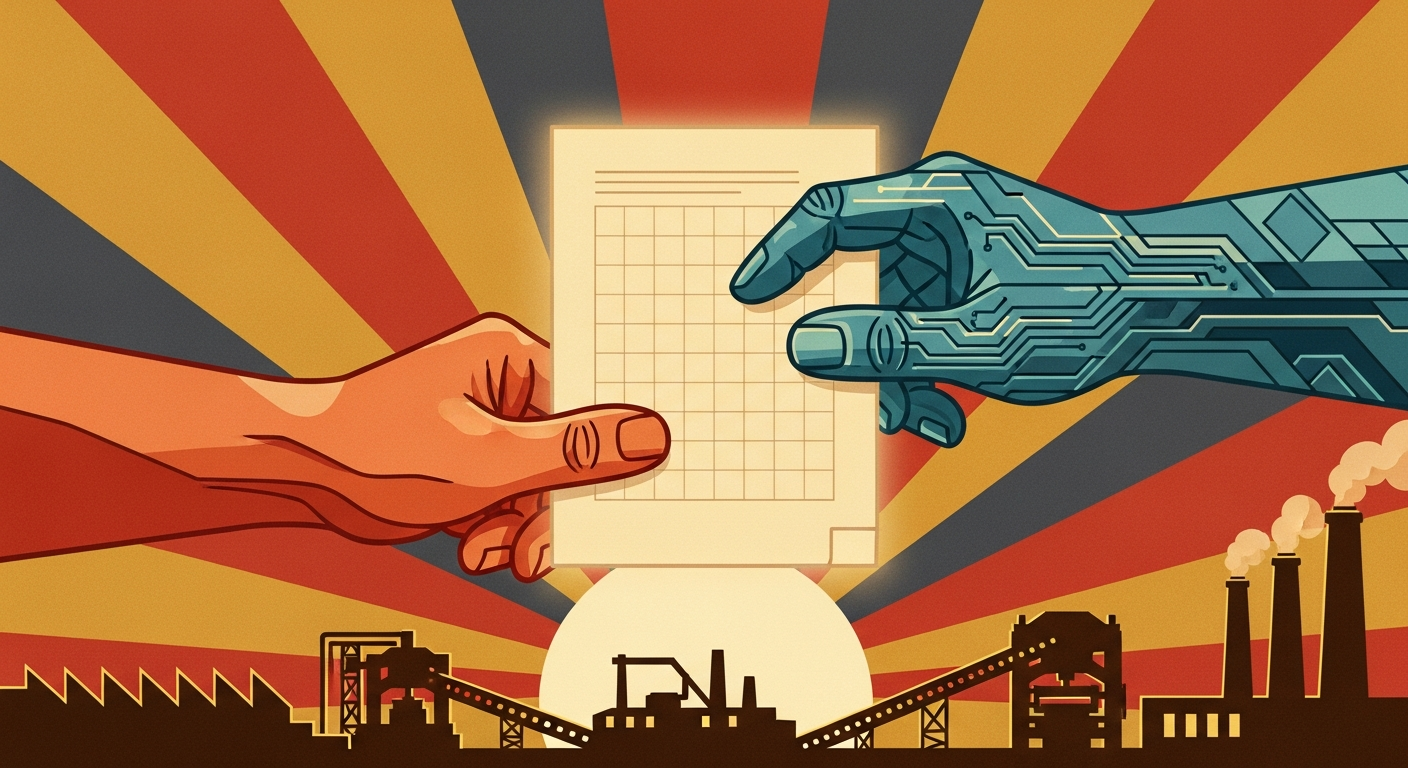
AI가 지시를 내리기 시작하면, 팀장은 무엇을 하는가 — 생산관리자에게 보내는 편지
AI Agent가 작업지시서를 스스로 생성하는 공장에서, 중간관리자의 존재 이유를 다시 묻는 공개 서신.
사장님께 드리는 편지 — 공장을 복제하시겠습니까?
독일 중소제조 컨설턴트가 한국 공장 대표에게 보내는 편지. 디지털 트윈은 기술이 아니라, 내 공장을 처음으로 객관적으로 바라보는 행위다.
Want to apply this in your factory?
MOAI helps manufacturing companies adopt AI tailored to their operations.
Talk to us →