Factory
A factory, manufacturing plant or production plant is an industrial facility, often a complex consisting of several buildings filled with machinery, where workers manufacture items or operate machines which process each item into another. They are a critical part of modern economic production, with the majority of the world's goods being created or processed within factories.
 Source: Wikimedia Commons, Public domain
Factories arose with the introduction of machinery during the Industrial Revolution, when the capital and space requirements became too great for cottage industry or workshops. Early factories that contained small amounts of machinery, such as one or two spinning mules, and fewer than a dozen workers have been called "glorified workshops".
Most modern factories have large warehouses or warehouse-like facilities that contain heavy equipment used for assembly line production. Large factories tend to be located with access to multiple modes of transportation, some having rail, highway and water loading and unloading facilities. In some countries like Australia, it is common to call a factory building a "Shed".
Factories may either make discrete products or some type of continuously produced material, such as chemicals, pulp and paper, or refined oil products. Factories manufacturing chemicals are often called plants and may have most of their equipment – tanks, pressure vessels, chemical reactors, pumps and piping – outdoors and operated from control rooms. Oil refineries have most of their equipment outdoors.
Discrete products may be final goods, or parts and sub-assemblies which are made into final products elsewhere. Factories may be supplied parts from elsewhere or make them from raw materials. Continuous production industries typically use heat or electricity to transform streams of raw materials into finished products.
The term mill originally referred to the milling of grain, which usually used natural resources such as water or wind power until those were displaced by steam power in the 19th century. Because many processes like spinning and weaving, iron rolling, and paper manufacturing were originally powered by water, the term survives as in steel mill, paper mill, etc.
 Source: Wikimedia Commons, CC BY-SA 3.0
History
Max Weber considered production during ancient and medieval times as never warranting classification as factories, with methods of production and the contemporary economic situation incomparable to modern or even pre-modern developments of industry. In ancient times, the earliest production limited to the household, developed into a separate endeavor independent to the place of inhabitation with production at that time only beginning to be characteristic of industry, termed as "unfree shop industry", a situation caused especially under the reign of the Egyptian pharaoh, with slave employment and no differentiation of skills within the slave group comparable to modern definitions as division of labour.
According to translations of Demosthenes and Herodotus, Naucratis was a, or the only, factory in the entirety of ancient Egypt. A source of 1983 (Hopkins), states the largest factory production in ancient times was of 120 slaves within fourth century BC Athens. An article within the New York Times article dated 13 October 2011 states:
"In African Cave, Signs of an Ancient Paint Factory" – (John Noble Wilford) ... discovered at Blombos Cave, a cave on the south coast of South Africa where 100,000-year-old tools and ingredients were found with which early modern humans mixed an ochre-based paint.
Although The Cambridge Online Dictionary definition of factory states:
a building or set of buildings where large amounts of goods are made using machines
elsewhere:
... the utilization of machines presupposes social cooperation and the division of labour
The first machine is stated by one source to have been traps used to assist with the capturing of animals, corresponding to the machine as a mechanism operating independently or with very little force by interaction from a human, with a capacity for use repeatedly with operation exactly the same on every occasion of functioning. The wheel was invented c. 3000 BC, the spoked wheel c. 2000 BC. The Iron Age began approximately 1200–1000 BC. However, other sources define machinery as a means of production.
Archaeology provides a date for the earliest city as 5000 BC as Tell Brak (Ur et al. 2006), therefore a date for cooperation and factors of demand, by an increased community size and population to make something like factory level production a conceivable necessity.
Archaeologist Bonnet unearthed the foundations of numerous workshops in the city of Kerma proving that as early as 2000 BC Kerma was a large urban capital.
The watermill was first made before the end of the third century BC. In the third century BC, Philo of Byzantium describes a water-driven wheel in his technical treatises. Factories producing garum were common in the Roman Empire. The Barbegal aqueduct and mills are an industrial complex from the second century AD found in southern France. By the time of the fourth century AD, there was a water-milling installation with a capacity to grind 28 tons of grain per day, a rate sufficient to meet the needs of 80,000 persons, in the Roman Empire.
The large population increase in medieval Islamic cities, such as Baghdad's 1.5 million population, led to the development of large-scale factory milling installations with higher productivity to feed and support the large growing population. A tenth-century grain-processing factory in the Egyptian town of Bilbays, for example, milled an estimated 300 tons of grain and flour per day. Both watermills and windmills were widely used in the Islamic world at the time.
 Source: Wikimedia Commons, Public domain
The Venice Arsenal also provides one of the first examples of a factory in the modern sense of the word. Founded in 1104 in Venice, Republic of Venice, several hundred years before the Industrial Revolution, it mass-produced ships on assembly lines using manufactured parts. The Venice Arsenal apparently produced nearly one ship every day and, at its height, employed 16,000 people.
Industrial Revolution
One of the earliest factories was John Lombe's water-powered silk mill at Derby, operational by 1721. By 1746, an integrated brass mill was working at Warmley near Bristol. Raw material went in at one end, was smelted into brass and was turned into pans, pins, wire, and other goods. Housing was provided for workers on site. Josiah Wedgwood in Staffordshire and Matthew Boulton at his Soho Manufactory were other prominent early industrialists, who employed the factory system.
The factory system began widespread use somewhat later when cotton spinning was mechanized.
 Source: Wikimedia Commons, Public domain
Richard Arkwright is the person credited with inventing the prototype of the modern factory. After he patented his water frame in 1769, he established Cromford Mill, in Derbyshire, England, significantly expanding the village of Cromford to accommodate the migrant workers new to the area. The factory system was a new way of organizing workforce made necessary by the development of machines which were too large to house in a worker's cottage. Working hours were as long as they had been for the farmer, that is, from dawn to dusk, six days per week. Overall, this practice essentially reduced skilled and unskilled workers to replaceable commodities. Arkwright's factory was the first successful cotton spinning factory in the world; it showed unequivocally the way ahead for industry and was widely copied.
 Source: Wikimedia Commons, Public domain
Between 1770 and 1850 mechanized factories supplanted traditional artisan shops as the predominant form of manufacturing institution, because the larger-scale factories enjoyed a significant technological and supervision advantage over the small artisan shops. The earliest factories (using the factory system) developed in the cotton and wool textiles industry. Later generations of factories included mechanized shoe production and manufacturing of machinery.
 Source: Wikimedia Commons, Public domain
Related Articles
From MOAI Insights
새벽 3시, 반장의 귀가 처음으로 받아 적혔다
23년 경력 반장은 사출기 소리만 듣고 불량을 안다. 그 귀가 처음으로 데이터가 되던 밤, 공장에서 가장 불편한 질문이 떠올랐다.
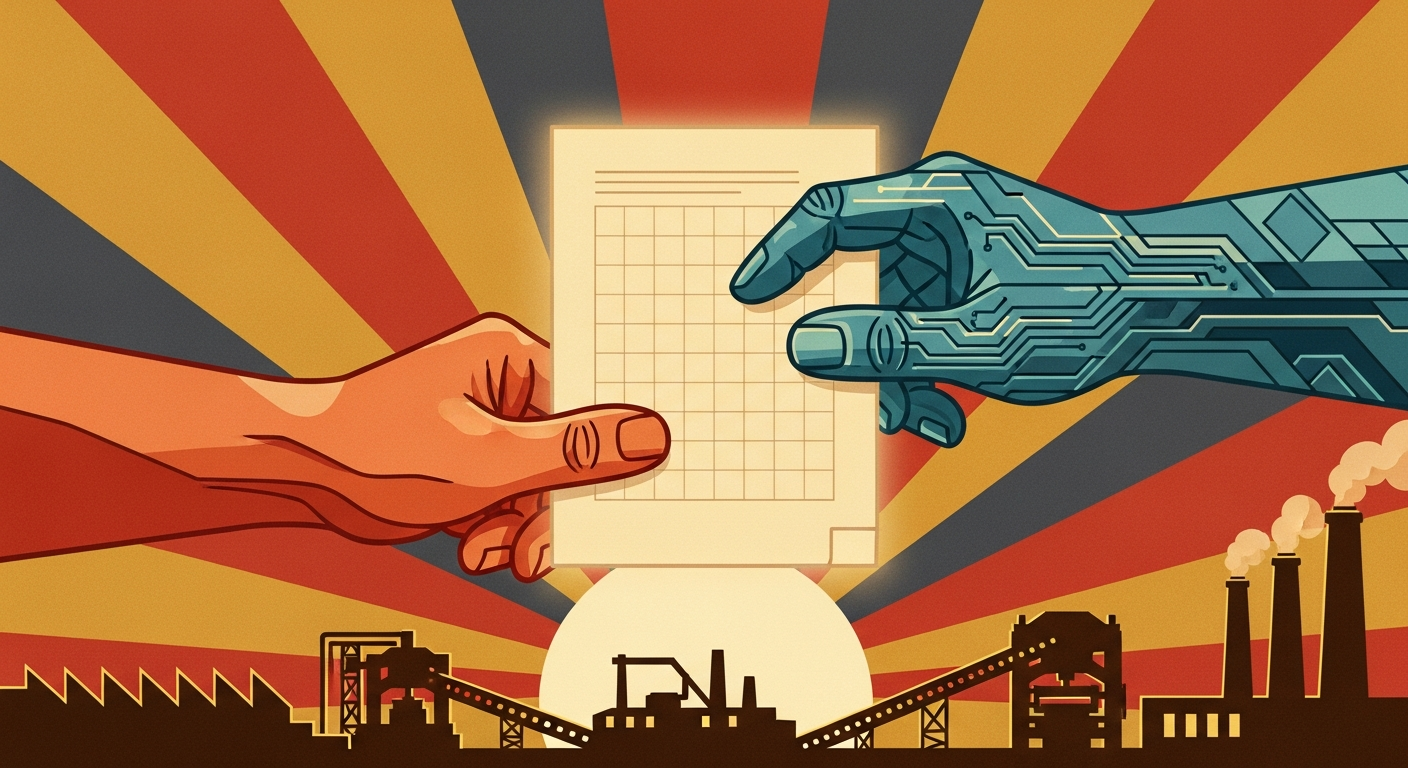
AI가 지시를 내리기 시작하면, 팀장은 무엇을 하는가 — 생산관리자에게 보내는 편지
AI Agent가 작업지시서를 스스로 생성하는 공장에서, 중간관리자의 존재 이유를 다시 묻는 공개 서신.
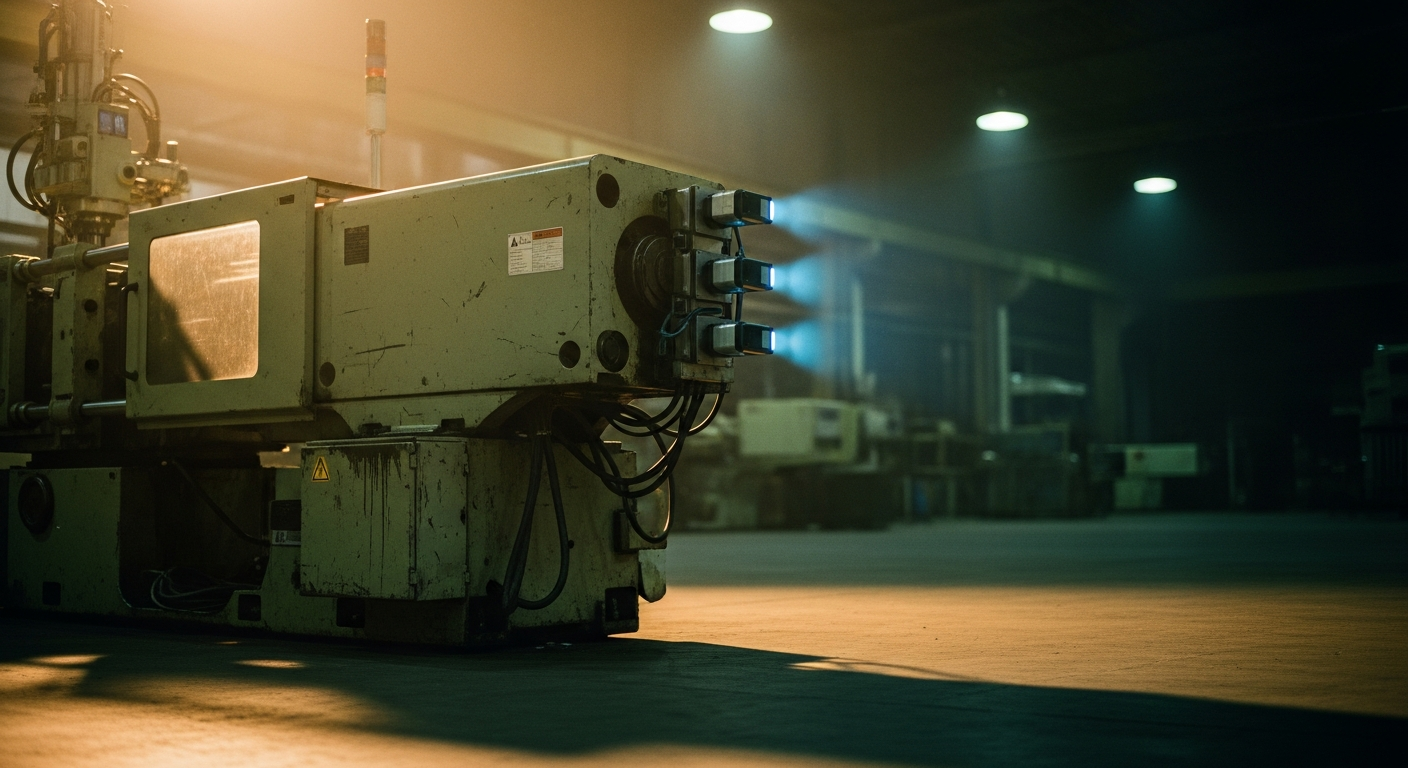
사장님께 드리는 편지 — 공장을 복제하시겠습니까?
독일 중소제조 컨설턴트가 한국 공장 대표에게 보내는 편지. 디지털 트윈은 기술이 아니라, 내 공장을 처음으로 객관적으로 바라보는 행위다.
Want to apply this in your factory?
MOAI helps manufacturing companies adopt AI tailored to their operations.
Talk to us →