Artificial intelligence
Artificial intelligence (AI) is the capability of computational systems to perform tasks typically associated with human intelligence, such as learning, reasoning, problem-solving, perception, and decision-making. It is a field of research in engineering, mathematics and computer science that develops and studies methods and software that enable machines to perceive their environment and use learning and intelligence to take actions that maximize their chances of achieving defined goals.
%20artificial%20intelligence%20icon.png&width=800) Source: Wikimedia Commons, Public domain
Source: Wikimedia Commons, Public domain
High-profile applications of AI include advanced web search engines, chatbots, virtual assistants, autonomous vehicles, and play and analysis in strategy games (e.g., chess and Go). Since the 2020s, generative AI has become widely available to generate images, audio, and videos from text prompts.
The traditional goals of AI research include learning, reasoning, knowledge representation, planning, natural language processing, and perception, as well as support for robotics. To reach these goals, AI researchers have used techniques including state space search and mathematical optimization, formal logic, artificial neural networks, and methods based on statistics, operations research, and economics. AI also draws upon psychology, linguistics, philosophy, neuroscience, and other fields. Some companies, such as OpenAI, Google DeepMind and Meta, aim to create artificial general intelligence (AGI) – AI that can complete virtually any cognitive task at least as well as a human.
Artificial intelligence was founded as an academic discipline in 1956, and the field went through multiple cycles of optimism throughout its history, followed by periods of disappointment and loss of funding, known as AI winters. Funding and interest increased substantially after 2012, when graphics processing units began being used to accelerate neural networks, and deep learning outperformed previous AI techniques. This growth accelerated further after 2017 with the transformer architecture. In the 2020s, an AI boom has coincided with advances in generative AI, which allowed for the creation and modification of media. In addition to AI safety and unintended consequences and harms from the use of AI, ethical concerns, AI's long-term effects, and potential existential risks have prompted discussions of AI regulation.
Goals
The general problem of simulating (or creating) intelligence has been broken into subproblems. These consist of particular traits or capabilities that researchers expect an intelligent system to display. The traits described below have received the most attention and cover the scope of AI research.
Reasoning and problem-solving
Early researchers developed algorithms that imitated step-by-step reasoning that humans use when they solve puzzles or make logical deductions. By the late 1980s and 1990s, methods were developed for dealing with uncertain or incomplete information, employing concepts from probability and economics.
Many of these algorithms are insufficient for solving large reasoning problems because they experience a "combinatorial explosion": They become exponentially slower as the problems grow. Even humans rarely use the step-by-step deduction that early AI research could model. They solve most of their problems using fast, intuitive judgments. Accurate and efficient reasoning is an unsolved problem.
Knowledge representation
Knowledge representation and knowledge engineering allow AI programs to answer questions intelligently and make deductions about real-world facts. Formal knowledge representations are used in content-based indexing and retrieval, scene interpretation, clinical decision support, knowledge discovery (mining "interesting" and actionable inferences from large databases), and other areas.
A knowledge base is a body of knowledge represented in a form that can be used by a program. An ontology is the set of objects, relations, concepts, and properties used by a particular domain of knowledge. Knowledge bases need to represent things such as objects, properties, categories, and relations between objects; situations, events, states, and time; causes and effects; knowledge about knowledge (what we know about what other people know); default reasoning (things that humans assume are true until they are told differently and will remain true even when other facts are changing); and many other aspects and domains of knowledge.
Among the most difficult problems in knowledge representation are the breadth of commonsense knowledge (the set of atomic facts that the average person knows is enormous); and the sub-symbolic form of most commonsense knowledge (much of what people know is not represented as "facts" or "statements" that they could express verbally). There is also the difficulty of knowledge acquisition, the problem of obtaining knowledge for AI applications.
Planning and decision-making
An "agent" is any entity (artificial or not) that perceives and takes actions in the world. A rational agent has goals or preferences and takes actions to make them happen. In automated planning, the agent has a specific goal. In automated decision-making, the agent has preferences—there are some situations it would prefer to be in, and some situations it is trying to avoid. The decision-making agent assigns a number to each situation (called the "utility") that measures how much the agent prefers it. For each possible action, it can calculate the "expected utility": the utility of all possible outcomes of the action, weighted by the probability that the outcome will occur. It can then choose the action with the maximum expected utility.
In classical planning, the agent knows exactly what the effect of any action will be. In most real-world problems, however, the agent may not be certain about the situation they are in (it is "unknown" or "unobservable") and it may not know for certain what will happen after each possible action (it is not "deterministic"). It must choose an action by making a probabilistic guess and then reassess the situation to see if the action worked.
Alongside thorough testing and improvement based on previous decisions, having an explanation for why the agent took certain decisions is a way to build trust, especially when the decisions have to be relied upon.
In some problems, the agent's preferences may be uncertain, especially if there are other agents or humans involved. These can be learned (e.g., with inverse reinforcement learning), or the agent can seek information to improve its preferences. Information value theory can be used to weigh the value of exploratory or experimental actions. The space of possible future actions and situations is typically intractably large, so the agents must take actions and evaluate situations while being uncertain of what the outcome will be.
A Markov decision process has a transition model that describes the probability that a particular action will change the state in a particular way and a reward function that supplies the utility of each state and the cost of each action. A policy associates a decision with each possible state. The policy could be calculated (e.g., by iteration), be heuristic, or it can be learned.
Game theory describes the rational behavior of multiple interacting agents and is used in AI programs that make decisions that involve other agents.
Learning
 Source: Wikimedia Commons, CC BY-SA 4.0
Machine learning is the study of programs that can improve their performance on a given task automatically. It has been a part of AI from the beginning.
There are several kinds of machine learning. Unsupervised learning analyzes a stream of data and finds patterns and makes predictions without any other guidance. Supervised learning requires labeling the training data with the expected answers, and comes in two main varieties: classification (where the program must learn to predict what category the input belongs in) and regression (where the program must deduce a numeric function based on numerical input).
Related Articles
From MOAI Insights
새벽 3시, 반장의 귀가 처음으로 받아 적혔다
23년 경력 반장은 사출기 소리만 듣고 불량을 안다. 그 귀가 처음으로 데이터가 되던 밤, 공장에서 가장 불편한 질문이 떠올랐다.
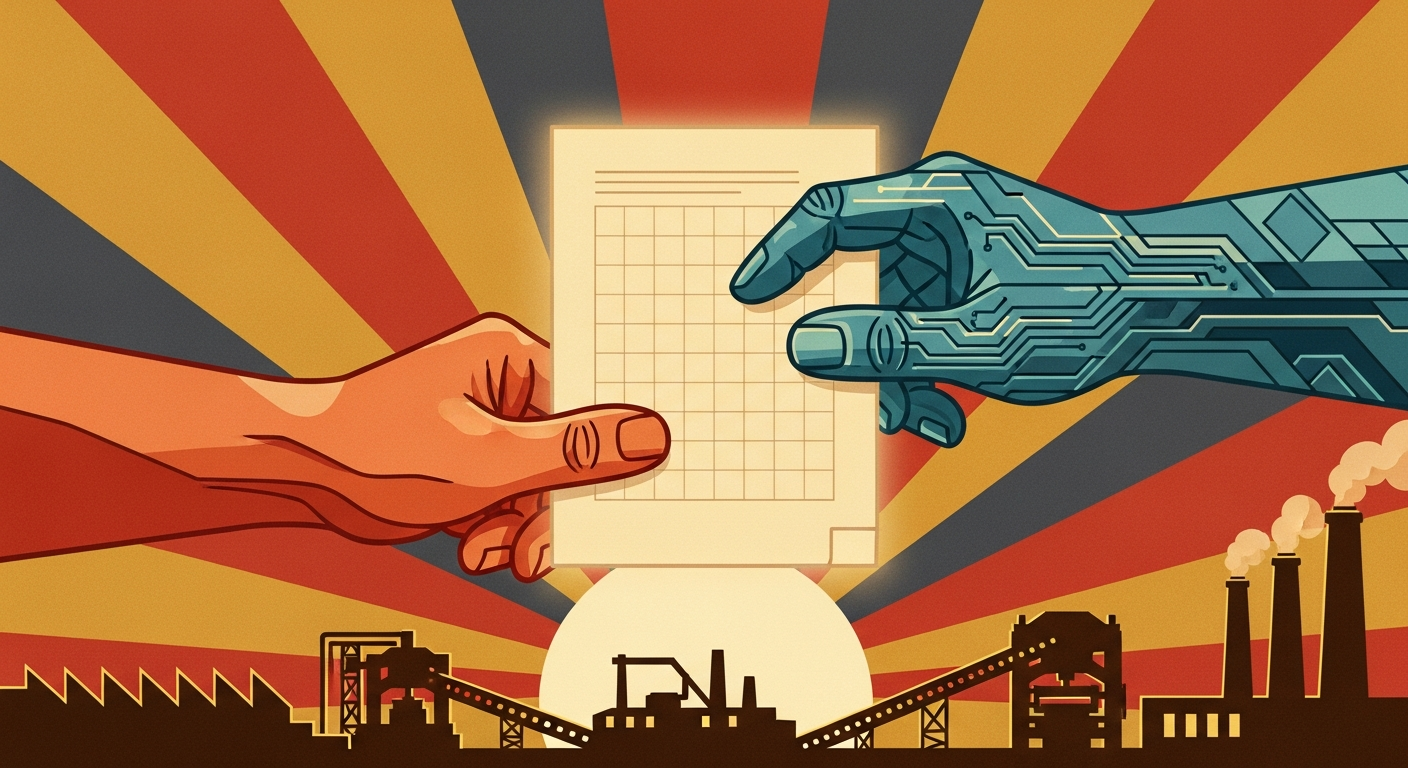
AI가 지시를 내리기 시작하면, 팀장은 무엇을 하는가 — 생산관리자에게 보내는 편지
AI Agent가 작업지시서를 스스로 생성하는 공장에서, 중간관리자의 존재 이유를 다시 묻는 공개 서신.

사장님께 드리는 편지 — 공장을 복제하시겠습니까?
독일 중소제조 컨설턴트가 한국 공장 대표에게 보내는 편지. 디지털 트윈은 기술이 아니라, 내 공장을 처음으로 객관적으로 바라보는 행위다.
Want to apply this in your factory?
MOAI helps manufacturing companies adopt AI tailored to their operations.
Talk to us →