Fourth Industrial Revolution
The Fourth Industrial Revolution, also known as 4IR, Industry 4.0 or the Intelligence Age, is a neologism describing rapid technological advancement in the 21st century. It follows the Third Industrial Revolution (the "Information Age"). The term was popularized in 2016 by Klaus Schwab, the World Economic Forum founder and former executive chairman, who asserts that these developments represent a significant shift in industrial capitalism.
A part of this phase of industrial change is the joining of technologies like artificial intelligence, gene editing, to advanced robotics that blur the lines between the physical, digital, and biological worlds.
 Source: Wikimedia Commons, CC BY-SA 4.0
Throughout this, fundamental shifts are taking place in how the global production and supply network operates through ongoing automation of traditional manufacturing and industrial practices, using modern smart technology, large-scale machine-to-machine communication (M2M), and the Internet of things (IoT). This integration results in increasing automation, improving communication and self-monitoring, and the use of smart machines that can analyse and diagnose issues without the need for human intervention.
It also represents a social, political, and economic shift from the digital age of the late 1990s and early 2000s to an era of embedded connectivity distinguished by the ubiquity of technology in society that changes the ways humans experience and know the world around them. It posits that we have created and are entering an augmented social reality compared to just the natural senses and industrial ability of humans alone. The Fourth Industrial Revolution is sometimes expected to mark the beginning of an imagination age, where creativity and imagination become the primary drivers of economic value.
History
The phrase Fourth Industrial Revolution was first introduced by a team of scientists developing a high-tech strategy for the German government. Klaus Schwab, former executive chairman of the World Economic Forum (WEF), introduced the phrase to a wider audience in a 2015 article published by Foreign Affairs. "Mastering the Fourth Industrial Revolution" was the 2016 theme of the World Economic Forum Annual Meeting, in Davos-Klosters, Switzerland.
On 10 October 2016, the Forum announced the opening of its Centre for the Fourth Industrial Revolution in San Francisco. This was also subject and title of Schwab's 2016 book. Schwab includes in this fourth era technologies that combine hardware, software, and biology (cyber-physical systems), and emphasizes advances in communication and connectivity. Schwab expects this era to be marked by breakthroughs in emerging technologies in fields such as robotics, artificial intelligence, nanotechnology, quantum computing, biotechnology, the internet of things, the industrial internet of things, decentralized consensus, fifth-generation wireless technologies, 3D printing, and fully autonomous vehicles.
 Source: Wikimedia Commons, CC BY-SA 4.0
In The Great Reset proposal by the WEF, The Fourth Industrial Revolution is included as a strategic intelligence in the solution to rebuild the economy sustainably following the COVID-19 pandemic.
First Industrial Revolution
The First Industrial Revolution was marked by a transition from hand production methods to machines through the use of steam power and water power. The implementation of new technologies took a long time, so the period which this refers to was between 1760 and 1820, or 1840 in Europe and the United States. Its effects had consequences on textile manufacturing, which was first to adopt such changes, as well as iron industry, agriculture, and mining–although it also had societal effects with an ever stronger middle class.
 Source: Wikimedia Commons, CC BY-SA 3.0
Second Industrial Revolution
The Second Industrial Revolution, also known as the Technological Revolution, is the period between 1871 and 1914 that resulted from installations of extensive railroad and telegraph networks, which allowed for faster transfer of people and ideas, as well as electricity. Increasing electrification allowed for factories to develop the modern production line.
Third Industrial Revolution
The Third Industrial Revolution, also known as the Digital Revolution, began in the late 20th century. It is characterized by the shift to an economy centered on information technology, marked by the advent of personal computers, the Internet, and the widespread digitalization of communication and industrial processes.
A book by Jeremy Rifkin titled The Third Industrial Revolution, published in 2011, focused on the intersection of digital communications technology and renewable energy. It was made into a 2017 documentary by Vice Media.
Characteristics
In essence, the Fourth Industrial Revolution is the trend towards automation and data exchange in manufacturing technologies and processes which include cyber-physical systems (CPS), internet of things (IoT), cloud computing, cognitive computing, and artificial intelligence.
Machines improve human efficiency in performing repetitive functions, and the combination of machine learning and computing power allows machines to carry out increasingly complex tasks.
The Fourth Industrial Revolution has been defined as technological developments in cyber-physical systems such as high capacity connectivity; new human-machine interaction modes such as touch interfaces and virtual reality systems; and improvements in transferring digital instructions to the physical world including robotics and 3D printing (additive manufacturing); "big data" and cloud computing; improvements to and uptake of off-grid: solar, wind, wave, hydroelectric and the electric batteries (lithium-ion renewable energy storage systems and EV).
.jpg&width=800) Source: Wikimedia Commons, CC BY-SA 4.0
Source: Wikimedia Commons, CC BY-SA 4.0
It also emphasizes decentralized decisions – the ability of cyber physical systems to make decisions on their own and to perform their tasks as autonomously as possible. Only in the case of exceptions, interference, or conflicting goals, are tasks delegated to a higher level.
Distinctiveness
Proponents of the Fourth Industrial Revolution suggest it is a distinct revolution rather than simply a prolongation of the Third Industrial Revolution. This is due to the following characteristics:
- Velocity – exponential speed at which incumbent industries are affected and displaced
- Scope and systems impact – the large amount of sectors and firms that are affected
- Paradigm shift in technology policy – new policies designed for this new way of doing are present. An example is Singapore's formal recognition of Industry 4.0 in its innovation policies.
Critics of the concept dismiss Industry 4.0 as a marketing strategy. They suggest that although revolutionary changes are identifiable in distinct sectors, there is no systemic change so far. In addition, the pace of recognition of Industry 4.0 and policy transition varies across countries; the definition of Industry 4.0 is not harmonised. One of the most known figures is Jeremy Rifkin who "agree[s] that digitalization is the hallmark and defining technology in what has become known as the Third Industrial Revolution". However, he argues "that the evolution of digitalization has barely begun to run its course and that its new configuration in the form of the Internet of Things represents the next stage of its development".
Components
The application of the Fourth Industrial Revolution operates through:
- Mobile devices
- Location detection technologies (electronic identification)
- Advanced human-machine interfaces
- Authentication and fraud detection
- Smart sensors
- Big analytics and advanced processes
- Multilevel customer interaction and customer profiling
- Augmented reality/wearables
- On-demand availability of computer system resources
- Data visualisation
.JPG&width=800) Source: Wikimedia Commons, CC BY-SA 3.0
Source: Wikimedia Commons, CC BY-SA 3.0
Industry 4.0 networks a wide range of new technologies to create value. Using cyber-physical systems that monitor physical processes, a virtual copy of the physical world can be designed.
Related Articles
From MOAI Insights
새벽 3시, 반장의 귀가 처음으로 받아 적혔다
23년 경력 반장은 사출기 소리만 듣고 불량을 안다. 그 귀가 처음으로 데이터가 되던 밤, 공장에서 가장 불편한 질문이 떠올랐다.
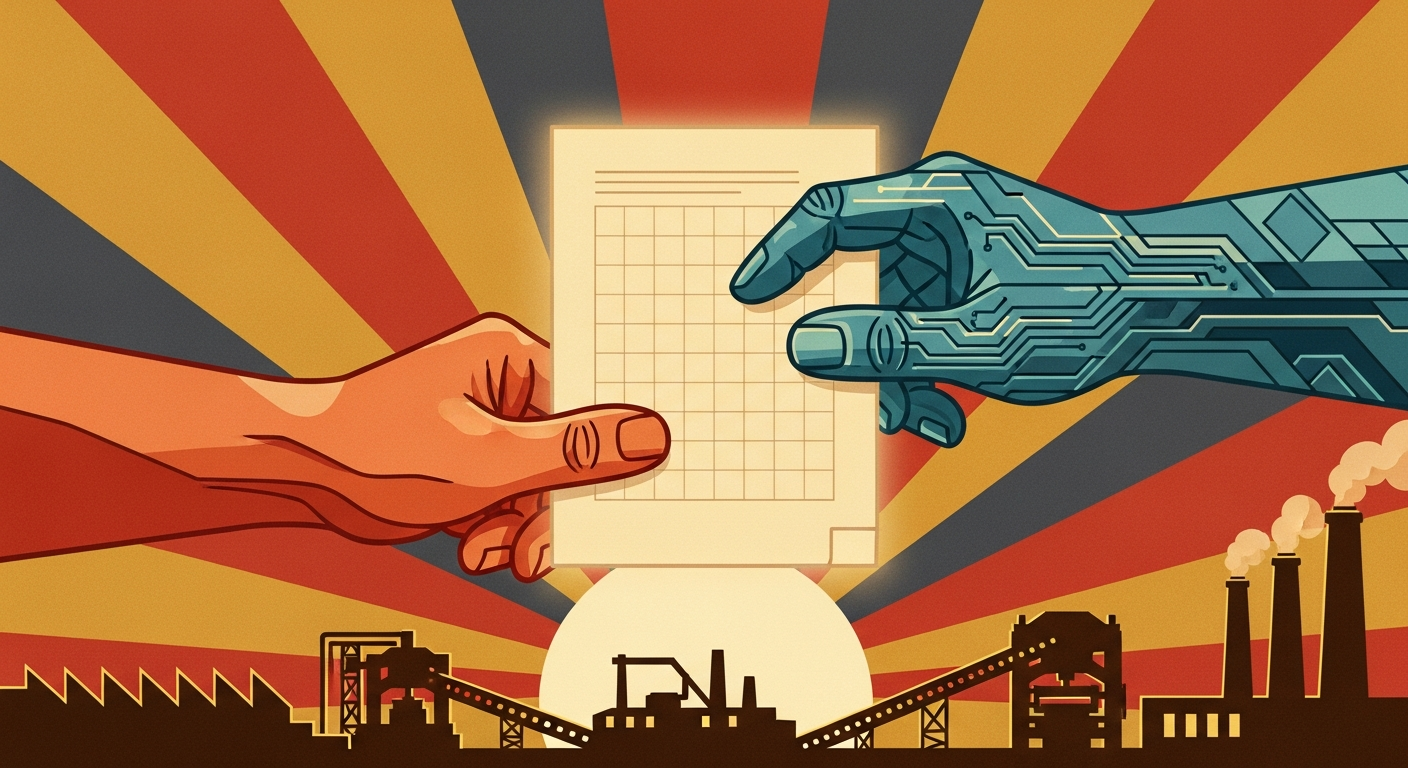
AI가 지시를 내리기 시작하면, 팀장은 무엇을 하는가 — 생산관리자에게 보내는 편지
AI Agent가 작업지시서를 스스로 생성하는 공장에서, 중간관리자의 존재 이유를 다시 묻는 공개 서신.
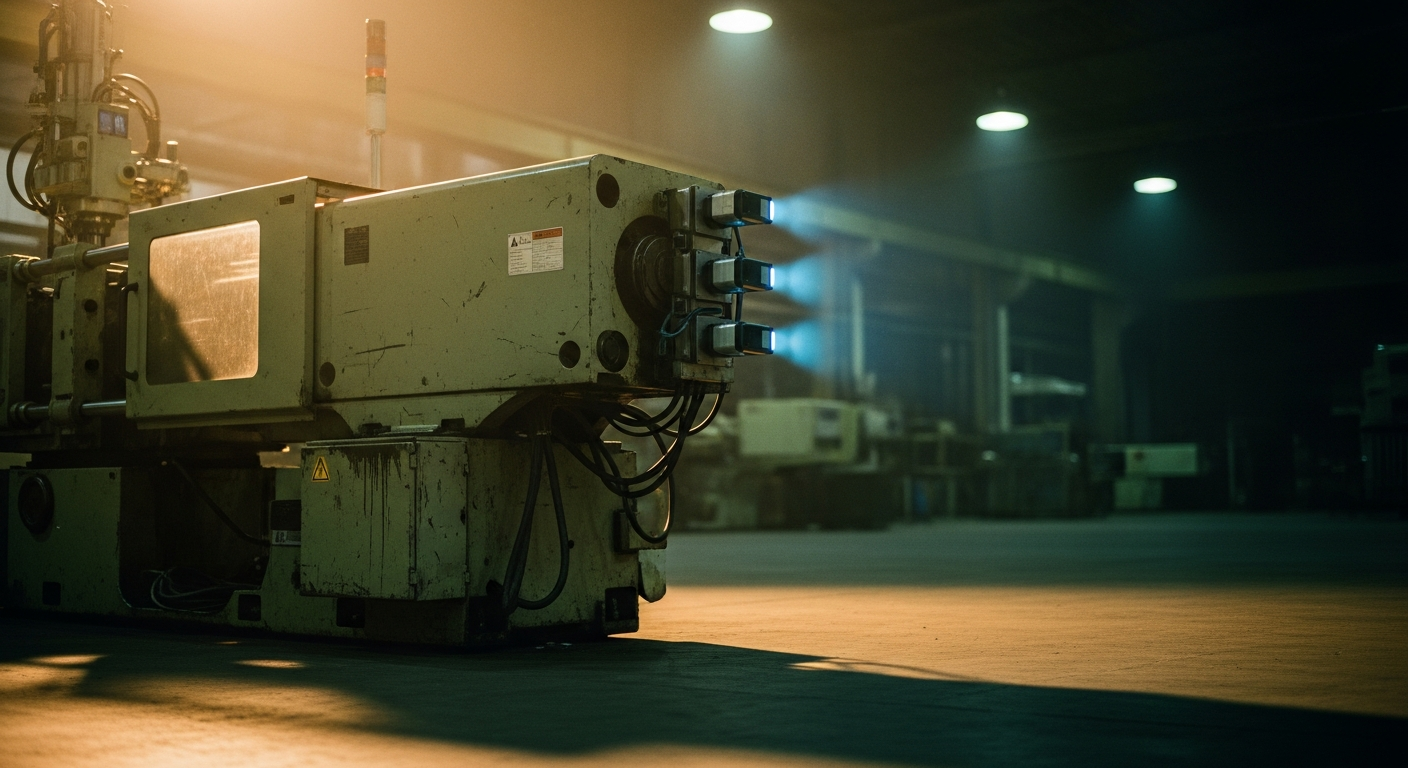
사장님께 드리는 편지 — 공장을 복제하시겠습니까?
독일 중소제조 컨설턴트가 한국 공장 대표에게 보내는 편지. 디지털 트윈은 기술이 아니라, 내 공장을 처음으로 객관적으로 바라보는 행위다.
Want to apply this in your factory?
MOAI helps manufacturing companies adopt AI tailored to their operations.
Talk to us →