Automation
Automation describes a wide range of technologies that reduce human intervention in processes, mainly by predetermining decision criteria, subprocess relationships, and related actions, as well as embodying those predeterminations in machines. Automation has been achieved by various means including mechanical, hydraulic, pneumatic, electrical, electronic devices, and computers, usually in combination. Complicated systems, such as modern factories, airplanes, and ships typically use combinations of all of these techniques. The benefits of automation includes labor savings, reducing waste, savings in electricity costs, savings in material costs, and improvements to quality, accuracy, and precision.
 Source: Wikimedia Commons, Public domain
Automation includes the use of various equipment and control systems such as machinery, processes in factories, boilers, and heat-treating ovens, switching on telephone networks, steering, stabilization of ships, aircraft and other applications and vehicles with reduced human intervention. Examples range from a household thermostat controlling a boiler to a large industrial control system with tens of thousands of input measurements and output control signals.
In the simplest type of an automatic control loop, a controller compares a measured value of a process with a desired set value and processes the resulting error signal to change some input to the process, in such a way that the process stays at its set point despite disturbances. This closed-loop control is an application of negative feedback to a system. The mathematical basis of control theory began in the 18th century and advanced rapidly in the 20th. The term automation, inspired by the earlier word automatic (coming from automaton), was not widely used before 1947, when Ford established an automation department. It was during this time that the industry was rapidly adopting feedback controllers, Technological advancements introduced in the 1930s revolutionized various industries significantly.
The World Bank's World Development Report of 2019 shows evidence that the new industries and jobs in the technology sector outweigh the economic effects of workers being displaced by automation. Job losses and downward mobility blamed on automation have been cited as one of many factors in the resurgence of nationalist, protectionist and populist politics in the US, UK and France, among other countries since the 2010s.
History
Early history
It was a preoccupation of the Greeks and Arabs (in the period between about 300 BC and about 1200 AD) to keep an accurate track of time. In Ptolemaic Egypt, about 270 BC, Ctesibius described a float regulator for a water clock, a device not unlike the ball and cock in a modern flush toilet. This was the earliest feedback-controlled mechanism. The appearance of the mechanical clock in the 14th century made the water clock and its feedback control system obsolete.
 Source: Wikimedia Commons, Public domain
The Persian Banū Mūsā brothers, in their Book of Ingenious Devices (850 AD), described a number of automatic controls. Two-step level controls for fluids, a form of discontinuous variable structure controls, were developed by the Banu Musa brothers. They also described a feedback controller. The design of feedback control systems up through the Industrial Revolution was by trial-and-error, together with a great deal of engineering intuition. It was not until the mid-19th century that the stability of feedback control systems was analyzed using mathematics, the formal language of automatic control theory.
The centrifugal governor was invented by Christiaan Huygens in the seventeenth century, and used to adjust the gap between millstones.
Industrial Revolution in Western Europe
The introduction of prime movers, or self-driven machines advanced grain mills, furnaces, boilers, and the steam engine created a new requirement for automatic control systems including temperature regulators (invented in 1624; see Cornelius Drebbel), pressure regulators (1681), float regulators (1700) and speed control devices. Another control mechanism was used to tent the sails of windmills. It was patented by Edmund Lee in 1745. Also in 1745, Jacques de Vaucanson invented the first automated loom. Around 1800, Joseph Marie Jacquard created a punch-card system to program looms.
In 1771 Richard Arkwright invented the first fully automated spinning mill driven by water power, known at the time as the water frame. An automatic flour mill was developed by Oliver Evans in 1785, making it the first completely automated industrial process.
 Source: Wikimedia Commons, CC BY 3.0
A centrifugal governor was used by Mr. Bunce of England in 1784 as part of a model steam crane. The centrifugal governor was adopted by James Watt for use on a steam engine in 1788 after Watt's partner Boulton saw one at a flour mill Boulton & Watt were building. The governor could not actually hold a set speed; the engine would assume a new constant speed in response to load changes. The governor was able to handle smaller variations such as those caused by fluctuating heat load to the boiler. Also, there was a tendency for oscillation whenever there was a speed change. As a consequence, engines equipped with this governor were not suitable for operations requiring constant speed, such as cotton spinning.
Several improvements to the governor, plus improvements to valve cut-off timing on the steam engine, made the engine suitable for most industrial uses before the end of the 19th century. Advances in the steam engine stayed well ahead of science, both thermodynamics and control theory. The governor received relatively little scientific attention until James Clerk Maxwell published a paper that established the beginning of a theoretical basis for understanding control theory.
20th century
Relay logic was introduced with factory electrification, which underwent rapid adaptation from 1900 through the 1920s. Central electric power stations were also undergoing rapid growth and the operation of new high-pressure boilers, steam turbines and electrical substations created a great demand for instruments and controls. Central control rooms became common in the 1920s, but as late as the early 1930s, most process controls were on-off. Operators typically monitored charts drawn by recorders that plotted data from instruments. To make corrections, operators manually opened or closed valves or turned switches on or off. Control rooms also used color-coded lights to send signals to workers in the plant to manually make certain changes.
 Source: Wikimedia Commons, Public domain
The development of the electronic amplifier during the 1920s, which was important for long-distance telephony, required a higher signal-to-noise ratio, which was solved by negative feedback noise cancellation. This and other telephony applications contributed to the control theory. In the 1940s and 1950s, German mathematician Irmgard Flügge-Lotz developed the theory of discontinuous automatic controls, which found military applications during the Second World War to fire control systems and aircraft navigation systems.
Controllers, which were able to make calculated changes in response to deviations from a set point rather than on-off control, began being introduced in the 1930s. Controllers allowed manufacturing to continue showing productivity gains to offset the declining influence of factory electrification.
Factory productivity was greatly increased by electrification in the 1920s. U.S. manufacturing productivity growth fell from 5.2%/yr 1919–29 to 2.76%/yr 1929–41. Alexander Field notes that spending on non-medical instruments increased significantly from 1929 to 1933 and remained strong thereafter.
The First and Second World Wars saw major advancements in the field of mass communication and signal processing. Other key advances in automatic controls include differential equations, stability theory and system theory (1938), frequency domain analysis (1940), ship control (1950), and stochastic analysis (1941).
 Source: Wikimedia Commons, CC BY-SA 3.0
Starting in 1958, various systems began to be developed.
Related Articles
From MOAI Insights
새벽 3시, 반장의 귀가 처음으로 받아 적혔다
23년 경력 반장은 사출기 소리만 듣고 불량을 안다. 그 귀가 처음으로 데이터가 되던 밤, 공장에서 가장 불편한 질문이 떠올랐다.
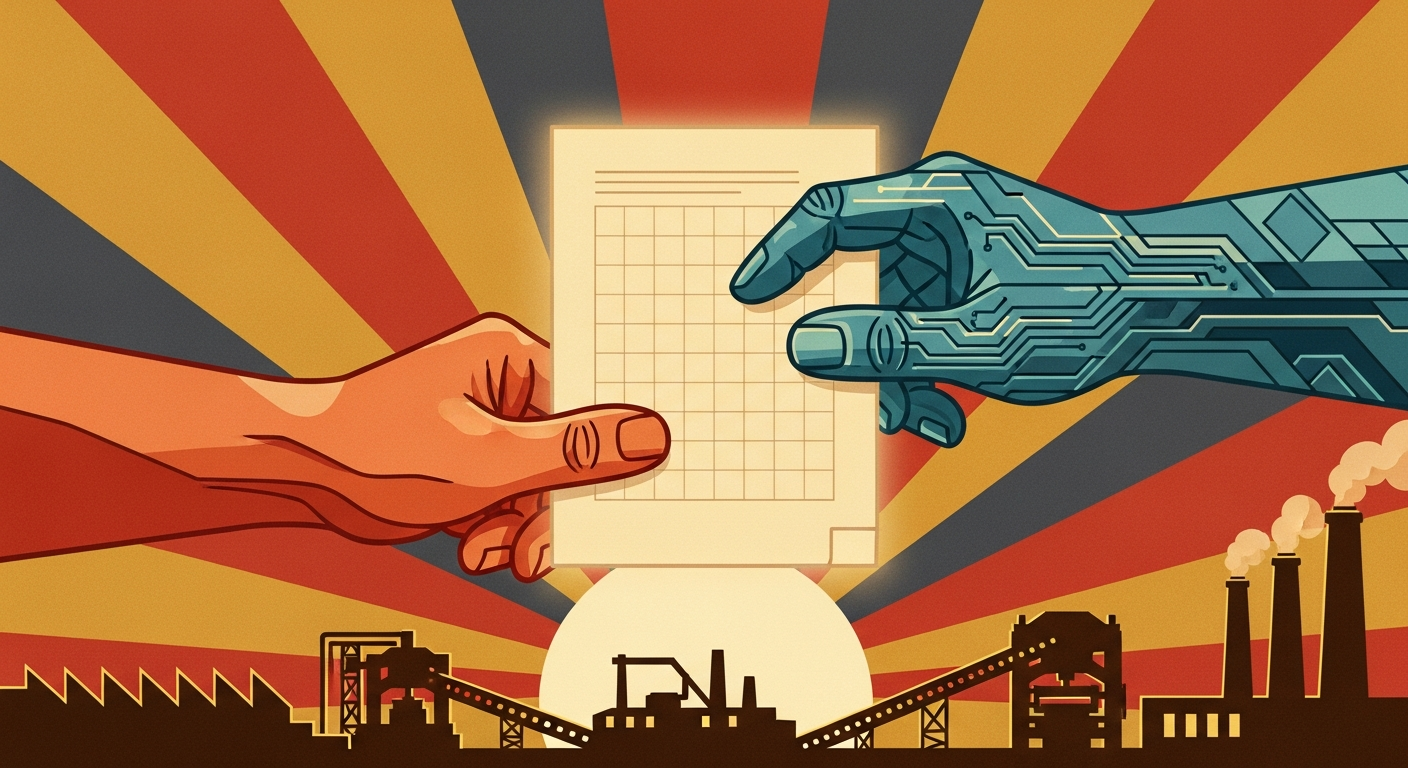
AI가 지시를 내리기 시작하면, 팀장은 무엇을 하는가 — 생산관리자에게 보내는 편지
AI Agent가 작업지시서를 스스로 생성하는 공장에서, 중간관리자의 존재 이유를 다시 묻는 공개 서신.
사장님께 드리는 편지 — 공장을 복제하시겠습니까?
독일 중소제조 컨설턴트가 한국 공장 대표에게 보내는 편지. 디지털 트윈은 기술이 아니라, 내 공장을 처음으로 객관적으로 바라보는 행위다.
Want to apply this in your factory?
MOAI helps manufacturing companies adopt AI tailored to their operations.
Talk to us →