Mass production, also known as series production, series manufacture, or continuous production, is the production of substantial amounts of standardized products in a constant flow, including and especially on assembly lines. Together with job production and batch production, it is one of the three main production methods.
The term mass production was popularized by a 1926 article in the Encyclopædia Britannica supplement that was written based on correspondence with Ford Motor Company. The New York Times used the term in the title of an article that appeared before the publication of the Britannica article.
The idea of mass production is applied to many kinds of products: from fluids and particulates handled in bulk (food, fuel, chemicals and mined minerals), to clothing, textiles, parts and assemblies of parts (household appliances and automobiles).
Some mass production techniques, such as standardized sizes and production lines, predate the Industrial Revolution by many centuries; however, it was not until the introduction of machine tools and techniques to produce interchangeable parts were developed in the mid-19th century that modern mass production was possible.
Overview
Mass production involves making many copies of products (mainly done through machines), very quickly, using assembly line techniques to send partially complete products to workers who each work on an individual step, rather than having a worker work on a whole product from start to finish. The emergence of mass production allowed supply to outstrip demand in many markets, forcing companies to seek new ways to become more competitive. Mass production ties into the idea of overconsumption and the idea that we as humans consume too much.
Mass production of fluid matter typically involves piping with centrifugal pumps or screw conveyors (augers) to transfer raw materials or partially complete products between vessels. Fluid flow processes such as oil refining and bulk materials such as wood chips and pulp are automated using a system of process control which uses various instruments to measure variables such as temperature, pressure, volumetric and level, providing feedback.
Bulk materials such as coal, ores, grains and wood chips are handled by belt, chain, slat, pneumatic or screw conveyors, bucket elevators and mobile equipment such as front-end loaders. Materials on pallets are handled with forklifts. Also used for handling heavy items like reels of paper, steel or machinery are electric overhead cranes, sometimes called bridge cranes because they span large factory bays.
Mass production is capital-intensive and energy-intensive, for it uses a high proportion of machinery and energy in relation to workers. It is also usually automated while total expenditure per unit of product is decreased. However, the machinery that is needed to set up a mass production line (such as robots and machine presses) is so expensive that in order to attain profits there must be some assurance that the product will be successful.
One of the descriptions of mass production is that "the skill is built into the tool", which means that the worker using the tool may not need the skill. For example, in the 19th or early 20th century, this could be expressed as "the craftsmanship is in the workbench itself" (not the training of the worker). Rather than having a skilled worker measure every dimension of each part of the product against the plans or the other parts as it is being formed, there were jigs ready at hand to ensure that the part was made to fit this set-up. It had already been checked that the finished part would be to specifications to fit all the other finished parts—and it would be made more quickly, with no time spent on finishing the parts to fit one another. Later, once computerized control came about (for example, CNC), jigs were obviated, but it remained true that the skill (or knowledge) was built into the tool (or process, or documentation) rather than residing in the worker's head. This is the specialized capital required for mass production; each workbench and set of tools (or each CNC cell, or each fractionating column) is different (fine-tuned to its task).
.jpg&width=800) Source: Wikimedia Commons, Public domain
Source: Wikimedia Commons, Public domain
History
Pre-industrial
Standardized parts and sizes and factory production techniques were developed in pre-industrial times; before the invention of machine tools the manufacture of precision parts, especially metal ones, was highly labour-intensive.
Crossbows made with bronze parts were produced in China during the Warring States period. The Qin Emperor unified China at least in part by equipping large armies with these weapons, which were fitted with a sophisticated trigger mechanism made of interchangeable parts. The Terracotta Army guarding the Emperor's tomb is also believed to have been created through the use of standardized molds on an assembly line.
 Source: Wikimedia Commons, CC BY-SA 3.0
In ancient Carthage, ships of war were mass-produced on a large scale at a moderate cost, allowing them to efficiently maintain their control of the Mediterranean. Many centuries later, the Republic of Venice would follow Carthage in producing ships with prefabricated parts on an assembly line: the Venetian Arsenal produced nearly one ship every day in what was effectively the world's first factory, which at its height employed 16,000 people.
The invention of movable type has allowed for documents such as books to be mass produced. The first movable type system was invented in China by Bi Sheng, during the reign of the Song dynasty, where it was used to, among other things, issue paper money. The oldest extant book produced using metal type is Jikji, printed in Korea in the year 1377. Johannes Gutenberg, through his invention of the printing press and production of the Gutenberg Bible, introduced movable type to Europe. Through this introduction, mass production in the European publishing industry was made commonplace, leading to a democratization of knowledge, increased literacy and education, and the beginnings of modern science.
 Source: Wikimedia Commons, Public domain
French artillery engineer Jean-Baptiste de Gribeauval introduced the standardization of cannon design in the late 18th century. He streamlined production and management of cannonballs and cannons by limiting them to only three calibers, and he improved their effectiveness by requiring more spherical ammunition. Redesigning these weapons to use interchangeable wheels, screws, and axles simplified mass production and repair.
Industrial
In the Industrial Revolution, simple mass production techniques were used at the Portsmouth Block Mills in England to make ships' pulley blocks for the Royal Navy in the Napoleonic Wars. It was achieved in 1803 by Marc Isambard Brunel in cooperation with Henry Maudslay under the management of Sir Samuel Bentham. The first unmistakable examples of manufacturing operations carefully designed to reduce production costs by specialized labour and the use of machines appeared in the 18th century in England.
 Source: Wikimedia Commons, CC BY-SA 3.0
The Navy was in a state of expansion that required 100,000 pulley blocks to be manufactured a year. Bentham had already achieved remarkable efficiency at the docks by introducing power-driven machinery and reorganising the dockyard system. Brunel, a pioneering engineer, and Maudslay, a pioneer of machine tool technology who had developed the first industrially practical screw-cutting lathe in 1800 which standardized screw thread sizes for the first time which in turn allowed the application of interchangeable parts, collaborated on plans to manufacture block-making machinery. By 1805, the dockyard had been fully updated with the revolutionary, purpose-built machinery at a time when products were still built individually with different components. A total of 45 machines were required to perform 22 processes on the blocks, which could be made into one of three possible sizes. The machines were almost entirely made of metal thus improving their accuracy and durability.
 Source: Wikimedia Commons, CC BY-SA 3.0
 Source: Wikimedia Commons, CC BY 2.5
From MOAI Insights
새벽 3시, 반장의 귀가 처음으로 받아 적혔다
23년 경력 반장은 사출기 소리만 듣고 불량을 안다. 그 귀가 처음으로 데이터가 되던 밤, 공장에서 가장 불편한 질문이 떠올랐다.
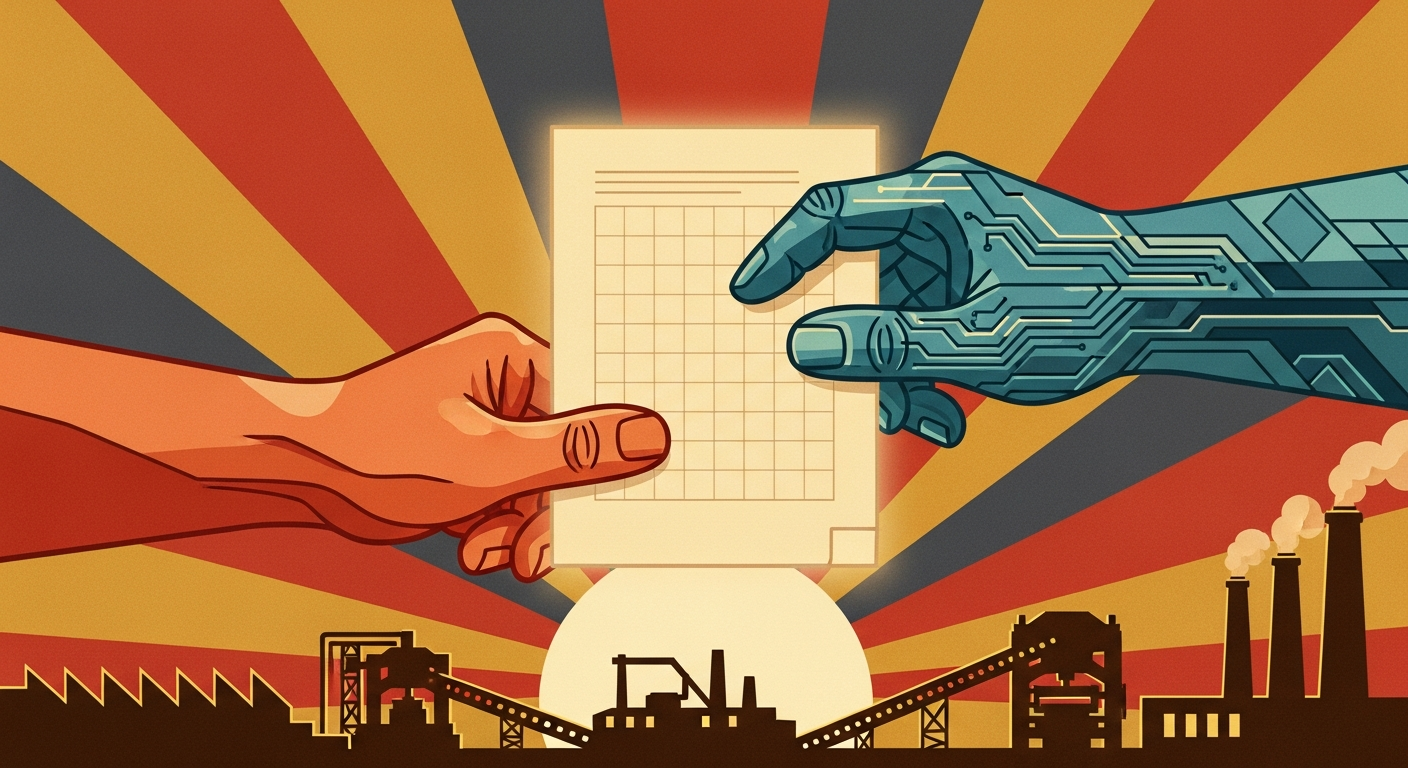
AI가 지시를 내리기 시작하면, 팀장은 무엇을 하는가 — 생산관리자에게 보내는 편지
AI Agent가 작업지시서를 스스로 생성하는 공장에서, 중간관리자의 존재 이유를 다시 묻는 공개 서신.
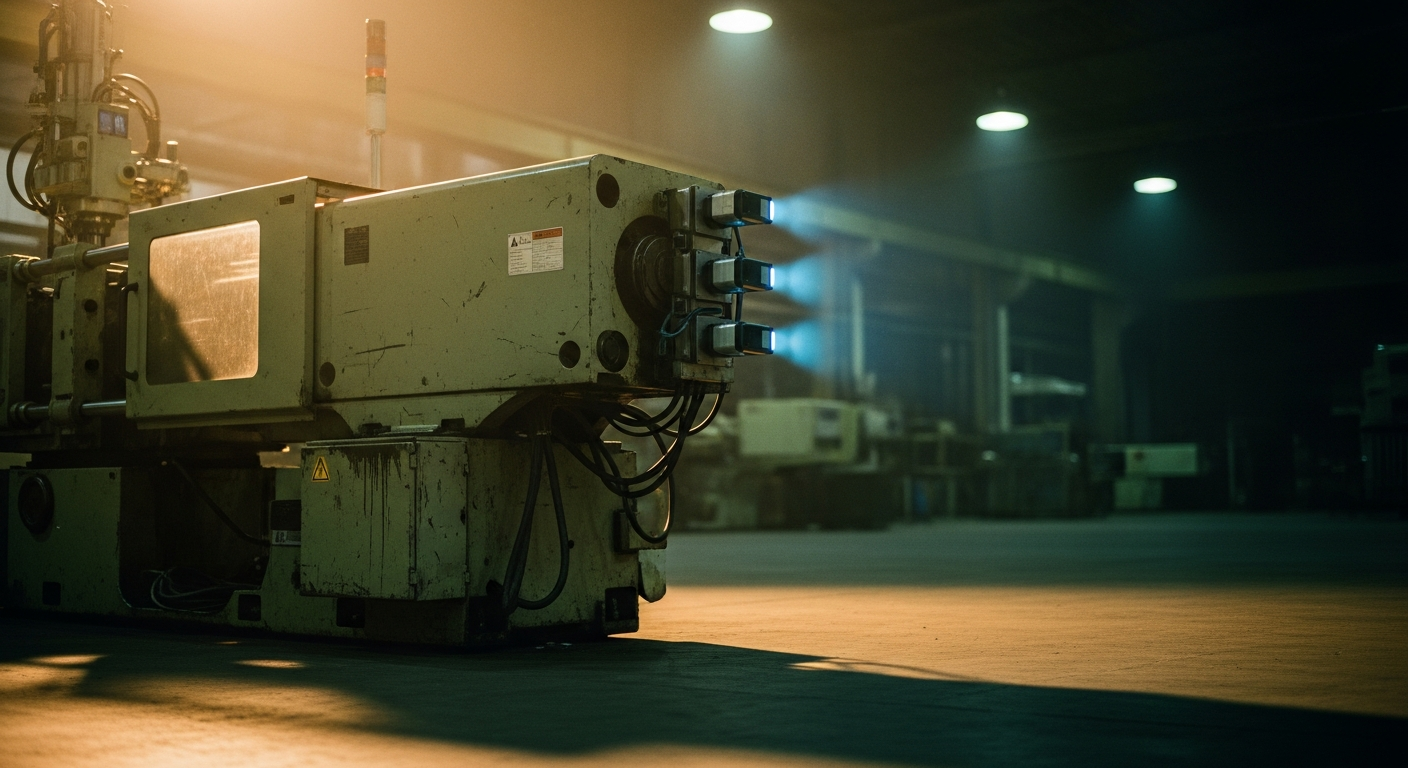
사장님께 드리는 편지 — 공장을 복제하시겠습니까?
독일 중소제조 컨설턴트가 한국 공장 대표에게 보내는 편지. 디지털 트윈은 기술이 아니라, 내 공장을 처음으로 객관적으로 바라보는 행위다.
Want to apply this in your factory?
MOAI helps manufacturing companies adopt AI tailored to their operations.
Talk to us →