The industrial Internet of things (IIoT) refers to interconnected sensors, instruments, and other devices networked together with computers' industrial applications, including manufacturing and energy management. This connectivity allows for data collection, exchange, and analysis, potentially facilitating improvements in productivity and efficiency as well as other economic benefits. The IIoT is an evolution of a distributed control system (DCS) that allows for a higher degree of automation by using cloud computing to refine and optimize the process controls.
Overview
The IIoT is enabled by technologies such as cybersecurity, cloud computing, edge computing, mobile technologies, machine-to-machine, 3D printing, advanced robotics, big data, Internet of things, RFID technology, and cognitive computing. Five of the most important ones are described below:
- Cyber-physical systems (CPS): the basic technology platform for IoT and IIoT and therefore the main enabler to connect physical machines that were previously disconnected. CPS integrates the dynamics of the physical process with those of software and communication, providing abstractions and modeling, design, and analysis techniques.
- Cloud computing: With cloud computing IT services and resources can be uploaded to and retrieved from the Internet as opposed to a direct connection to a server. Files can be kept on cloud-based storage systems rather than on local storage devices.
- Edge computing: A distributed computing paradigm which brings computer data storage closer to the location where it is needed. In contrast to cloud computing, edge computing refers to decentralized data processing at the edge of the network. The industrial internet requires more of an edge-plus-cloud architecture rather than one based on purely centralized cloud; in order to transform productivity, products and services in the industrial world.
- Big data analytics: Big data analytics is the process of examining large and varied data sets, or big data.
- Artificial intelligence and machine learning: Artificial intelligence (AI) is a field within computer science in which intelligent machines are created that work and react like humans. Machine learning is a core part of AI, allowing software to more accurately predict outcomes without explicitly being programmed. It is also possible to combine artificial intelligence with edge computing in order to provide industrial edge intelligence solutions. There are many use-cases using AI with IIoT, to name a few: condition monitoring and predictive maintenance, process optimization, federate learning.
Architecture
 Source: Wikimedia Commons, CC BY-SA 4.0
IIoT systems are usually conceived as a layered modular architecture of digital technology. The device layer refers to the physical components: CPS, sensors or machines. The network layer consists of physical network buses, cloud computing and communication protocols that aggregate and transport the data to the service layer, which consists of applications that manipulate and combine data into information that can be displayed on the driver dashboard. The top-most stratum of the stack is the content layer or the user interface.
History
The history of the IIoT begins with the invention of the programmable logic controller (PLC) by Richard E. Morley in 1968, which was used by General Motors in their automatic transmission manufacturing division. These PLCs allowed for fine control of individual elements in the manufacturing chain. In 1975, Honeywell and Yokogawa introduced the world's first DCSs, the TDC 2000 and the CENTUM system, respectively. These DCSs were the next step in allowing flexible process control throughout a plant, with the added benefit of backup redundancies by distributing control across the entire system, eliminating a singular point of failure in a central control room.
With the introduction of Ethernet in 1980, people began to explore the concept of a network of smart devices as early as 1982, when a modified Coke machine at Carnegie Mellon University became the first Internet-connected appliance, able to report its inventory and whether newly loaded drinks were cold. As early as in 1994, greater industrial applications were envisioned, as Reza Raji described the concept in IEEE Spectrum as "[moving] small packets of data to a large set of nodes, so as to integrate and automate everything from home appliances to entire factories".
The concept of the Internet of things first became popular in 1999, through the Auto-ID Center at MIT and related market-analysis publications. Radio-frequency identification (RFID) was seen by Kevin Ashton (one of the founders of the original Auto-ID Center) as a prerequisite for the Internet of things at that point. If all objects and people in daily life were equipped with identifiers, computers could manage and inventory them. Besides using RFID, the tagging of things may be achieved through such technologies as near field communication, barcodes, QR codes and digital watermarking.
The current conception of the IIoT arose after the emergence of cloud technology in 2002, which allows for the storage of data to examine for historical trends, and the development of the OPC Unified Architecture protocol in 2006, which enabled secure, remote communications between devices, programs, and data sources without the need for human intervention or interfaces.
One of the first consequences of implementing the industrial internet of things (by equipping objects with minuscule identifying devices or machine-readable identifiers) would be to create instant and ceaseless inventory control. Another benefit of implementing an IIoT system is the ability to create a digital twin of the system. Using this digital twin allows for further optimization of the system by allowing for experimentation with new data from the cloud without having to halt production or sacrifice safety, as the new processes can be refined virtually until they are ready to be implemented. A digital twin can also serve as a training ground for new employees who won't have to worry about real impacts on the live system.
Standards and frameworks
IoT frameworks help support the interaction between "things" and allow for more complex structures like distributed computing and the development of distributed applications.
- IBM has announced cognitive IoT, which combines traditional IoT with machine intelligence and learning, contextual information, industry-specific models and natural language processing.
- The XMPP Standards Foundation (XSF) is creating such a framework called Chatty Things, which is a fully open, vendor-independent standard using XMPP to provide a distributed, scalable, and secure infrastructure.
- REST is a scalable architecture which allows for things to communicate over Hypertext Transfer Protocol and is easily adopted for IoT applications to provide communication from a thing to a central web server.
- MQTT is a publish-subscribe architecture on top of TCP/IP which allows for bi-directional communication between a thing and a MQTT broker.
- Node-RED is an open-source software designed by IBM to connect APIs, hardware, and online services.
- OPC is a series of standards designed by the OPC Foundation to connect computer systems to automated devices.
- OMG Data Distribution Service (DDS) is an open international middleware standard directly addressing publish-subscribe communications for real-time and embedded systems.
- The Industrial Internet Consortium's (IIC) Industrial Internet Reference Architecture (IIRA) and the German Industry 4.0 are independent efforts to create a defined standard for IIoT-enabled facilities.
Application and industries
The term industrial internet of things is often encountered in the manufacturing industries, referring to the industrial subset of the IoT. Potential benefits of the industrial internet of things include improved productivity, improved reliability, analytics and the transformation of the work.
From MOAI Insights
새벽 3시, 반장의 귀가 처음으로 받아 적혔다
23년 경력 반장은 사출기 소리만 듣고 불량을 안다. 그 귀가 처음으로 데이터가 되던 밤, 공장에서 가장 불편한 질문이 떠올랐다.
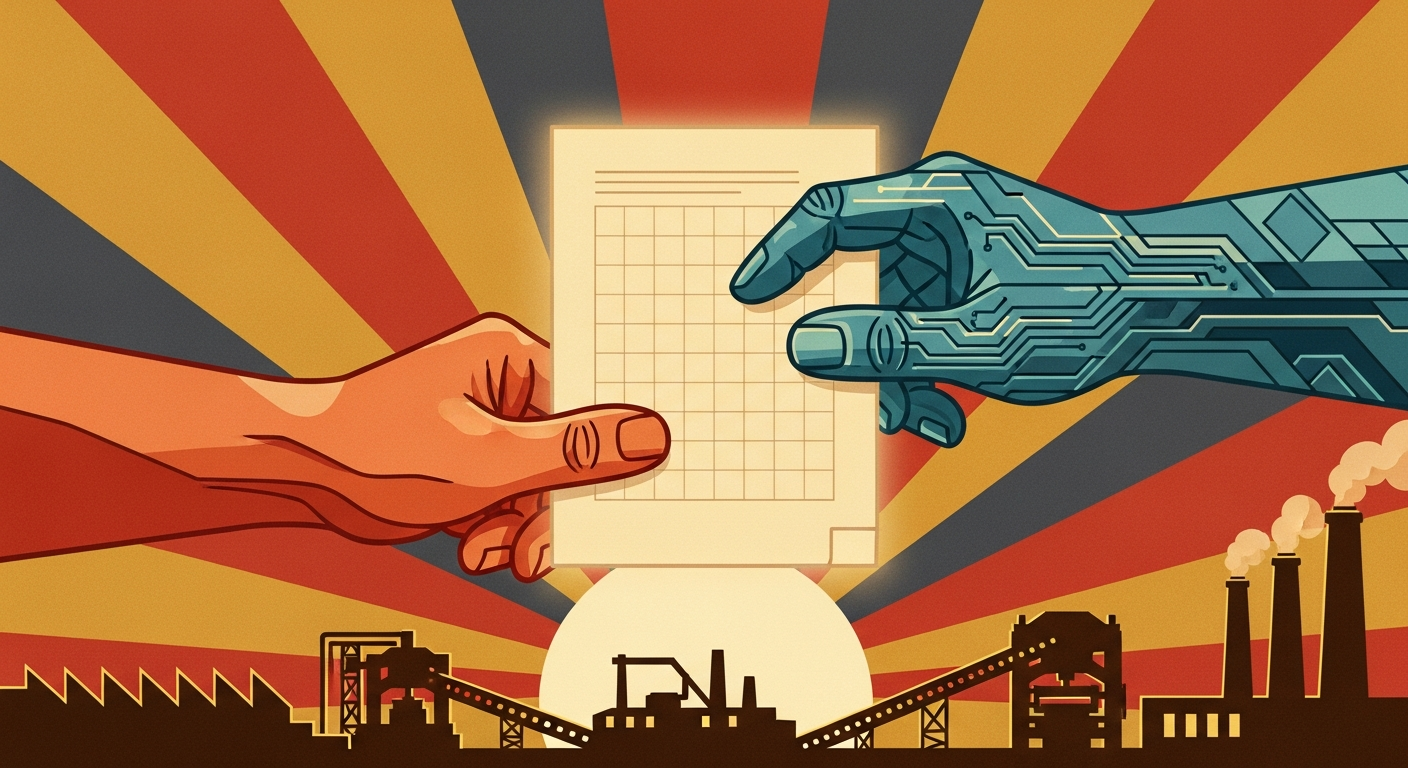
AI가 지시를 내리기 시작하면, 팀장은 무엇을 하는가 — 생산관리자에게 보내는 편지
AI Agent가 작업지시서를 스스로 생성하는 공장에서, 중간관리자의 존재 이유를 다시 묻는 공개 서신.
사장님께 드리는 편지 — 공장을 복제하시겠습니까?
독일 중소제조 컨설턴트가 한국 공장 대표에게 보내는 편지. 디지털 트윈은 기술이 아니라, 내 공장을 처음으로 객관적으로 바라보는 행위다.
Want to apply this in your factory?
MOAI helps manufacturing companies adopt AI tailored to their operations.
Talk to us →